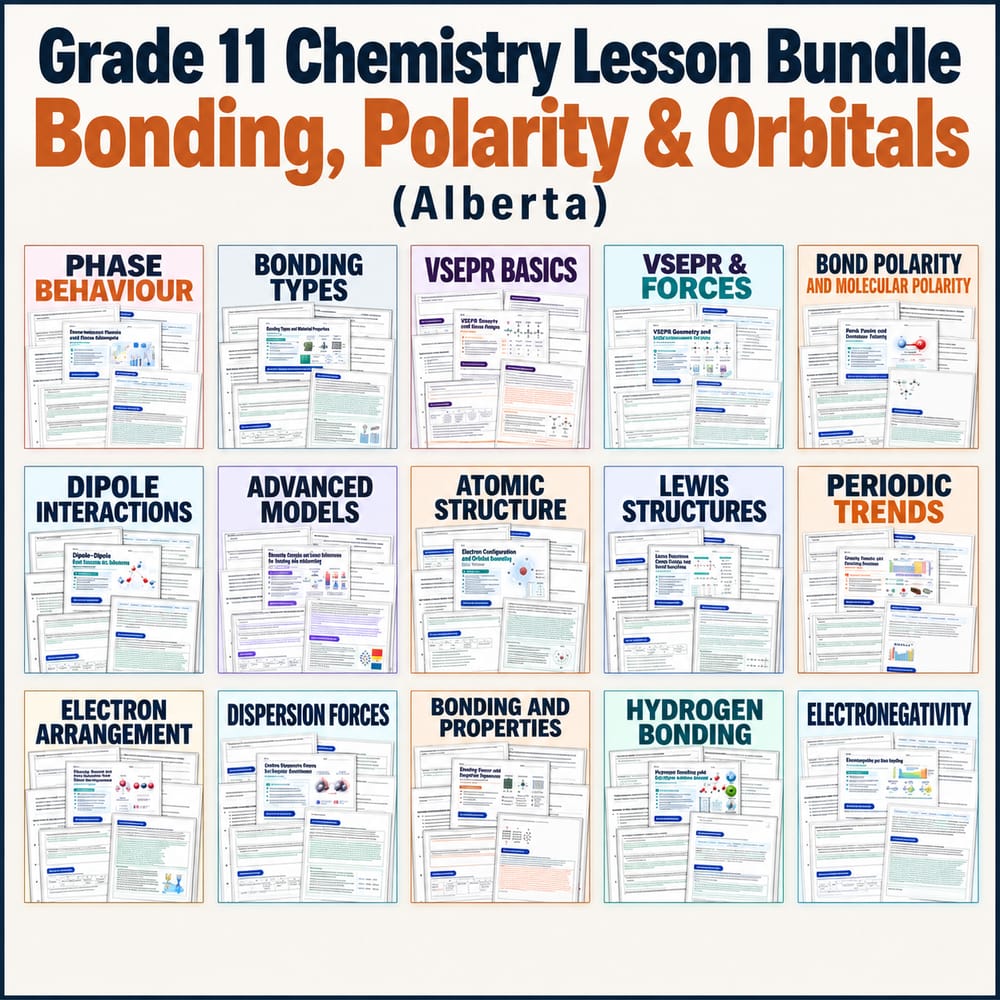
Grade 11 Chemistry Lesson Bundle — Bonding, Polarity & Orbitals (Alberta) — bundle cover
Grade 11 Chemistry Lesson Bundle — Bonding, Polarity & Orbitals (Alberta) — included worksheet 1
Grade 11 Chemistry Lesson Bundle — Bonding, Polarity & Orbitals (Alberta) — included worksheet 2
Grade 11 Chemistry Lesson Bundle — Bonding, Polarity & Orbitals (Alberta) — included worksheet 3
Grade 11 Chemistry Lesson Bundle — Bonding, Polarity & Orbitals (Alberta) — included worksheet 4
Grade 11 Chemistry Lesson Bundle — Bonding, Polarity & Orbitals (Alberta) — included worksheet 5
Grade 11 Chemistry Lesson Bundle — Bonding, Polarity & Orbitals (Alberta) — included worksheet 6
Grade 11 Chemistry Lesson Bundle — Bonding, Polarity & Orbitals (Alberta) — included worksheet 7
Grade 11 Chemistry Lesson Bundle — Bonding, Polarity & Orbitals (Alberta) — included worksheet 8
Grade 11 Chemistry Lesson Bundle — Bonding, Polarity & Orbitals (Alberta) — included worksheet 9
Grade 11 Chemistry Lesson Bundle — Bonding, Polarity & Orbitals (Alberta) — included worksheet 10
Grade 11 Chemistry Lesson Bundle — Bonding, Polarity & Orbitals (Alberta) — included worksheet 11
Grade 11 Chemistry Lesson Bundle — Bonding, Polarity & Orbitals (Alberta) — included worksheet 12
Grade 11 Chemistry Lesson Bundle — Bonding, Polarity & Orbitals (Alberta) — included worksheet 13
Grade 11 Chemistry Lesson Bundle — Bonding, Polarity & Orbitals (Alberta) — included worksheet 14
Grade 11 Chemistry Lesson Bundle — Bonding, Polarity & Orbitals (Alberta) — included worksheet 15
Grade 11 Science worksheet — Grade 11 Chemistry Lesson Bundle — Bonding, Polarity & Orbitals (Alberta)

Description

Overview


Bonding, Polarity & Orbitals in Grade 11 Chemistry supports Alberta expectations with 15 worksheets that build practical skills for bonding, polarity, and molecular orbitals. Students progress from Lewis structure fundamentals and VSEPR reasoning to intermolecular forces, phase behavior connections, and finally molecular orbitals and band structures.

Designed as a single unit of practice, the bundle emphasizes model-based thinking and evidence-based explanations. Learners use diagrams, quantitative reasoning, and structured claims to connect microscopic structures to observable material properties—an essential thread in Alberta Science and Chemistry.

Using this resource, you can support consistent lesson flow while keeping each worksheet tightly focused on a specific subtopic, from bond angles to dipole moments to material behavior.


What's Included


  • ✅ VSEPR Shapes and Bond Angles Worksheet for Grade 11 Chemistry – Students determine molecular shapes and interpret bond angle patterns using VSEPR.
  • ✅ VSEPR Geometry and Intermolecular Forces Worksheets | Grade 11 – Learners connect predicted geometry to the likelihood of intermolecular interactions.
  • ✅ Intermolecular Forces & Phase Behaviour Worksheets | Grade 11 Chemistry – Students link intermolecular forces to boiling/melting behavior and phase changes.
  • ✅ Periodic Trends and Bonding Worksheets: Grade 11 Chemistry – Students use periodic trends to reason about bonding tendencies and reactivity.
  • ✅ Lewis Structures, Formal Charge and Octet Exceptions Worksheets Grade 11 – Learners construct Lewis structures, evaluate formal charge, and recognize octet exceptions.
  • ✅ Hydrogen Bonding and Water Properties Worksheet Grade 11 Chemistry – Students explain how hydrogen bonding explains water’s distinctive properties.
  • ✅ Electronegativity and Bond Polarity Worksheets | Grade 11 Chemistry – Students predict bond polarity from electronegativity and interpret sign/direction.
  • ✅ Molecular Polarity and Dipole Moments Worksheets Grade 11 Science – Learners determine overall molecular polarity and relate structure to dipole moments.
  • ✅ London Dispersion Forces Worksheets | Grade 11 Matter & Bonding – Students model dispersion forces and compare strength across substances.
  • ✅ Dipole–Dipole Interactions in Solutions Worksheets | Grade 11 Science – Learners connect dipole–dipole forces to intermolecular attraction and solution behavior.
  • ✅ Bonding Models and Material Properties Worksheets Grade 11 Science – Students relate bonding models to properties such as conductivity and melting point.
  • ✅ Bonding Types and Material Properties Worksheets | Grade 11 Science – Learners compare ionic, covalent, and metallic bonding patterns using property evidence.
  • ✅ Bond Polarity and Molecular Polarity Worksheets | Grade 11 Chemistry – Students practice distinguishing bond polarity from overall molecular polarity.
  • ✅ Electron Configuration and Chemical Reactivity Worksheets Grade 11 – Learners connect electron configuration patterns to valence behavior and reactivity.
  • ✅ Molecular Orbitals & Band Structures Worksheets | Grade 11 Chemistry – Students use orbital ideas to explain bonding and broad band behavior.

Skills & Standards


Aligned to Alberta Science/Chemistry expectations, this unit builds disciplinary understanding of matter at the atomic and molecular level. Students practice crosscutting approaches by:

  • Using modeling and analytical reasoning to predict shapes, bonding arrangements, and interaction strength.
  • Applying evidence-based explanations by linking structural features (Lewis structures, VSEPR geometry, polarity) to observable outcomes (phase behavior, material properties).
  • Interpreting patterns across frameworks such as periodic trends, electronegativity, and molecular interaction types.

Within bonding, polarity, and molecular orbitals, students develop concrete competencies: assigning electron configurations and valence patterns, constructing Lewis structures and checking for formal charge logic, identifying bond polarity from electronegativity, determining molecular polarity from geometry, estimating relative intermolecular forces (dispersion, dipole–dipole, hydrogen bonding), and using bonding models to justify macroscopic properties. The later worksheets extend reasoning to electron orbital concepts, supporting explanations that connect molecular orbital/band ideas to bonding behavior and conductivity trends.

Throughout, learners are prompted to move from “what the model shows” to “what the model predicts,” strengthening the habit of reasoning with scientific representations—exactly the kind of transfer Alberta learners need for Chemistry assessments.


Perfect For


  • Teachers seeking structured instruction
  • Sub plans
  • Homework or review
  • Intervention or centers
  • Assessment preparation

How to Use


Plan this single unit for typical multi-day pacing (about 1–3 weeks), depending on your schedule and class needs. Suggested approach: use 2–3 worksheets per class cycle, with a short review after every cluster of related concepts (VSEPR → polarity → intermolecular forces → bonding models → orbitals).

  • Run brief warm-ups where students sketch VSEPR shapes or label polarity directions, then complete one quick application question.
  • Use guided practice for diagram interpretation: model how to go from Lewis structure/formal charge to predicted geometry and then to bond-angle expectations.
  • End each session with an exit ticket that requires a claim-evidence-style explanation (for example, “Which intermolecular force dominates and why?”) connected to the worksheet’s bonding, polarity, and molecular orbitals ideas.

Closing


This bundle gives students repeated, focused practice to confidently explain how bonding patterns create the properties and behaviors they observe.

Grade 11 Chemistry Lesson Bundle — Bonding, Polarity & Orbitals (Alberta)

$36.00$45.00Save $9.00
Sunny Desk Resources
·2 followers·18 sales
SubjectScienceGradeGrade 11Pages189 Pages

What’s included

15 worksheets · 189 pages · Save $9.00 (20%) · prices shown inside the bundle

  1. Intermolecular Forces & Phase Behaviour Worksheets | Grade 11 Chemistry
    Intermolecular Forces & Phase Behaviour Worksheets | Grade 11 Chemistry

    Grade 11 · Science · 14 Pages

    • Explain how intermolecular forces affect vapor pressure and volatility
    • Relate intermolecular forces to boiling point
    • Interpret phase diagrams using temperature and molecular properties
    $2.40$3.00
  2. Bonding Models and Material Properties Worksheets Grade 11 Science
    Bonding Models and Material Properties Worksheets Grade 11 Science

    Grade 11 · Science · 12 Pages

    • Compare ionic, covalent, and metallic bonding models
    • Explain electron transfer, sharing, and delocalized electrons
    • Predict conductivity, hardness, and solubility from bonding type
    $2.40$3.00
  3. VSEPR Shapes and Bond Angles Worksheet for Grade 11 Chemistry
    VSEPR Shapes and Bond Angles Worksheet for Grade 11 Chemistry

    Grade 11 · Science · 12 Pages

    • Explain how VSEPR predicts molecular geometry from electron pairs
    • Identify electron-pair geometry for coordination numbers from 2 to 6
    • Identify molecular shapes for common electron-domain arrangements
    $2.40$3.00
  4. VSEPR Geometry and Intermolecular Forces Worksheets | Grade 11
    VSEPR Geometry and Intermolecular Forces Worksheets | Grade 11

    Grade 11 · Science · 13 Pages

    • Predict molecular geometry using VSEPR electron-pair repulsion
    • Relate molecular shape to dipole strength
    • Explain molecular shape and hydrogen-bonding ability
    $2.40$3.00
  5. Bond Polarity and Molecular Polarity Worksheets | Grade 11 Chemistry
    Bond Polarity and Molecular Polarity Worksheets | Grade 11 Chemistry

    Grade 11 · Science · 13 Pages

    • Explain how electronegativity differences create polar bonds
    • Describe how partial charges arise in polar bonds
    • Explain how bond dipoles determine overall molecular polarity
    $2.40$3.00
  6. Dipole–Dipole Interactions in Solutions Worksheets | Grade 11 Science
    Dipole–Dipole Interactions in Solutions Worksheets | Grade 11 Science

    Grade 11 · Science · 12 Pages

    • Explain how molecular polarity produces dipole–dipole attractions
    • Predict how molecular orientation affects interaction strength
    • Predict how temperature affects dipole–dipole interaction strength
    $2.40$3.00
  7. Molecular Orbitals & Band Structures Worksheets | Grade 11 Chemistry
    Molecular Orbitals & Band Structures Worksheets | Grade 11 Chemistry

    Grade 11 · Science · 12 Pages

    • Explain how orbital overlap contributes to electronic delocalization
    • Describe how molecular symmetry supports delocalization in bonding models
    • Explain electrical behavior using band theory
    $2.40$3.00
  8. Electron Configuration and Chemical Reactivity Worksheets Grade 11
    Electron Configuration and Chemical Reactivity Worksheets Grade 11

    Grade 11 · Science · 12 Pages

    • Describe atomic structure using protons, neutrons, and electrons
    • Explain how shell arrangements relate to valence electrons
    • Interpret subshell electron arrangements in relation to chemical behavior
    $2.40$3.00
  9. Lewis Structures, Formal Charge and Octet Exceptions Worksheets Grade 11
    Lewis Structures, Formal Charge and Octet Exceptions Worksheets Grade 11

    Grade 11 · Science · 12 Pages

    • Construct Lewis structures using valence electrons and lone pairs
    • Calculate formal charges within molecular structures
    • Select appropriate resonance structures using formal charge
    $2.40$3.00
  10. Periodic Trends and Bonding Worksheets: Grade 11 Chemistry
    Periodic Trends and Bonding Worksheets: Grade 11 Chemistry

    Grade 11 · Science · 14 Pages

    • Describe atomic radius trends across periods and down groups
    • Explain ionization energy trends in the periodic table
    • Relate electronegativity trends to cation and anion formation
    $2.40$3.00

Reviews & Feedback

Loading reviews...

Questions & Answers

Loading questions…

About this bundle

Related categories

Frequently asked questions

Who is Grade 11 Chemistry Lesson Bundle — Bonding, Polarity & Orbitals (Alberta) designed for?
Grade 11 Chemistry Lesson Bundle — Bonding, Polarity & Orbitals (Alberta) is designed for Grade 11 students and Science learners and can be used in classrooms, homeschool, or independent practice.
How do I download Grade 11 Chemistry Lesson Bundle — Bonding, Polarity & Orbitals (Alberta)?
Add it to your cart and complete checkout. After payment, you can download immediately from your account, and you'll also receive a download link by email.