
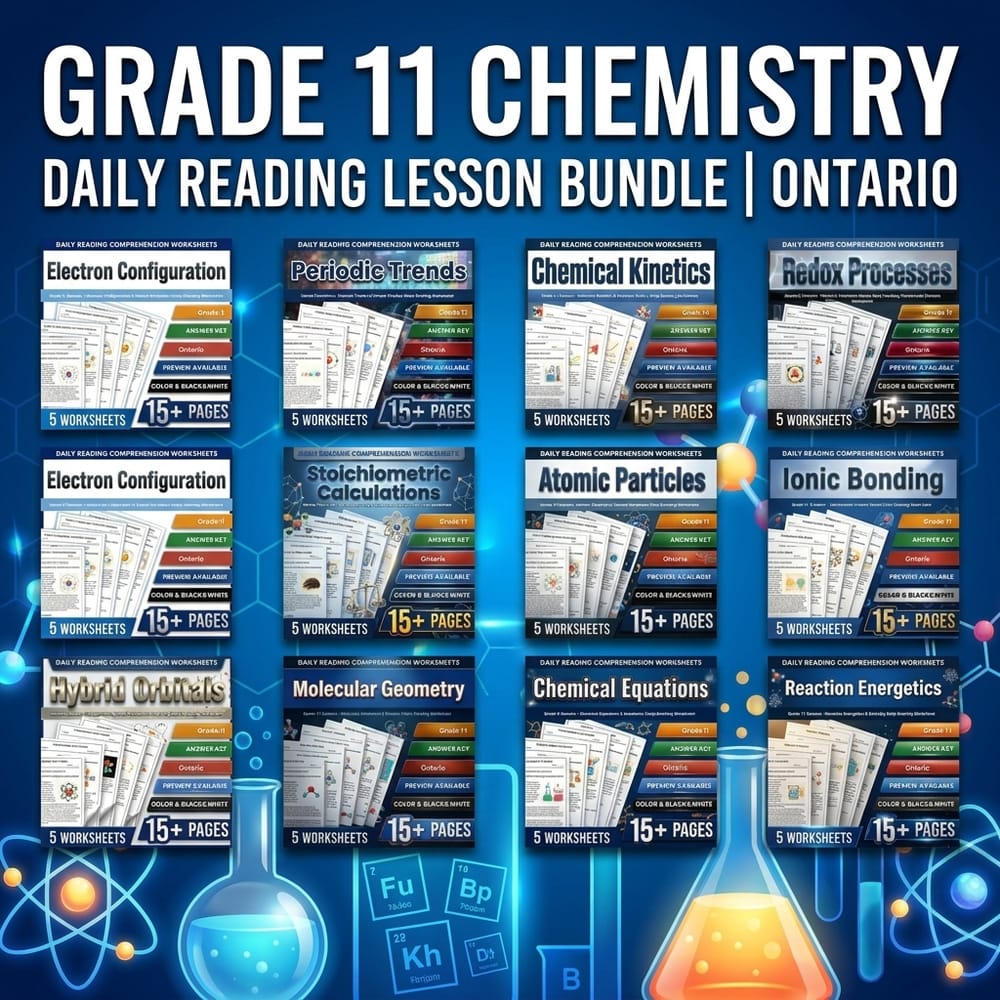


Grade 11 Chemistry Science Daily Reading Lesson Bundle | Ontario
$38.40$48.00Save $9.60
Bright Mind Resources
New·1 followers·12 sales
SubjectScienceGradeGrade 11
What’s included
12 worksheets · Save $9.60 (20%) · prices shown inside the bundle
 Grade 11 Science – Covalent Bonding & Structures Daily Reading Worksheet
- Explain the concept of shared-electron bonding using Lewis structures
- Identify and interpret octet considerations and formal charge assessments in covalent molecules
- Describe the continuum between covalent (polar and non-polar) and ionic bonding based on electronegativity differences
$3.20$4.00 Grade 11 Science – Periodic Trends & Atomic Radius | Daily Reading Worksheet
- Understand the concept of atomic radius and how it varies across periods and groups
- Identify the factors influencing atomic size, such as nuclear charge and electron shielding
- Analyze trends in atomic radius in relation to periodic properties
$3.20$4.00 Grade 11 Science – Chemical Kinetics & Reaction Rates | Daily Reading Worksheet
- Understand the factors influencing reaction rates.
- Interpret experimental rate data to determine reaction order.
- Apply collision theory and activation energy concepts to reaction mechanisms.
$3.20$4.00 Grade 11 Science – Redox & Oxidation States Worksheet | Ontario Standards
- Understand the concept of oxidation states in inorganic molecules
- Identify oxidation and reduction in chemical reactions
- Learn how to formulate half-reactions
$3.20$4.00 Grade 11 Science – Electron Configuration & Orbital Principles | Worksheet
- Understand the structure of electron orbitals and their notation
- Identify the rules governing electron placement in atoms
- Apply the Aufbau principle, Hund’s rule, and Pauli exclusion principle
$3.20$4.00 Grade 11 Science – Mole Concept & Stoichiometry | Daily Reading Worksheet
- Define the mole and understand its significance in chemistry.
- Convert between mass, moles, and particle counts using molar mass and Avogadro's number.
- Solve quantitative problems involving the mole concept, including limiting reagent and percent yield calculations.
$3.20$4.00 Grade 11 Science – Atomic Particles & Atomic Structure | Daily Reading Worksheet
- Identify the roles of protons, neutrons, and electrons in atoms.
- Understand how atomic number, mass number, and isotopic variation relate to subatomic particles.
- Compare early atomic models with modern quantum models of electron distribution.
$3.20$4.00 Grade 11 Science – Introduction to Ionic Bonds Daily Reading Worksheet
- Understand the basic concept of ionic bonding
- Identify features of ionic compounds
- Recognize how ions attract each other to form compounds
$3.20$4.00 Grade 11 Science – Hybrid Orbitals & Bonding | Daily Reading Worksheet
- Define hybridization and explain its role in molecular bonding.
- Identify different types of hybrid orbitals (sp, sp2, sp3).
- Describe how hybrid orbitals influence molecular geometry.
$3.20$4.00 Grade 11 Science – Molecular Geometry & Shapes | Daily Reading Worksheet
- Understand electron-domain considerations for molecular shape prediction
- Identify basic molecular geometries such as linear, trigonal planar, tetrahedral, trigonal bipyramidal, and octahedral
- Recognize effects of lone pairs and molecular symmetry on physical properties
$3.20$4.00
Reviews & Feedback
Loading reviews...
Questions & Answers
Loading questions…
About this bundle
Related categories
Frequently asked questions
Who is Grade 11 Chemistry Science Daily Reading Lesson Bundle | Ontario designed for?
Grade 11 Chemistry Science Daily Reading Lesson Bundle | Ontario is designed for Grade 11 students and Science learners and can be used in classrooms, homeschool, or independent practice.
How do I download Grade 11 Chemistry Science Daily Reading Lesson Bundle | Ontario?
Add it to your cart and complete checkout. After payment, you can download immediately from your account, and you'll also receive a download link by email.
Similar Products

Grade 10 Chemistry Science Lesson Bundle Daily Reading Worksheets | Alberta
$48.00$60.00

Grade 12 Chemistry Daily Reading Worksheets Lesson Bundle | Alberta Science
$48.00$60.00

Grade 12 Chemistry Daily Reading Science Lesson Bundle | AP Standards
$38.40$48.00

Grade 11 Chemistry Concepts Science Daily Reading Worksheets Lesson Bundle | AP
$38.40$48.00

Chemical Reactions Grade 11 Science Daily Reading Worksheets Bundle | Ontario
$38.40$48.00