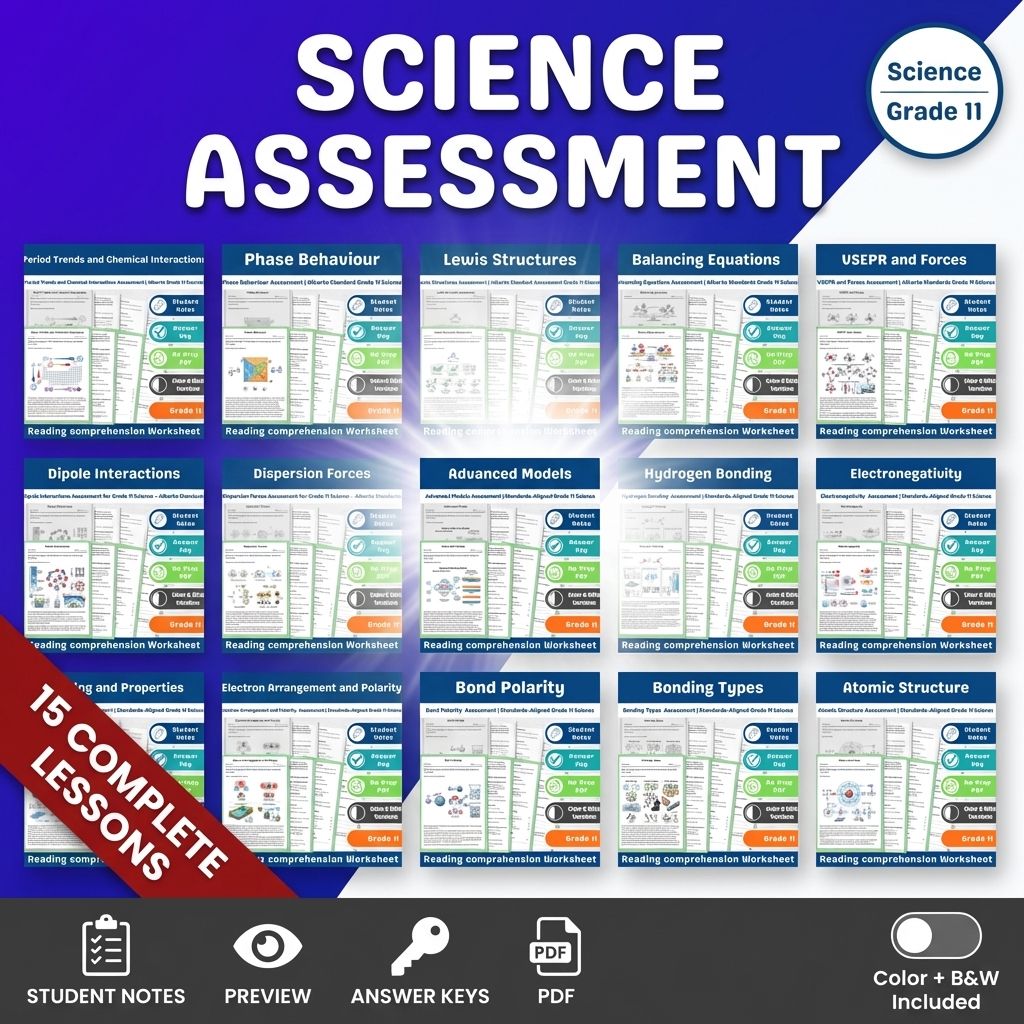
Grade 11 Matter and Chemical Bonding Science Lesson Bundle for Alberta — bundle cover
Grade 11 Matter and Chemical Bonding Science Lesson Bundle for Alberta — included worksheet 1
Grade 11 Matter and Chemical Bonding Science Lesson Bundle for Alberta — included worksheet 2
Grade 11 Matter and Chemical Bonding Science Lesson Bundle for Alberta — included worksheet 3
Grade 11 Matter and Chemical Bonding Science Lesson Bundle for Alberta — included worksheet 4
Grade 11 Matter and Chemical Bonding Science Lesson Bundle for Alberta — included worksheet 5
Grade 11 Matter and Chemical Bonding Science Lesson Bundle for Alberta — included worksheet 6
Grade 11 Matter and Chemical Bonding Science Lesson Bundle for Alberta — included worksheet 7
Grade 11 Matter and Chemical Bonding Science Lesson Bundle for Alberta — included worksheet 8
Grade 11 Matter and Chemical Bonding Science Lesson Bundle for Alberta — included worksheet 9
Grade 11 Matter and Chemical Bonding Science Lesson Bundle for Alberta — included worksheet 10
Grade 11 Matter and Chemical Bonding Science Lesson Bundle for Alberta — included worksheet 11
Grade 11 Matter and Chemical Bonding Science Lesson Bundle for Alberta — included worksheet 12
Grade 11 Matter and Chemical Bonding Science Lesson Bundle for Alberta — included worksheet 13
Grade 11 Matter and Chemical Bonding Science Lesson Bundle for Alberta — included worksheet 14
Grade 11 Matter and Chemical Bonding Science Lesson Bundle for Alberta — included worksheet 15
Grade 11 Science worksheet — Grade 11 Matter and Chemical Bonding Science Lesson Bundle for Alberta

Description

Overview


Grade Grade 11 Science Mini Bundle focuses on matter and chemical bonding in an Alberta framework, using 15 print-ready assessment worksheets to check understanding as students move from atomic-level patterns to forces and structure. Use this lesson bundle independently or within your full-year curriculum sequence to keep instruction and grading consistent ✅.

What’s Included


  • ✅ 1. Period Trends and Chemical Interactions Assessment | Alberta Grade 11 Science – Reviews how trends connect to chemical interactions.
  • ✅ 2. Phase Behaviour Assessment | Alberta Standard Grade 11 Science – Checks understanding of phase changes and behavior.
  • ✅ 3. Lewis Structures Assessment | Alberta Standard Assessment Grade 11 Science – Supports mastery of valence electrons and bonding representation.
  • ✅ 4. VSEPR Basics Assessment | Alberta Standards Grade 11 Science – Assesses shape predictions from electron-pair repulsion.
  • ✅ 5. VSEPR and Forces Assessment | Alberta Standards Grade 11 Science – Evaluates links between molecular shape, forces, and effects.
  • ✅ 6. Dipole Interactions Assessment for Grade 11 Science | Alberta Standards – Targets how polarity leads to dipole attractions.
  • ✅ 7. Dispersion Forces Assessment for Grade 11 Science – Alberta Standards – Practices explanations of temporary dipoles and attraction strength.
  • ✅ 8. Advanced Models Assessment | Alberta Standards Grade 11 Science – Uses models to justify claims about particles and bonding.
  • ✅ 9. Hydrogen Bonding Assessment for Grade 11 Science – Alberta Standards – Assesses reasoning about hydrogen bonding and properties.
  • ✅ 10. Electronegativity Assessment | Alberta Standards – Confirms students can connect electronegativity to bond behavior.
  • ✅ 11. Bonding and Properties Assessment for Grade 11 Science – Alberta Standards – Checks how bonding types influence observable properties.
  • ✅ 12. Electron Arrangement and Polarity Assessment | Alberta Standard Grade 11 Science – Evaluates how electron arrangement determines overall polarity.
  • ✅ 13. Bond Polarity Assessment | Alberta Standards – Reviews use of polarity rules and dipole direction.
  • ✅ 14. Bonding Types Assessment | Alberta Standard Grade 11 Science Worksheet – Assesses identification and comparison of bonding categories.
  • ✅ 15. Atomic Structure Assessment for Grade 11 Science | Alberta Standards – Verifies foundational atomic ideas needed for later bonding lessons.

Skills & Standards Alignment


Across the Alberta Grade 11 Science topic cluster, students build crosscutting concepts such as structure and function, along with disciplinary core ideas involving atomic structure, electron behavior, and the relationship between bonding and properties. The set emphasizes modeling (Lewis structures, VSEPR-based shapes, and polarity representations) so students practice analytical reasoning to connect particle-level explanations to macroscopic observations. Each assessment supports evidence-based explanations using patterns (period trends, electronegativity) and reasoning steps tied to what students observe in chemistry contexts.

Perfect For


  • Teachers seeking structured instruction
  • Sub plans
  • Homework or review
  • Intervention or centers
  • Assessment preparation

How to Use


Plan for multi-day pacing by assigning 3–5 related worksheets per week (for example, group 1–5 for foundational electron and structure reasoning, then 6–11 for intermolecular forces and polarity, and finish with 12–15 for bonding types and atomic structure connections). Print PDFs for morning work or exit tickets, use the answer keys for fast formative checks, and have students annotate models (electron arrangements and shape diagrams) before completing the written evidence-based explanations. For intervention or centers, place one worksheet per station with a model sheet and a short prompt about “What pattern supports your claim?”

Closing


This standards-aligned, topic-focused lesson bundle helps Grade 11 Science students develop clear models and explanations for chemical bonding while making assessment straightforward for teachers.

Grade 11 Matter and Chemical Bonding Science Lesson Bundle for Alberta

$60.00$75.00Save $15.00
Prism Point Learning
·2 followers·13 sales
SubjectScienceGradeGrade 11

What’s included

15 worksheets · Save $15.00 (20%) · prices shown inside the bundle

  1. Electronegativity Assessment | Alberta Standards Grade 11 Science
    Electronegativity Assessment | Alberta Standards Grade 11 Science

    Grade 11 · Science · 6 Pages

    • Understand the concept of electronegativity and how it influences chemical bonding.
    • Identify electronegativity trends across periods and groups of the periodic table.
    • Compare bond types (polar covalent vs. nonpolar covalent) based on electronegativity differences.
    $4.00$5.00
  2. Bonding and Properties Assessment for Grade 11 Science – Alberta Standards
    Bonding and Properties Assessment for Grade 11 Science – Alberta Standards

    Grade 11 · Science · 6 Pages

    • Explain how ionic, covalent, and metallic bonds influence material properties such as hardness, conductivity, melting point, and solubility.
    • Compare the properties of ionic solids, metals, and covalent network materials based on their bonding paradigms.
    • Identify real-world Alberta examples of materials with different bonding types and their applications.
    $4.00$5.00
  3. Electron Arrangement and Polarity Assessment | Alberta Standard Grade 11 Science
    Electron Arrangement and Polarity Assessment | Alberta Standard Grade 11 Science

    Grade 11 · Science · 6 Pages

    • Explain how valence electron distribution affects molecular polarity.
    • Describe how electron density maps relate to observable polarity in molecules.
    • Compare polar and nonpolar molecules using examples like water and carbon dioxide.
    $4.00$5.00
  4. VSEPR and Forces Assessment | Alberta Standards Grade 11 Science
    VSEPR and Forces Assessment | Alberta Standards Grade 11 Science

    Grade 11 · Science

    • Describe the VSEPR model and predict molecular geometries based on electron pair arrangements.
    • Explain how molecular shapes influence intermolecular forces such as dipole interactions and hydrogen bonding.
    • Relate molecular shape to physical properties like boiling and melting points, with real-world examples.
    $4.00$5.00
  5. Bonding Types Assessment | Alberta Standard Grade 11 Science Worksheet
    Bonding Types Assessment | Alberta Standard Grade 11 Science Worksheet

    Grade 11 · Science

    • Compare electron transfer, sharing, and delocalized models in bonding.
    • Identify structural motifs linked to ionic, covalent, and metallic bonds.
    • Relate bond types to properties such as electrical conductivity, hardness, and solubility.
    $4.00$5.00
  6. VSEPR Basics Assessment | Alberta Standards Grade 11 Science
    VSEPR Basics Assessment | Alberta Standards Grade 11 Science

    Grade 11 · Science · 6 Pages

    • Understand how electron pair repulsion influences molecular geometry according to VSEPR theory.
    • Identify common molecular shapes such as linear, trigonal planar, tetrahedral, trigonal bipyramidal, and octahedral.
    • Explain the role of bonding and nonbonding electron pairs in determining bond angles and molecular symmetry.
    $4.00$5.00
  7. Bond Polarity Assessment | Alberta Standards Grade 11 Science
    Bond Polarity Assessment | Alberta Standards Grade 11 Science

    Grade 11 · Science

    • Understand the concept of bond polarity and how it relates to partial charges and dipoles.
    • Distinguish between polar bonds and polar molecules using examples like HCl and H2O.
    • Explain the implications of bond polarity for solubility, pollutant transport, and solvent selection.
    $4.00$5.00
  8. Atomic Structure Assessment for Grade 11 Science | Alberta Standards
    Atomic Structure Assessment for Grade 11 Science | Alberta Standards

    Grade 11 · Science

    • Describe the organization of protons, neutrons, and electrons within atoms.
    • Explain how electron arrangements, including shells and valence electrons, influence reactivity and bonding.
    • Identify atomic features of Alberta elements used in industry and their macroscopic chemical behaviors.
    $4.00$5.00
  9. Dispersion Forces Assessment for Grade 11 Science – Alberta Standards
    Dispersion Forces Assessment for Grade 11 Science – Alberta Standards

    Grade 11 · Science

    • Explain the concept of London dispersion forces and how they arise from transient electron fluctuations.
    • Describe how atomic and molecular size and shape influence the strength of dispersion forces.
    • Link the microscopic interactions of dispersion forces to macroscopic properties such as melting points, viscosity, and phase behavior in nonpolar substances.
    $4.00$5.00
  10. Advanced Models Assessment | Alberta Standards Grade 11 Science
    Advanced Models Assessment | Alberta Standards Grade 11 Science

    Grade 11 · Science

    • Explain how molecular orbital theory accounts for delocalization, metallic conduction, and semiconductor behavior.
    • Describe how band structure and molecular symmetry influence the spectroscopic features and reactivity of transition metal complexes.
    • Assess the electronic properties of materials used in energy technologies through advanced bonding models.
    $4.00$5.00

Reviews & Feedback

Loading reviews...

Questions & Answers

Loading questions…

About this bundle

Related categories

Frequently asked questions

Who is Grade 11 Matter and Chemical Bonding Science Lesson Bundle for Alberta designed for?
Grade 11 Matter and Chemical Bonding Science Lesson Bundle for Alberta is designed for Grade 11 students and Science learners and can be used in classrooms, homeschool, or independent practice.
How do I download Grade 11 Matter and Chemical Bonding Science Lesson Bundle for Alberta?
Add it to your cart and complete checkout. After payment, you can download immediately from your account, and you'll also receive a download link by email.