

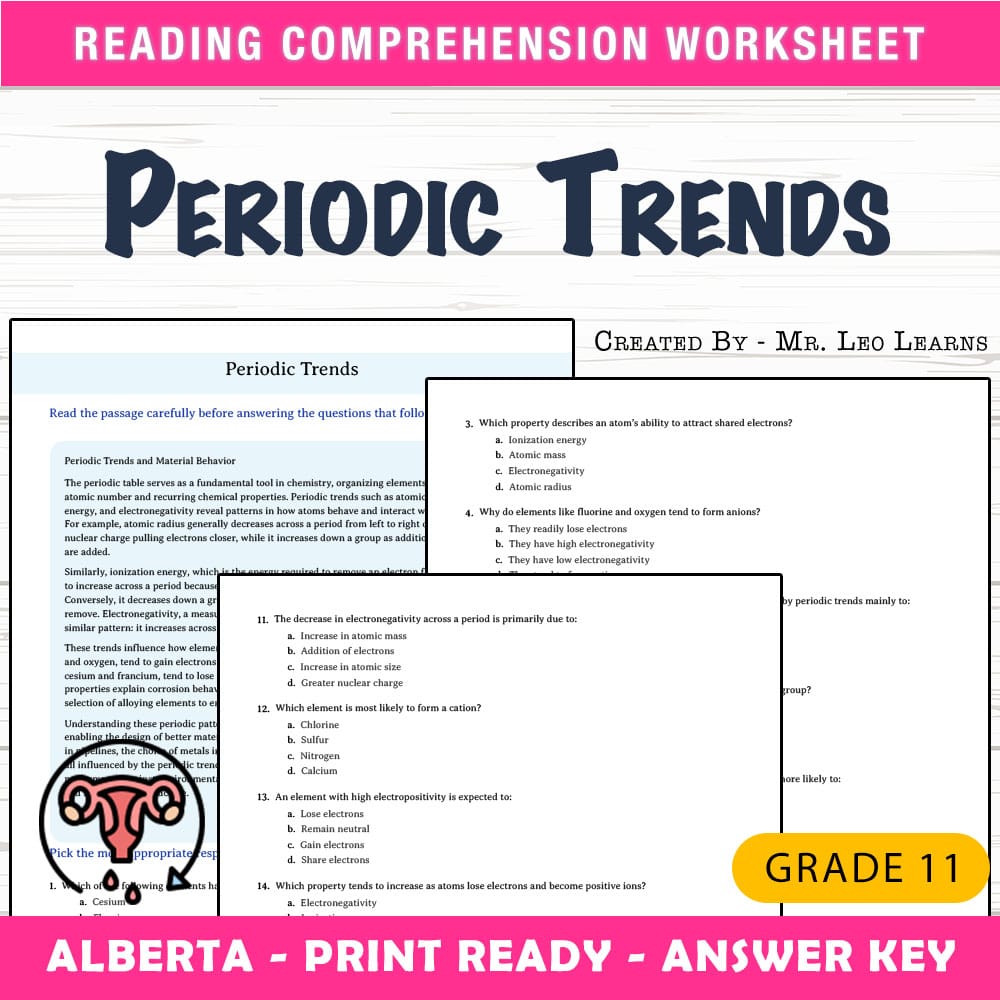
Grade 11 Science Matter and Chemical Bonding Lesson Bundle | Alberta
$36.00$45.00Save $9.00
The Resource Hub
·2 followers·9 sales
SubjectScienceGradeGrade 11
What’s included
15 worksheets · Save $9.00 (20%) · prices shown inside the bundle
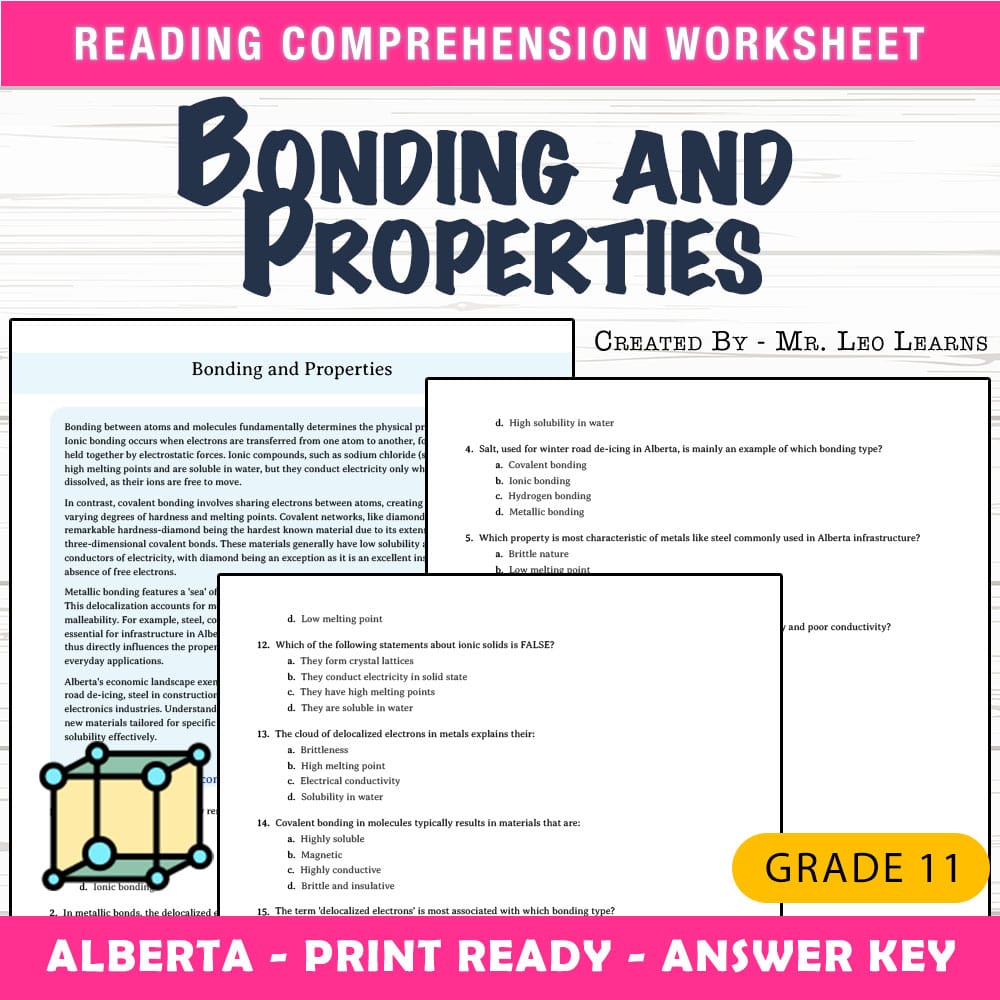
 Grade 11 Science — Bonding Types Worksheet MCQ for Mastery
- Explain the differences between ionic, covalent, and metallic bonding in terms of electron transfer, sharing, and delocalization.
- Relate bonding types to characteristic structural motifs such as ionic lattices, covalent molecular frameworks, and metallic electron seas.
- Apply understanding of bond types to real Alberta phenomena like road salt, hydrocarbons, and pipeline steels, explaining how bonding influences properties such as electrical conductivity, hardness, and solubility.
$2.40$3.00 Grade 11 Science — Worksheet MCQ Paper for Mastering Hydrogen Bonding
- Understand the concept of hydrogen bonding and its role in molecular interactions.
- Identify the effects of hydrogen bonding on properties like boiling point and density.
- Analyze how hydrogen bonds influence biological molecules such as proteins.
$2.40$3.00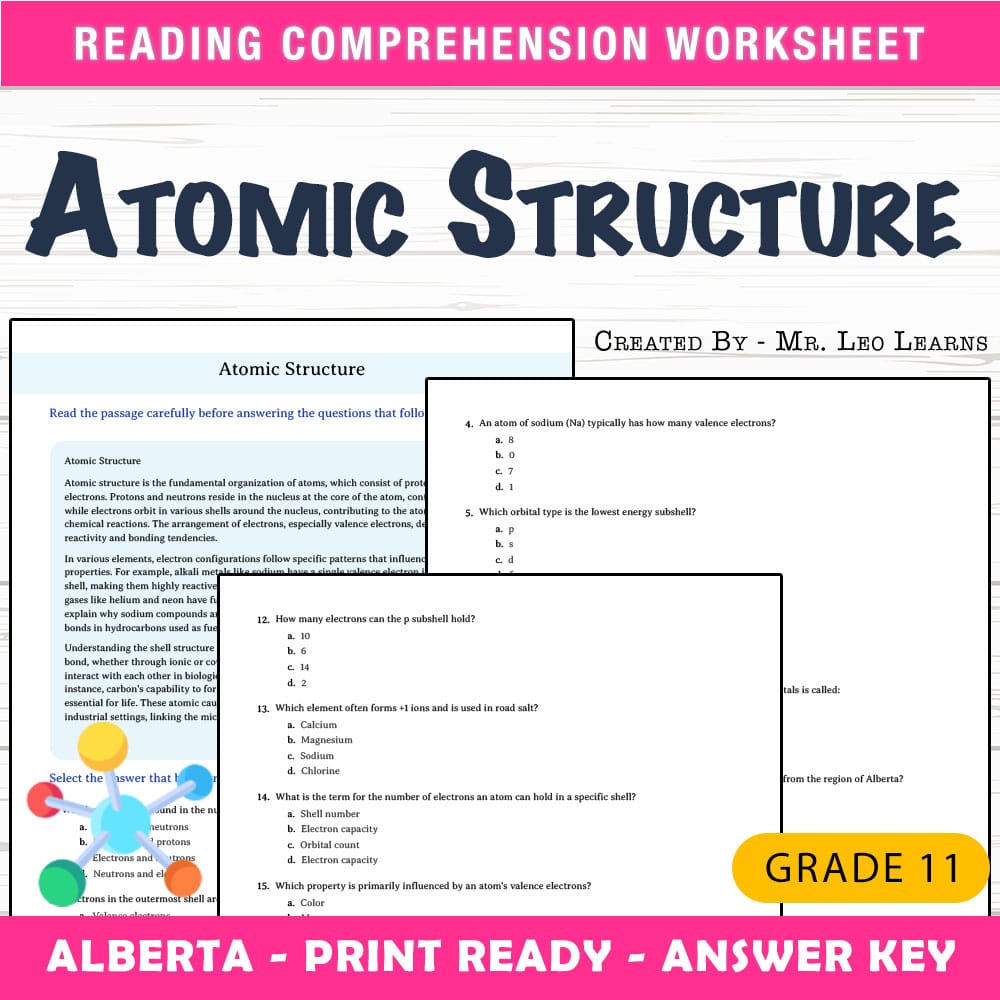 Grade 11 Science — Worksheet MCQ Paper for Mastering Atomic Structure
- Describe the organization of protons, neutrons, and electrons within an atom.
- Explain how electron arrangements influence reactivity, ion formation, and bonding.
- Identify regional examples like sodium in road salt and carbon in hydrocarbons to illustrate atomic behavior.
$2.40$3.00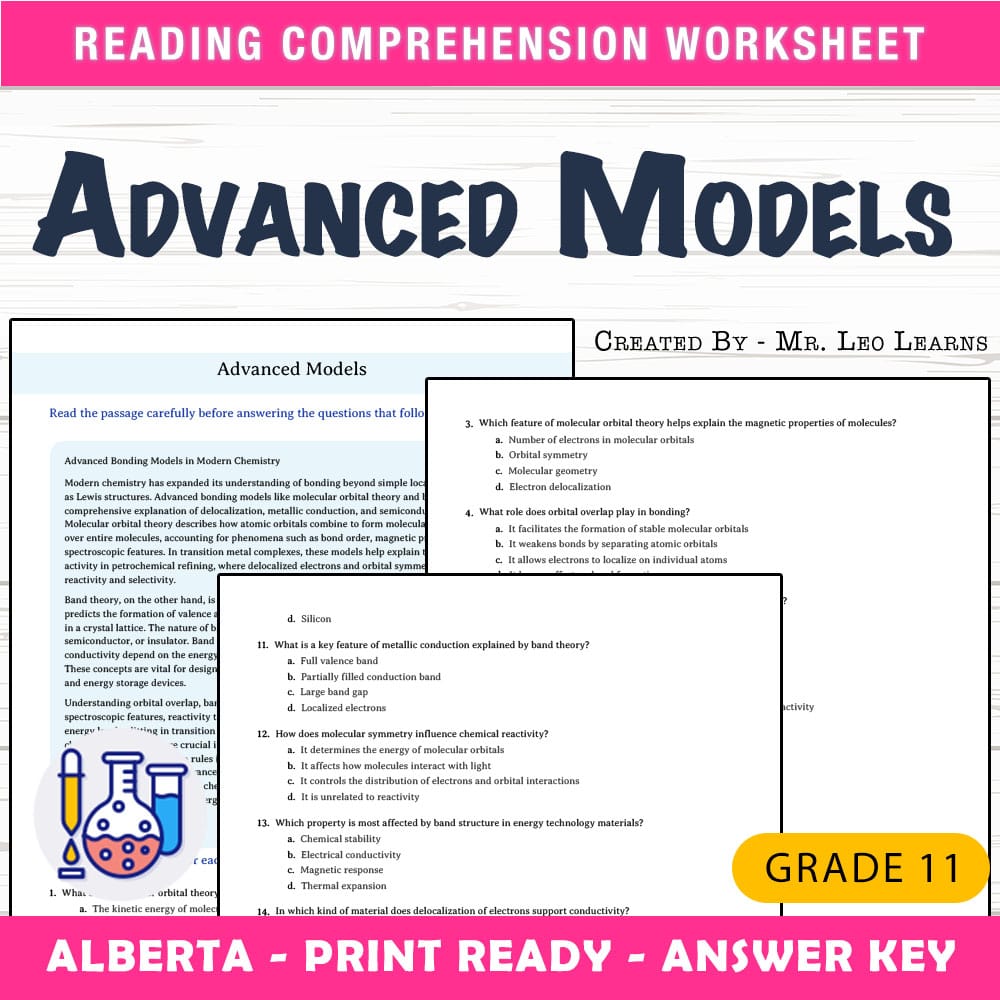 Grade 11 Science — Worksheet MCQ Paper for Mastering Advanced Models
- Understand how molecular orbital theory explains delocalization, metallic conduction, and semiconductor behavior.
- Identify the role of band structure and molecular symmetry in predicting spectroscopic features and reactivity.
- Apply concepts of orbital overlap and electronic properties to transition metal complexes and energy materials.
$2.40$3.00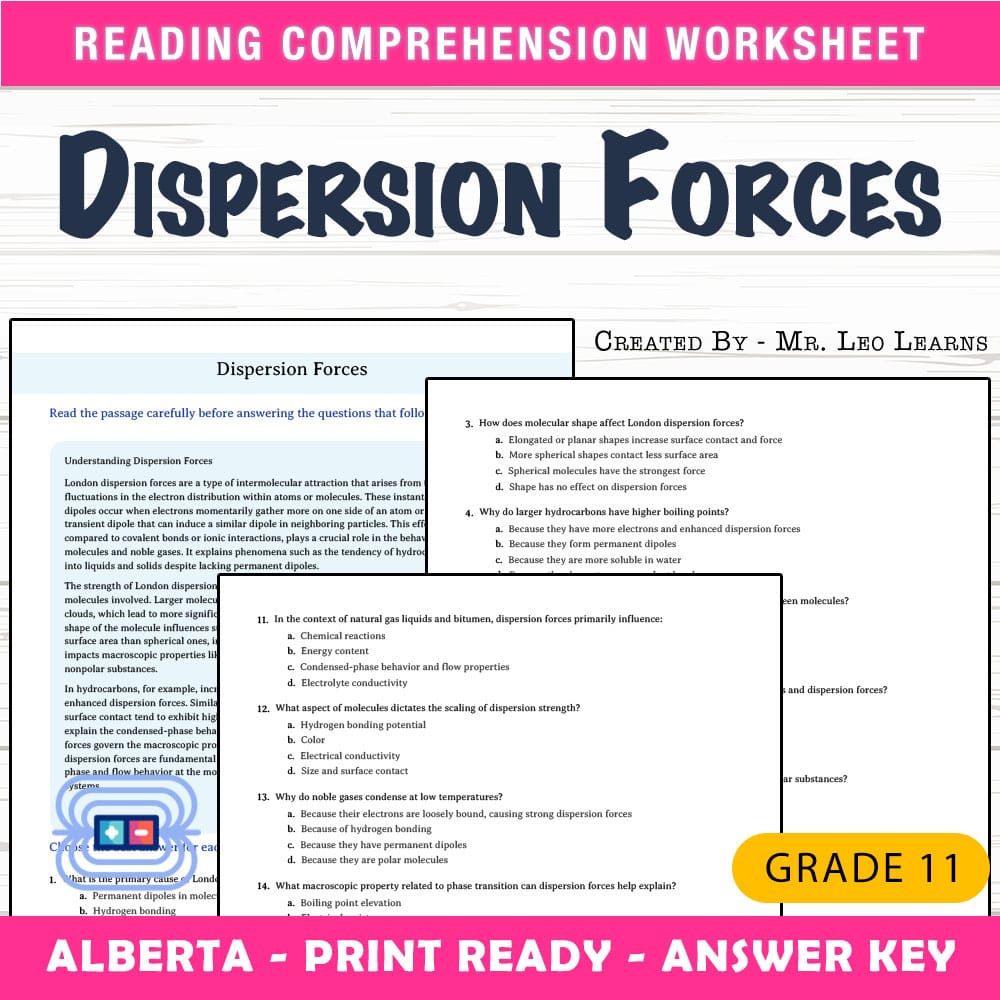 Grade 11 Science — Worksheet MCQ Paper for Mastering Dispersion Forces
- Explain the concept of London dispersion forces and their role in intermolecular interactions.
- Describe how size and shape influence the strength of dispersion forces.
- Understand the relationship between molar mass, surface contact, and macroscopic properties such as melting points and viscosities of nonpolar substances.
$2.40$3.00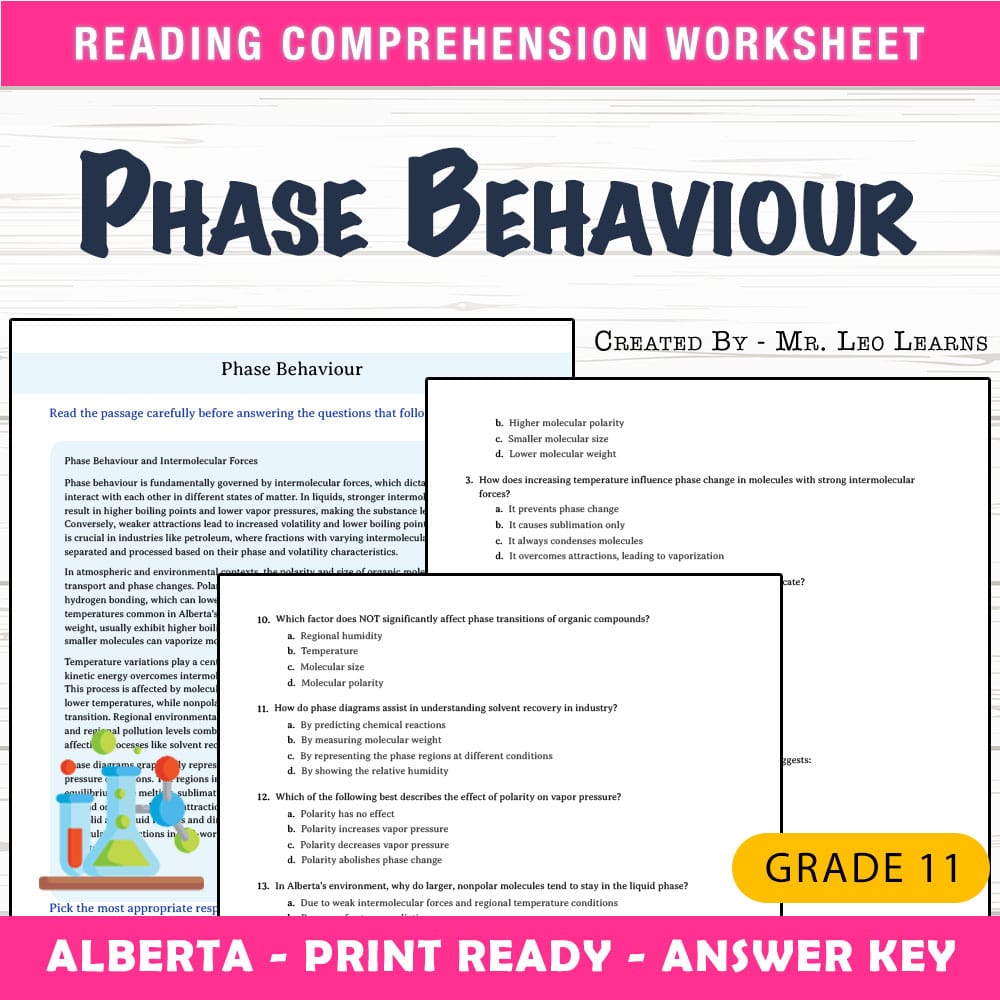 Grade 11 Science — Worksheet MCQ Paper for Mastering Phase Behaviour
- Describe how intermolecular forces influence phase transitions, vapor pressure, and boiling points.
- Explain how molecular size, polarity, and temperature affect phase diagrams and observable changes.
- Apply knowledge of phase behaviour to practical scenarios such as petroleum processing and atmospheric transport.
$2.40$3.00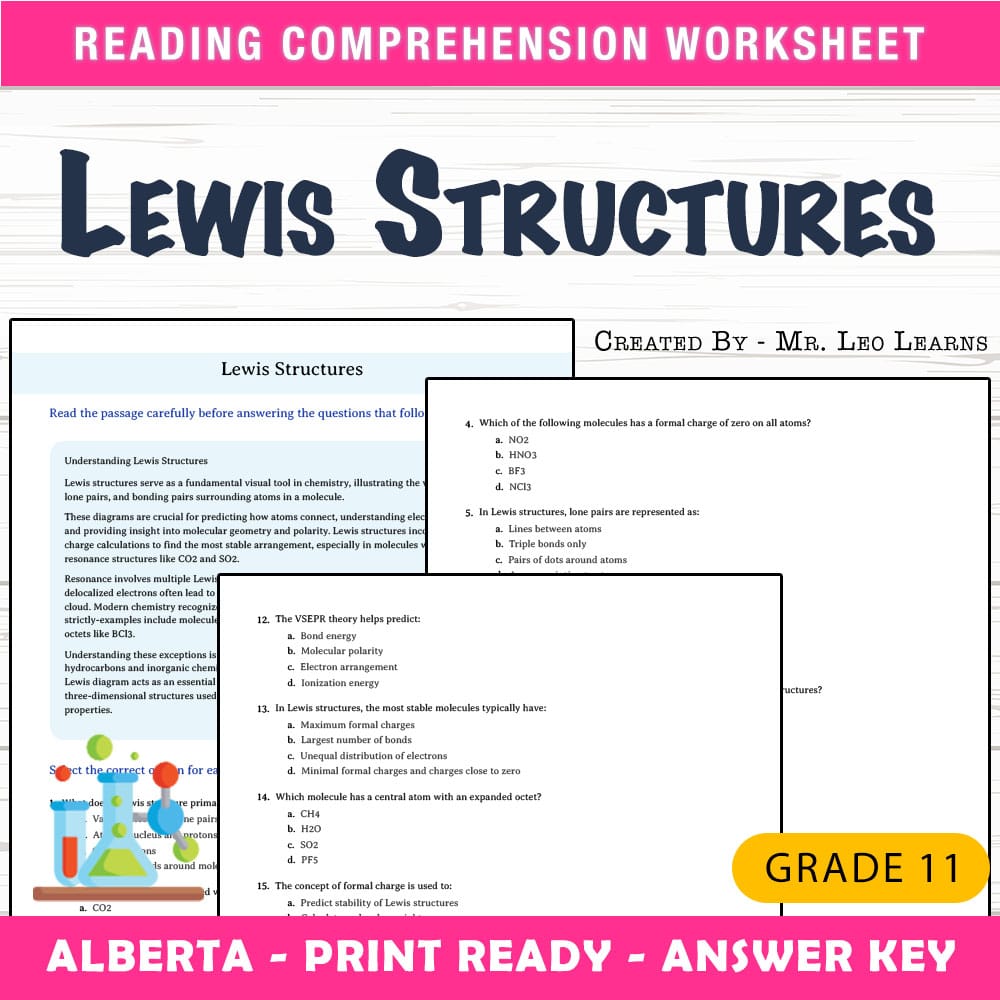 Grade 11 Science — Worksheet MCQ Paper for Mastering Lewis Structures
- Understand how Lewis structures represent valence electrons, lone pairs, and bonding pairs.
- Apply Lewis structures to predict molecular connectivity and electron arrangements.
- Identify molecules that require formal charge minimization, resonance, or exhibit exceptions to the octet rule.
$2.40$3.00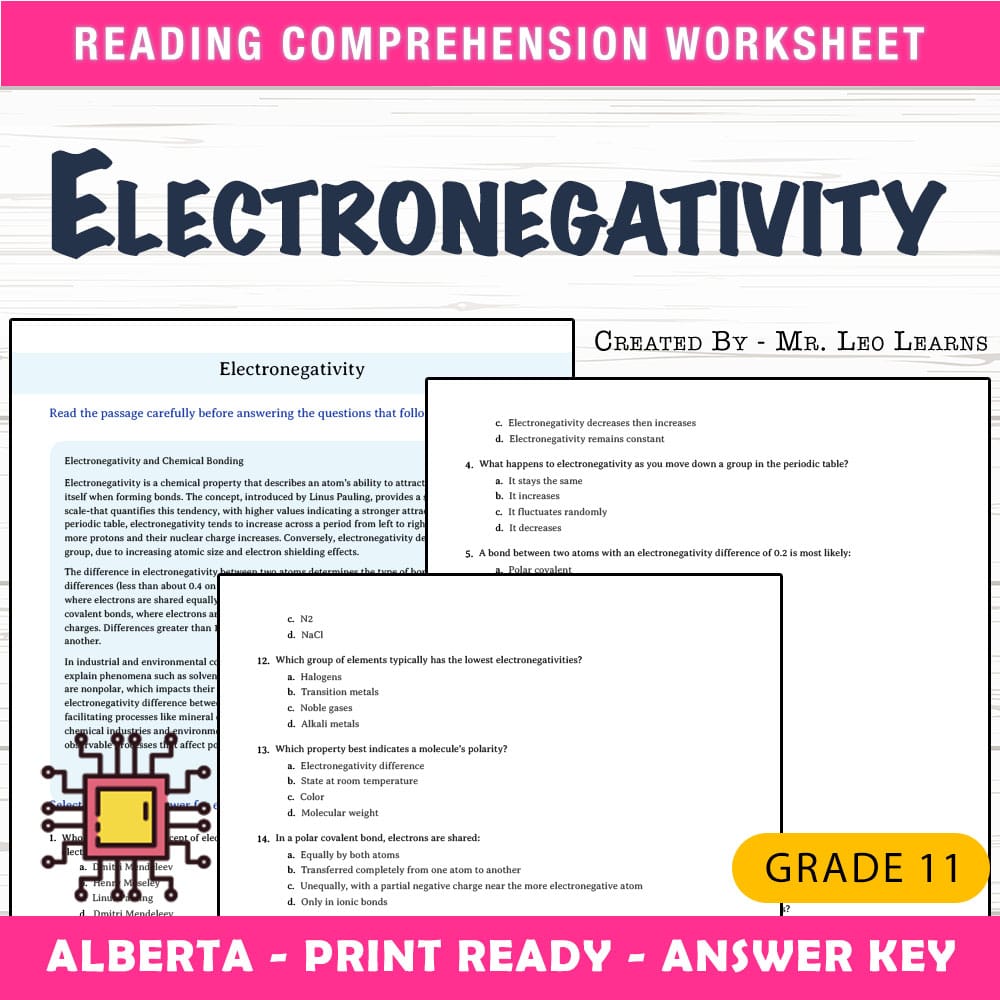 Grade 11 Science — Electronegativity Worksheet MCQ Paper for Mastery
- Understand the concept of electronegativity and its significance in chemical bonding.
- Identify the trends of electronegativity across periods and down groups in the periodic table.
- Differentiate between polar covalent and nonpolar covalent bonds based on electronegativity differences.
$2.40$3.00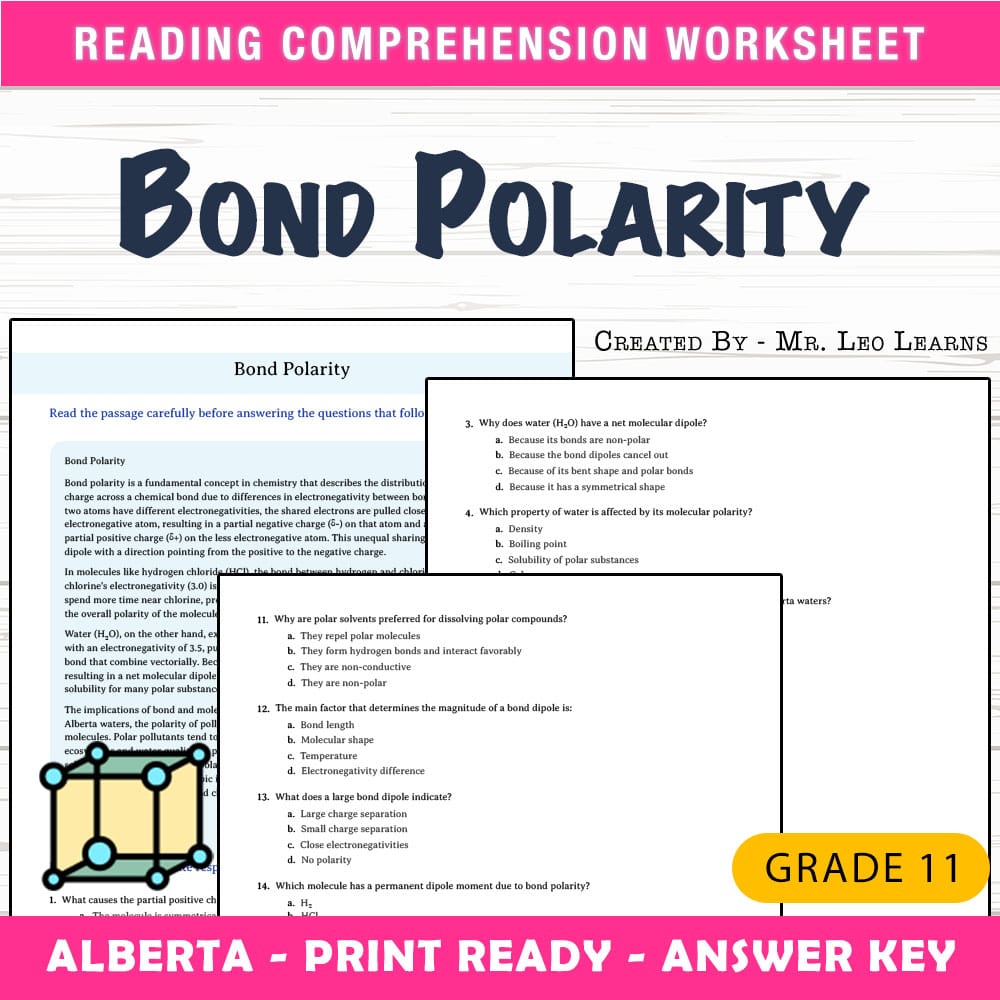 Grade 11 Science — Worksheet MCQ Paper for Mastering Bond Polarity
- Understand the vector nature of bond polarity and the concept of partial charges.
- Distinguish between polar bonds and polar molecules using examples like HCl and H₂O.
- Explain how bond dipoles contribute to the overall molecular polarity and its implications.
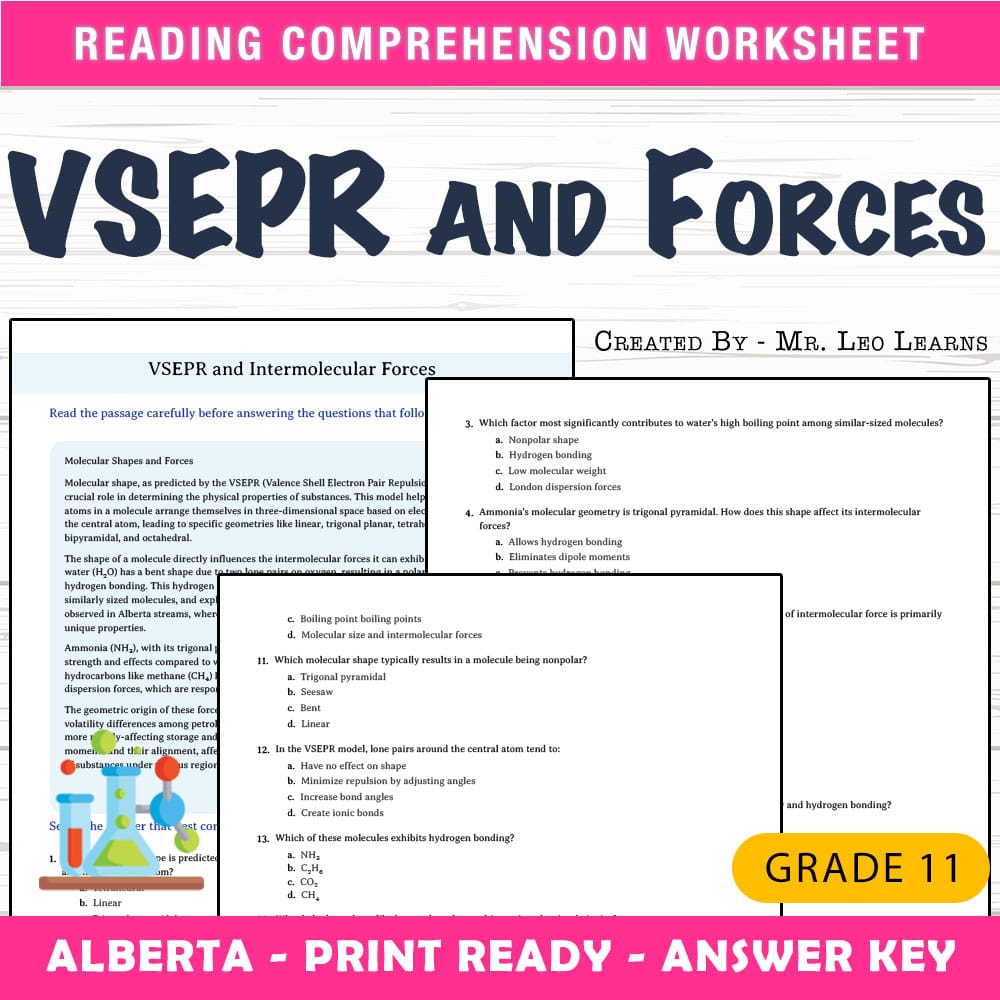
$2.40$3.00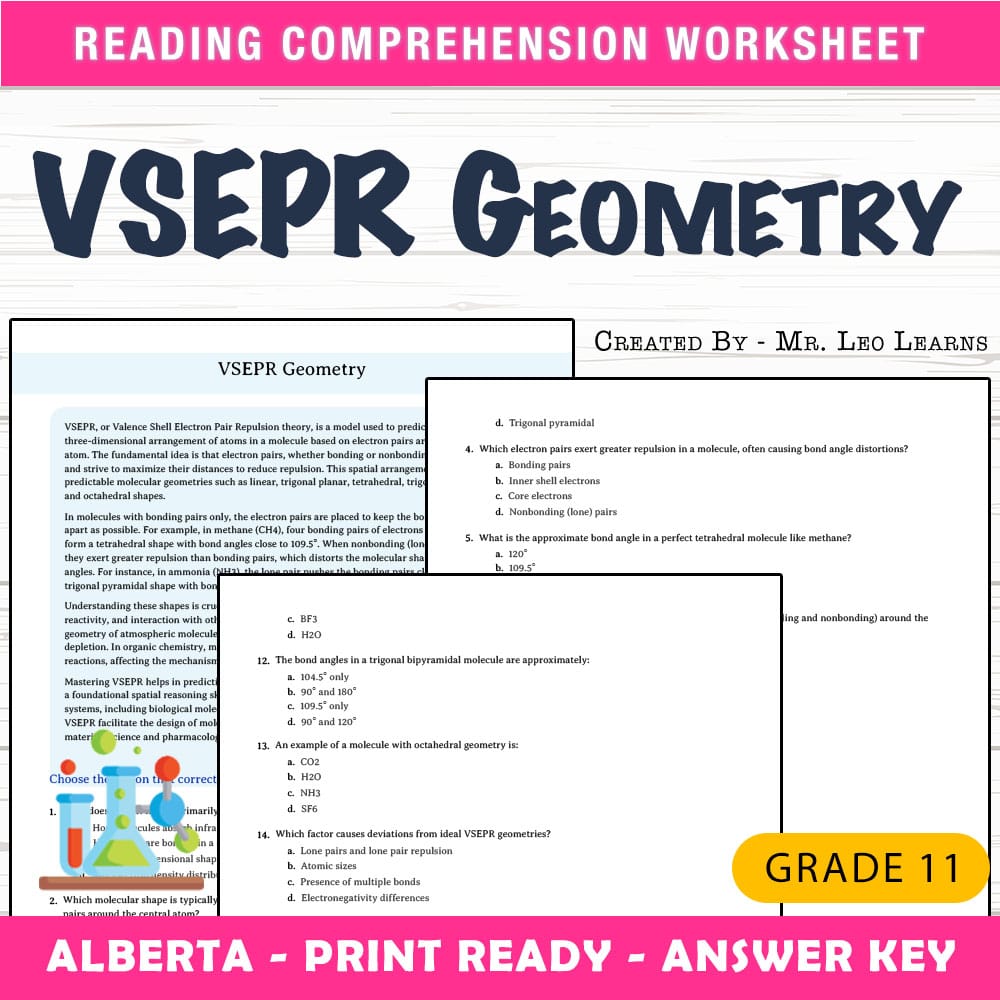 Grade 11 Science — Worksheet MCQ Paper for Mastering VSEPR Geometry
- Understand the principles of VSEPR theory and how electron pair repulsion determines molecular shape.
- Identify common molecular geometries such as linear, trigonal planar, tetrahedral, trigonal bipyramidal, and octahedral.
- Explain the influence of bonding and nonbonding electron pairs on bond angles and molecular symmetry.
$2.40$3.00
Reviews & Feedback
Loading reviews...
Questions & Answers
Loading questions…
About this bundle
Related categories
Frequently asked questions
Who is Grade 11 Science Matter and Chemical Bonding Lesson Bundle | Alberta designed for?
Grade 11 Science Matter and Chemical Bonding Lesson Bundle | Alberta is designed for Grade 11 students and Science learners and can be used in classrooms, homeschool, or independent practice.
How do I download Grade 11 Science Matter and Chemical Bonding Lesson Bundle | Alberta?
Add it to your cart and complete checkout. After payment, you can download immediately from your account, and you'll also receive a download link by email.
Similar Products

Grade 8 Matter & Chemical Change Lesson Bundle | Alberta Science
$60.00$75.00

Matter and Chemical Change Lesson Bundle – Alberta Grade 8 Science
$60.00$75.00

Grade 8 Matter & Chemical Change Science Lesson Bundle | Alberta Framework
$60.00$75.00

Grade 8 Matter and Chemical Change Science Lesson Bundle – Alberta Framework
$60.00$75.00

Grade 7 Matter, Mixtures & Chemical Changes Lesson Bundle | Alberta Science
$60.00$75.00