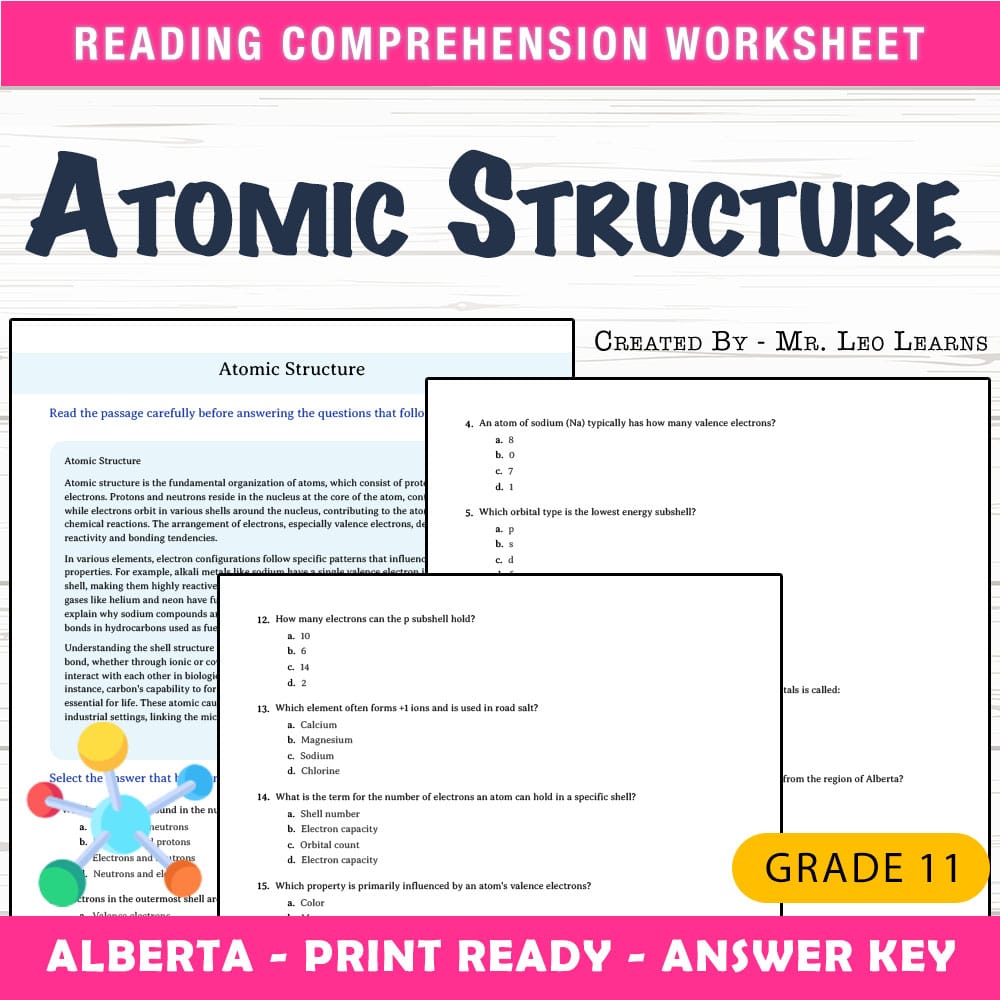
Imagine stepping into your classroom as students settle in, ready to explore the core concepts of atomic structure. Some students might feel overwhelmed by the details of protons, neutrons, and electrons, while others struggle to connect the theoretical ideas with real-world applications. This worksheet provides a straightforward, print-and-go resource designed to clarify these fundamental ideas and support student understanding through targeted multiple-choice questions grounded in Alberta standards.
What This Resource Helps Students Do
This worksheet encourages students to deepen their understanding of atomic structure by engaging with a carefully crafted set of multiple-choice questions. It guides learners through reading comprehension of a passage about atomic organization and then tests their knowledge with 25 focused MCQs. The questions reinforce key concepts such as particle composition, atomic models, and the characteristics of subatomic particles. By working through these questions independently, students develop confidence in identifying the roles of protons, neutrons, and electrons, as well as understanding the structure of the atom as a whole. The worksheet promotes critical thinking and helps students internalize how atomic structure relates to broader topics in science.
Inside the PDF
• A reading passage that introduces the basics of atomic structure
• 25 multiple-choice questions focused on core concepts
• A printable, printer-friendly format requiring no prior setup
• An answer key with rubric for quick assessment and record-keeping
• Designed layout to facilitate easy photocopying for classroom use
How It Improves Learning
This resource supports teachers in fostering a clear understanding of atomic structure by providing a structured approach to formative assessment. The reading passage sets the scene for learners to grasp the basic ideas, while the MCQs challenge them to apply their knowledge. The questions help identify misconceptions and enable quick feedback, which is essential for reinforcing learning. Using this worksheet regularly can help students gain confidence in describing atoms and their components, making abstract concepts more tangible. The answer key allows for efficient review sessions, promoting meaningful discussion and clarification where needed. Overall, it helps students transition from confusion to mastery, establishing a solid foundation for more advanced topics in chemistry and physics.
Core Skills Students Will Develop
- ➡️ Understanding atomic particles and their locations
- ➡️ Applying knowledge to identify subatomic particles in diagrams
- ➡️ Analyzing descriptions of atomic models
- ➡️ Assessing comprehension of atomic structure terminology
Ways Teachers Use This Worksheet
This worksheet serves many practical purposes in the classroom. It is ideal for supporting lesson introductions, providing additional practice after instruction, or serving as a quick formative assessment to gauge student understanding. Teachers may assign it as a classwork activity, homework, or early finisher task. It can also be employed in small-group review sessions or as part of a quiz or test review. Its straightforward format makes it a reliable resource for reinforcing core concepts of atomic structure and ensuring students are prepared for more complex topics ahead.
Why This PDF Saves Time
Designed with simplicity and efficiency in mind, this PDF resource allows teachers to distribute a ready-made assessment instantly. The print-friendly format eliminates the need for extensive preparation, while the clear layout ensures quick photocopying. The included answer key simplifies grading and provides immediate feedback, saving teachers valuable time during busy class periods. Its straightforward design means it’s a dependable tool that can be used repeatedly without additional modifications, giving teachers consistency and peace of mind.
Remember, this printable worksheet is fully prepared to support your instruction and help your students build a strong understanding of atomic structure with confidence. It’s ready to print, easy to implement, and ideal for fostering a solid foundation in science. 😊