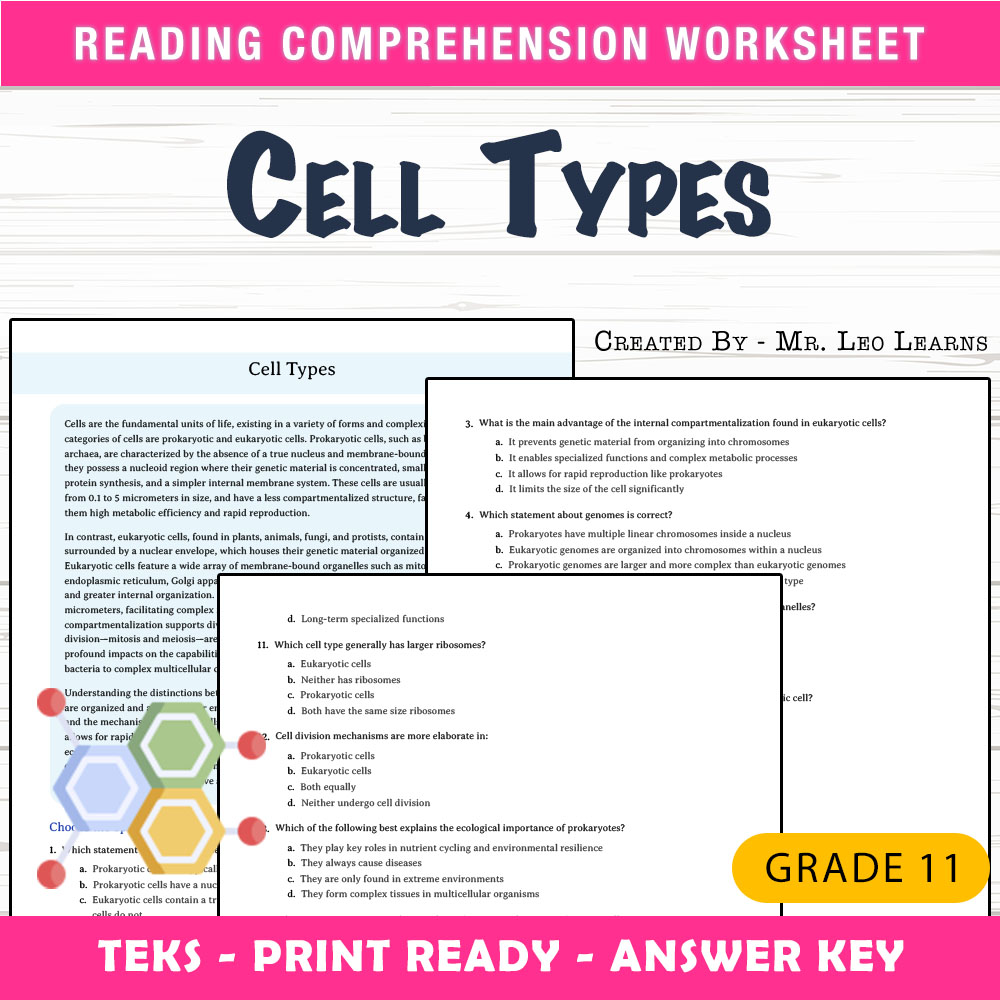
Imagine walking into your classroom, ready to guide your students through the fascinating world of cells. You notice some students looking puzzled when discussing the differences between prokaryotic and eukaryotic cells. You want a clear, straightforward resource to help them grasp these essential concepts quickly. This Grade 11 Science worksheet on cell types offers a practical, print-ready solution that simplifies this complex topic, encouraging independent learning and confident mastery.
What This Resource Helps Students Do
This worksheet is designed to support students in understanding the fundamental differences between various cell types, focusing on prokaryotic and eukaryotic cells. Through a combination of a reading passage and multiple-choice questions, students can build their scientific vocabulary, develop critical thinking skills, and reinforce key concepts about cell structure and function. It encourages active engagement by prompting students to analyze information, recall facts, and apply their knowledge. By working through these structured activities, students can enhance their ability to distinguish between cell types, which is essential for deeper biological understanding.
Inside the PDF
• A clear reading passage explaining the basics of prokaryotic and eukaryotic cells
• 25 multiple-choice questions that assess comprehension and application
• An easy-to-use, print-ready format that requires no additional preparation
• A detailed answer key with a rubric, facilitating quick assessment and feedback
• Layout optimized for photocopying and classroom distribution
How It Improves Learning
This worksheet enhances learning by providing a structured approach to understanding cell types, making complex information accessible for students. The reading passage serves as an informative foundation, helping students clarify key differences. The multiple-choice questions reinforce comprehension and critical thinking, encouraging students to analyze how prokaryotic and eukaryotic cells are similar or different. The answer key with rubric allows teachers to quickly assess student understanding and provide targeted feedback. Students gain confidence as they move from initial confusion to a solid grasp of cell concepts, developing their scientific reasoning and vocabulary along the way.
Core Skills Students Will Develop
- ➡️ Understanding differences between prokaryotic and eukaryotic cells
- ➡️ Reading comprehension of scientific passages
- ➡️ Application of cell biology concepts
- ➡️ Critical thinking and analysis skills
Ways Teachers Use This Worksheet
This worksheet is a versatile tool that can be used during classwork to introduce or review the topic of cell types, or as a homework assignment to reinforce lesson content. It serves as an effective assessment tool to gauge student understanding or as small-group practice for more targeted support. Teachers can also incorporate it into review sessions or early finisher activities, providing structured, independent practice that aligns with lesson objectives and promotes mastery of essential biology concepts.
Why This PDF Saves Time
This resource requires no prep time, as it comes in a print-ready PDF format designed for immediate classroom use. Its clear layout and straightforward questions make photocopying quick and easy, ensuring consistency in delivery. Teachers can rely on this worksheet as a dependable classroom staple, freeing up time to focus on instruction and student support rather than material preparation. The included answer key makes grading efficient and provides a clear standard for student performance, streamlining your assessment process.
In summary, this Grade 11 Science worksheet on cell types offers a practical, focused, and easy-to-implement resource to support student learning. It helps clarify the fundamental differences between prokaryotic and eukaryotic cells through structured guidance and assessment. With its print-and-go format, it’s designed to save teachers valuable prep time while fostering deep understanding and confidence in students. This worksheet is a ready-to-use tool that fits seamlessly into any biology curriculum, helping students succeed with clarity and confidence. 🚀