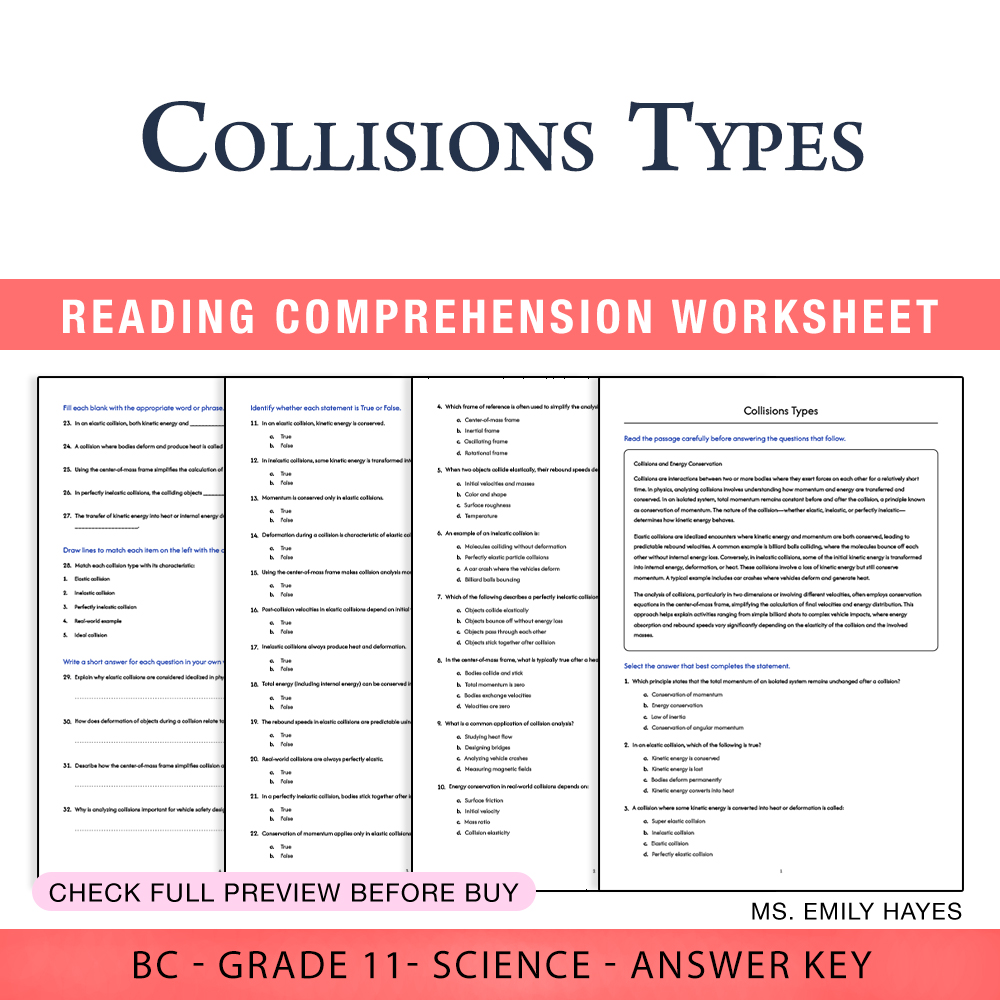
Are you seeking a practical, print-ready resource to help your Grade 11 Science students master the essential concepts of collision types? This comprehensive worksheet offers a timely solution for educators aiming to build students' understanding of physics principles such as conservation of momentum, types of elastic and inelastic collisions, and real-world applications of collision analysis. Perfect for in-class practice, homework, or review sessions, this worksheet provides engaging, varied question formats designed to enhance student comprehension and problem-solving skills.
Why Teachers Love This
✅ Saves valuable planning time with a ready-made, professionally designed PDF worksheet and answer key
✅ Easy to implement—print and distribute for immediate classroom use
✅ Covers key concepts aligned with BC science standards for Grade 11
✅ Structured to foster critical thinking and application skills through diverse question types
Why Students Succeed With This
✅ Clear, concise instructions guide students through complex topics with confidence
✅ Variety of question formats—including reading passages, multiple choice, true/false, fill-in-the-blank, matching, and short answers—cater to different learning styles
✅ Focus on real-world applications makes physics concepts tangible and relevant
✅ Builds foundational skills essential for success in higher-level physics and STEM courses
What You Get
This resource includes a fully prepared, print-ready PDF worksheet and an accompanying answer key with rubric, designed for seamless classroom integration. The worksheet features multiple sections:
- One reading passage explaining the nature of collisions with comprehension questions
- Ten multiple-choice questions assessing understanding of key principles like momentum conservation and collision types
- Dozens of true/false questions to reinforce critical concepts such as energy conservation
- Fill-in-the-blank prompts focusing on key terminology and concepts, including elastic and inelastic collisions
- Matching exercises linking collision types to their characteristics, fostering deeper understanding
- Thought-provoking short-answer questions that require explanation of theoretical principles and real-world implications
- Two comprehensive, essay-style questions designed to develop students’ analytical and communication skills regarding physics applications
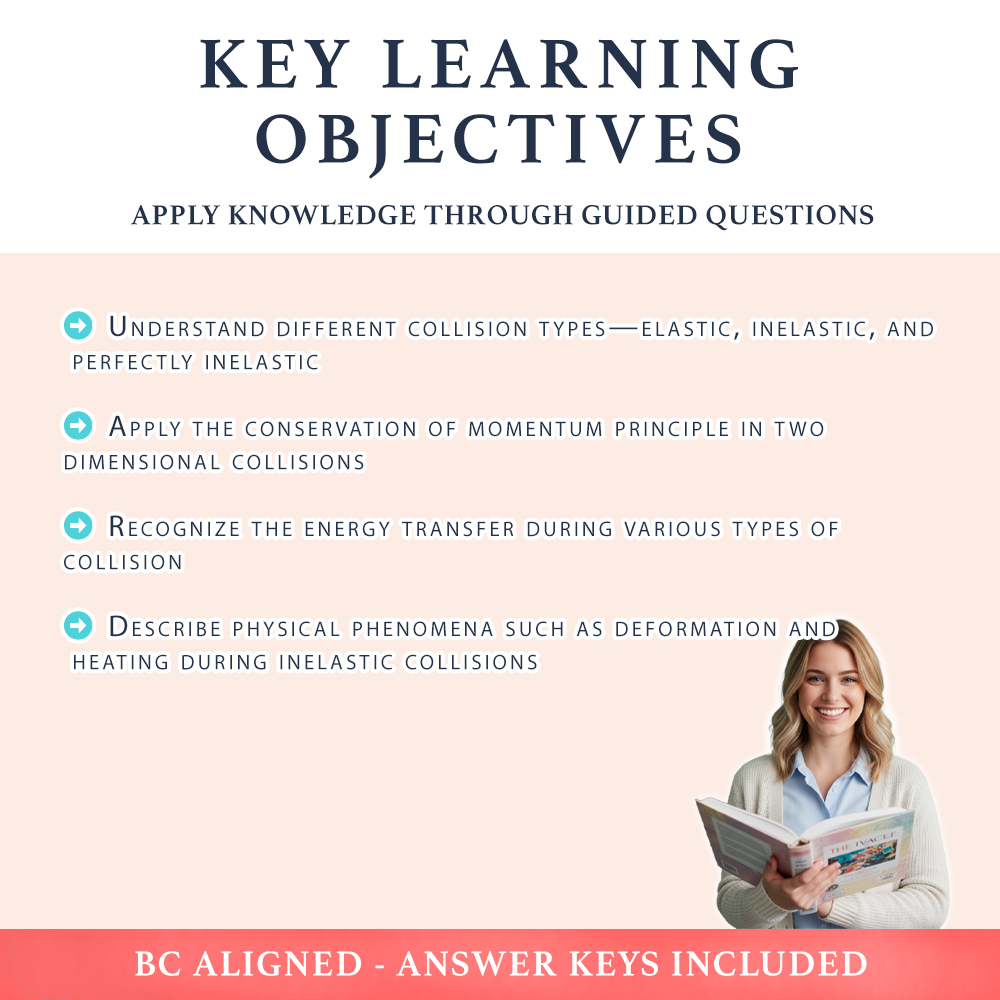
Key Learning Objectives
Students will master these essential skills:
- ➡️ Understand different collision types—elastic, inelastic, and perfectly inelastic
- ➡️ Apply the conservation of momentum principle in two-dimensional collisions
- ➡️ Recognize the energy transfer during various types of collision
- ➡️ Describe physical phenomena such as deformation and heating during inelastic collisions
Ideal Usage
This worksheet is perfect for a variety of classroom scenarios—including in-class exercises, formative assessments, homework assignments, and review sessions. The printable PDF format ensures quick, hassle-free distribution, making it suitable for whole-class, small-group, or individual practice. Use it to reinforce theoretical concepts, prepare students for upcoming exams, or develop discussion around real-world physics phenomena related to collision analysis.
Equip your students with the tools they need to excel in physics—download this engaging, print-ready worksheet today and set the stage for meaningful learning and critical thinking! 🚀