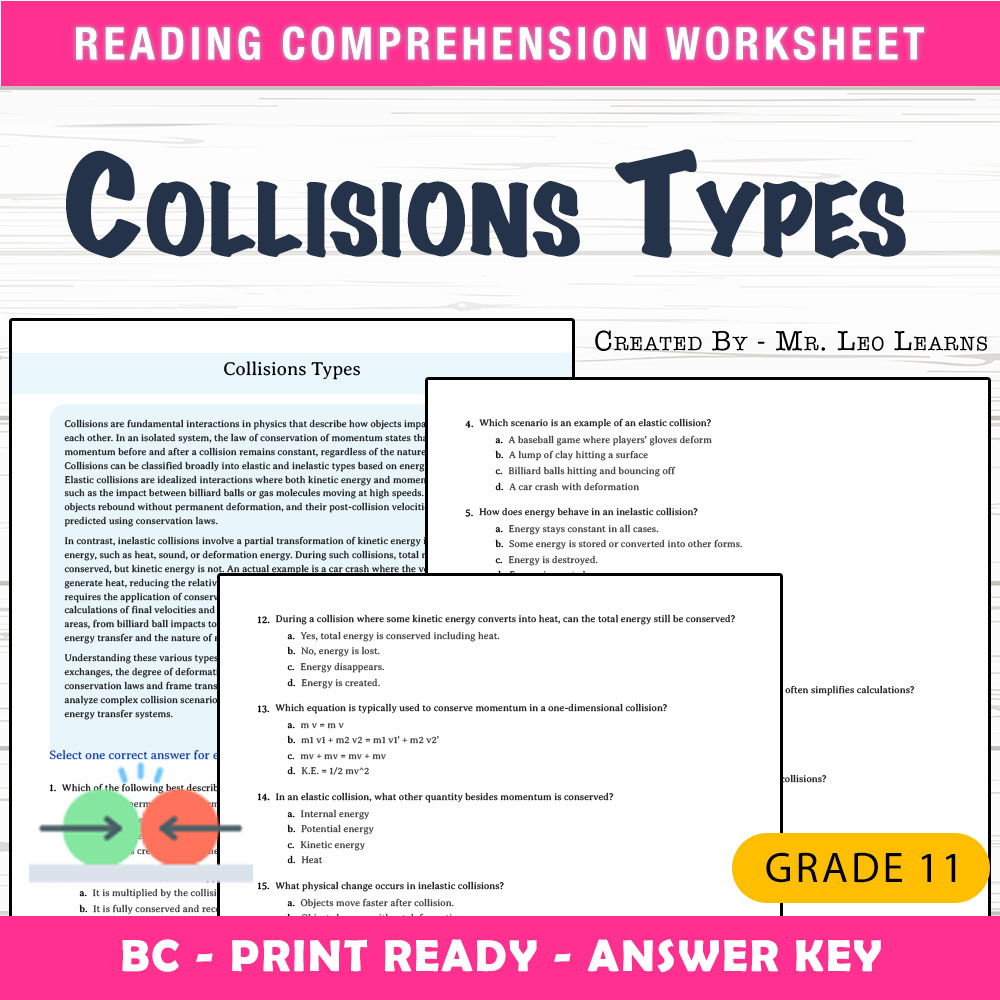
Imagine teaching a class where students are working through complex physics concepts like collisions, yet many struggle to grasp the differences between elastic and inelastic collisions. As students sit together, some look confused while others attempt to recall definitions from memory. This worksheet provides a straightforward, print-and-go solution that guides students step-by-step through understanding various collision types, helping to clarify these fundamental physics interactions with minimal classroom preparation.
What This Resource Helps Students Do
This worksheet helps students develop a clear understanding of collision types by providing engaging multiple-choice questions grounded in a real reading passage. It guides students to analyze the characteristics of elastic and inelastic collisions, encouraging critical thinking and reasoning skills. Students practice identifying collision types based on physical principles, which builds confidence in applying physics concepts accurately. The structure supports independent work, enabling learners to reinforce their understanding at their own pace while receiving immediate practice with relevant content.
Inside the PDF
• 1 reading passage explaining collision interactions
• 25 multiple-choice questions to assess understanding
• Clear layout designed for ease of use and photocopying
• PDF answer key with rubric for quick grading and review
How It Improves Learning
This worksheet provides a logical progression from reading comprehension to application, helping students solidify their grasp on collision concepts. The reading passage offers foundational knowledge, giving students context before answering questions. The multiple-choice format encourages active engagement and immediate self-assessment, reinforcing understanding. By working through real-world examples and applying physics rules, students develop reasoning skills that extend beyond memorization. The structured questions help teachers identify misconceptions quickly, allowing for targeted follow-up discussions or instruction. Overall, this resource guides learners from confusion to confident explanation, making learning about collisions both accessible and meaningful.
Core Skills Students Will Develop
- ➡️ Understanding physics interactions
- ➡️ Analyzing collision types
- ➡️ Applying scientific principles
- ➡️ Critical thinking and decision making
Ways Teachers Use This Worksheet
Teachers incorporate this worksheet into their lessons as both an instructional tool and an assessment resource. It works well as in-class work during a lesson on kinetic energy and momentum, or as a review activity before a quiz or test. Some teachers assign it as homework to reinforce recent topics or provide additional practice for students needing extra support. It also serves as a useful small-group activity for discussing collision concepts, or as early finisher work. The printable format means teachers can quickly distribute the worksheet without any prep work, saving valuable instructional time while supporting student learning.
Why This PDF Saves Time
This resource’s print-ready format allows teachers to print the worksheet immediately, eliminating time-consuming preparation. The included answer key with rubric ensures quick and consistent grading, reducing teacher workload and providing a reliable assessment tool. Its clear layout and straightforward questions make it easy to replicate for multiple classes or to modify as needed, helping teachers maintain consistent evaluation standards across lessons.
Designed to be immediately classroom-ready, this worksheet offers a practical, effective way to deepen students' understanding of collision types. It’s a dependable resource you can use repeatedly to support student success confidently. 😊