
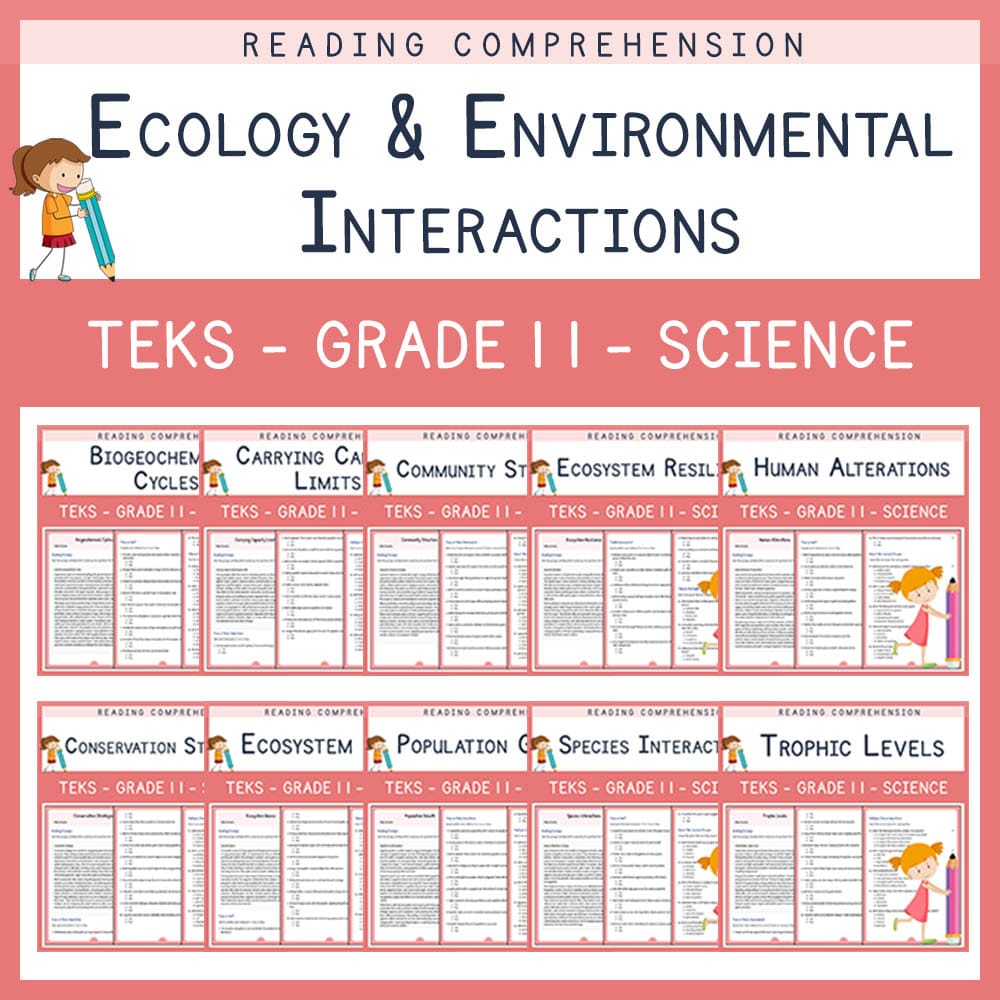
Grade 11 Science | Ecology Conservation & Biogeochem Cycles Science | TEKS
$24.00$30.00Save $6.00
Lumora Learning
·3 followers·12 sales
GradeGrade 11
What’s included
10 worksheets · Save $6.00 (20%) · prices shown inside the bundle
 Grade 11 Science | Carrying Capacity Limits Worksheet | TEKS-Aligned
- Understand the concept of carrying capacity and its significance in ecology.
- Identify factors that influence ecological carrying capacity.
- Differentiate between density-dependent and density-independent effects.
$2.40$3.00 Grade 11 Science | Ecosystem Basics Worksheet | TEKS-Aligned
- Describe the fundamental components of ecosystems and their interactions.
- Explain the flow of energy through food chains and the cycling of nutrients like carbon and nitrogen.
- Differentiate between primary productivity, energy flow, and nutrient reuse within ecosystems.
$2.40$3.00 Grade 11 Science | Population Growth Worksheet | TEKS-Aligned
- Understand the concepts of exponential and logistic population growth.
- Identify factors that influence population dynamics, including density-dependent and density-independent factors.
- Apply mathematical models to analyze population trends over time.
$2.40$3.00 Grade 11 Science | Biogeochemical Cycles Worksheet | TEKS-Aligned
- Understand the key processes involved in biogeochemical cycles, including carbon, nitrogen, and phosphorus cycles.
- Identify how elements move through ecosystems and the factors that influence their residence times and pool sizes.
- Explain human impacts on biogeochemical cycles and their effects on ecosystem productivity and health.
$2.40$3.00 Grade 11 Science | Trophic Levels Worksheet | TEKS Aligned
- Understand the concept of trophic levels and their roles within ecosystems.
- Describe how energy transfer occurs between organisms at different trophic levels.
- Differentiate between producers, consumers, decomposers, and other feeding relationships.
$2.40$3.00 Grade 11 Science | Human Alterations Worksheet | TEKS-Aligned
- Understand various ways humans alter ecosystems and their impacts on biodiversity.
- Identify different types of human activities that affect ecological processes.
- Evaluate the trade-offs between economic development and conservation efforts.
$2.40$3.00 Grade 11 Science | Community Structure Worksheet | TEKS Aligned
- Understand the key concepts of community structure including species composition, abundance, and spatial arrangement.
- Explain the impact of biodiversity metrics like species richness, evenness, and keystone species on ecosystem stability.
- Describe how successional stages influence community development after disturbances.
$2.40$3.00 Grade 11 Science | Ecosystem Resilience Worksheet | TEKS-Aligned
- Define ecosystem resilience and identify its key mechanisms.
- Understand how ecosystems recover from disturbances and how stability can shift.
- Explain the role of energy flow, nutrient cycling, and species interactions in resilience.
$2.40$3.00 Grade 11 Science | Conservation Strategies Worksheet | TEKS-Aligned
- Explain various conservation strategies used to protect biodiversity and ecosystems.
- Identify key components of habitat restoration and sustainable resource management.
- Assess the importance of connectivity corridors and monitoring in conservation efforts.
$2.40$3.00 Grade 11 Science | Species Interactions Worksheet | TEKS-Aligned
- Understand different types of species interactions including competition, predation, mutualism, and parasitism.
- Identify how abiotic factors influence species interactions and community structure.
- Describe trophic interactions and their effects through top-down and bottom-up processes.
$2.40$3.00
Reviews & Feedback
Loading reviews...
Questions & Answers
Loading questions…
About this bundle
Related categories
Frequently asked questions
Who is Grade 11 Science | Ecology Conservation & Biogeochem Cycles Science | TEKS designed for?
Grade 11 Science | Ecology Conservation & Biogeochem Cycles Science | TEKS is designed for Grade 11 students and can be used in classrooms, homeschool, or independent practice.
How do I download Grade 11 Science | Ecology Conservation & Biogeochem Cycles Science | TEKS?
Add it to your cart and complete checkout. After payment, you can download immediately from your account, and you'll also receive a download link by email.


