Imagine standing in front of your class as students try to grasp the complex concept of electron configuration. Some are confused about how electrons fill atomic orbitals, and others struggle to remember the principles that govern their placement. This worksheet provides a straightforward, print-ready resource that helps clarify these ideas with a series of focused questions, guiding students step-by-step through understanding electron arrangements in atoms. It’s designed to support your lesson by reinforcing core concepts and encouraging independent thinking, making it easier for your students to develop confidence in atomic theory.
What This Resource Helps Students Do
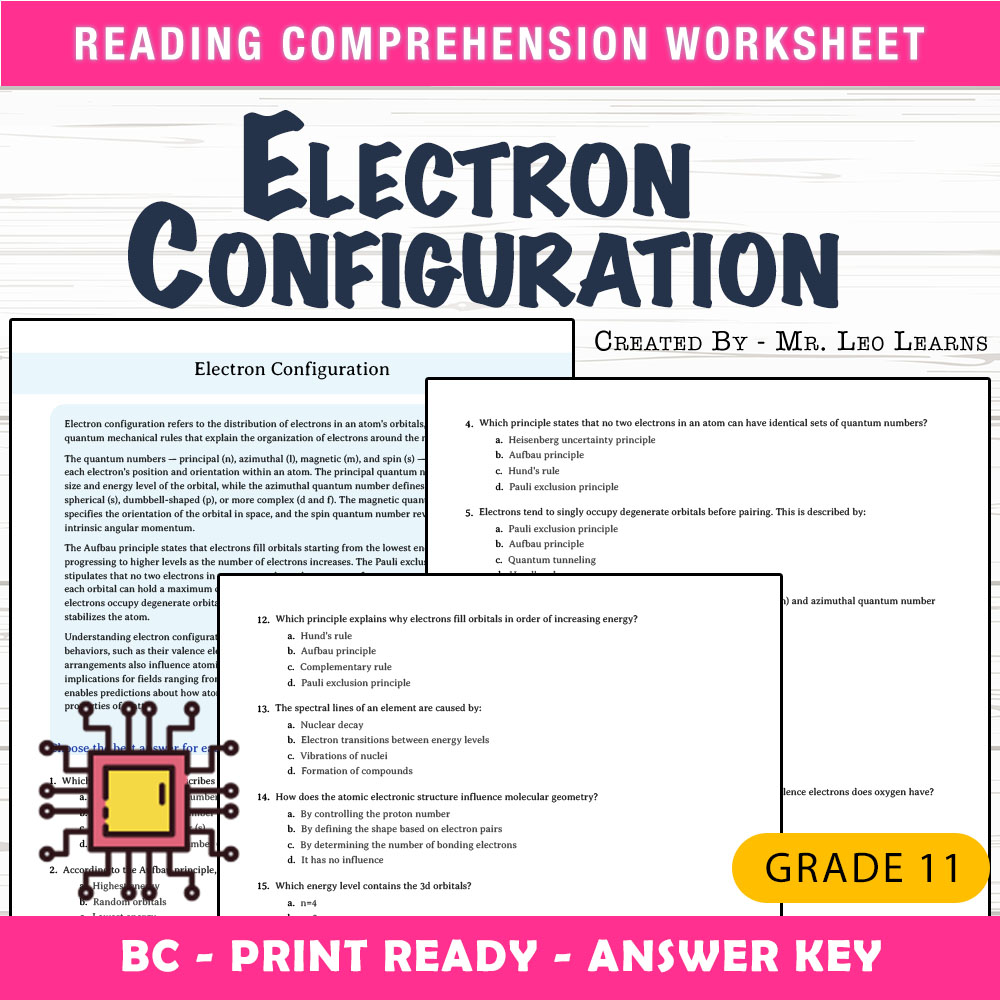
This worksheet helps students solidify their understanding of electron configuration through a variety of question formats. It walks them through key ideas like quantum numbers, orbital shapes, and the rules for filling electrons — including the Aufbau principle, Pauli exclusion principle, and Hund’s rule. By completing this practice, students not only recall factual information but also learn to apply principles to real-world atomic models. The structured questions encourage critical thinking and provide a clear pathway for students to connect theory with visual representations of electron arrangements, supporting their ability to solve related problems independently.
Inside the PDF
• 1 reading passage explaining the basics of electron configuration
• 25 multiple choice questions to assess understanding of orbitals, quantum numbers, and filling rules
• A printable, PDF format that is ready to use immediately
• An answer key with a detailed rubric to assist grading and feedback
• Designed layout that is easy to photocopy and distribute for classroom use
How It Improves Learning
This worksheet boosts student confidence by breaking down complicated atomic concepts into manageable parts. The reading passage sets a clear foundation, and the multiple choice questions reinforce key ideas and test comprehension. Students learn to interpret orbital diagrams and understand how electrons fill them according to established principles. Repeated exposure to these questions helps reinforce learning and encourages students to think critically about electron configurations. The structured format promotes independent problem-solving, making it easier to identify and address common misconceptions. Overall, it supports a deeper understanding of atomic structure that students can carry into higher-level chemistry topics.
Core Skills Students Will Develop
- ➡️ Understanding atomic orbitals and their shapes
- ➡️ Applying principles of electron filling and configuration
- ➡️ Interpreting quantum numbers and their significance
- ➡️ Developing problem-solving strategies related to atomic structure
Ways Teachers Use This Worksheet
This worksheet can serve many instructional purposes — as classwork to introduce or review electron configuration, as homework to reinforce understanding after a lesson, or as an assessment to gauge student progress. It works well for small-group activities, independent practice, or early finisher tasks. Teachers often incorporate it into review sessions before quizzes or exams, providing students with structured practice that supports mastery of the material. It’s a versatile, classroom-ready resource that helps you support all learners in understanding this fundamental chemistry topic with clarity and confidence.
Why This PDF Saves Time
Designed in a print-and-go format, this resource reduces your prep time by providing all necessary content in a ready-to-use PDF. Its clear layout ensures uniformity across classes, and you can simply print copies for immediate classroom use. The included answer key streamlines grading and offers quick feedback, helping you manage assessment efficiently. Its straightforward design makes it reliable for consistent use, allowing you to focus more on instruction and student support rather than creating new assessment tools from scratch.
Remember, this worksheet is a practical, ready-to-print resource built to help your students master electron configuration with confidence. It’s classroom-friendly, easy to implement, and designed to support your teaching goals. Simply print and distribute — your students will appreciate the clear structure and focused practice that guides them toward understanding atomic structure better. 😊