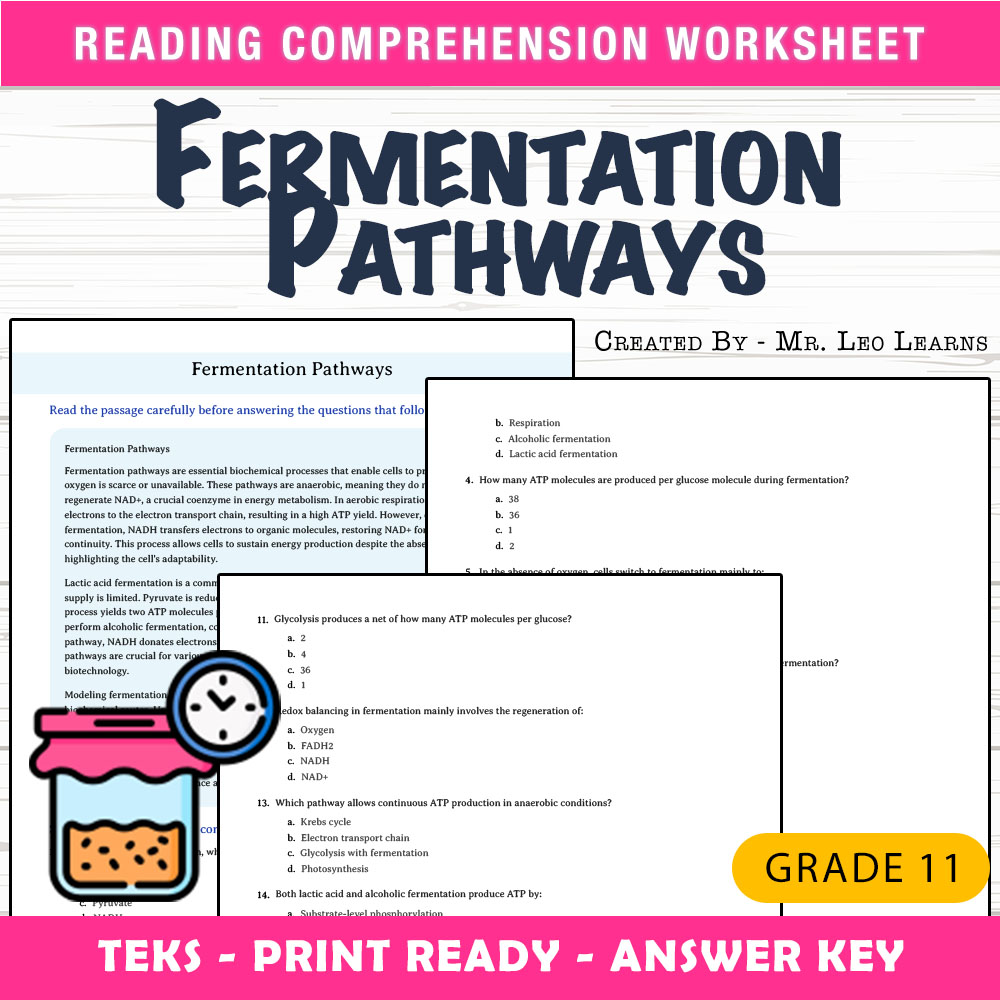
Imagine walking into your classroom and seeing students engaged in exploring the complex processes behind cellular energy production. They may be puzzled by how cells generate energy in the absence of oxygen or how fermentation pathways differ. This worksheet provides a practical, straightforward way to clarify those concepts, guiding students step-by-step through understanding fermentation pathways with minimal prep time. The printable PDF allows for seamless integration into your lesson plan, offering both activity and assessment in one resource.
What This Resource Helps Students Do
This worksheet supports students in unraveling the biochemical processes involved in fermentation pathways, such as lactic acid and alcohol fermentation. It encourages independent thinking by prompting students to analyze reading passages, answer multiple-choice questions, and reinforce key concepts. As students work through the questions, they build confidence in understanding cellular respiration alternatives, how ATP is produced without oxygen, and the biological significance of NAD+ regeneration. The structured questions provide clarity, helping students connect theoretical knowledge with real-world biological functions.
Inside the PDF
• 1 detailed reading passage explaining fermentation pathways
• 25 multiple-choice questions for comprehension and application
• A print-ready layout requiring no further preparation
• An answer key with rubric for quick grading and feedback
• Designed for easy photocopying and classroom use
How It Improves Learning
This worksheet enhances student understanding by providing clear, step-by-step questions that reinforce key points about fermentation. The reading passage introduces the biochemical processes in a simple yet comprehensive way, laying a strong foundation. Multiple-choice questions with carefully crafted distractors challenge students to think critically about each step, helping to deepen their grasp. The variety of question formats encourages active engagement, consolidating learning and building confidence. As students move from initial confusion to mastery, they develop better reasoning skills and a stronger grasp of how organisms can produce energy in different environments. The presence of an answer key allows for immediate assessment and targeted feedback, supporting differentiated instruction and self-study opportunities.
Core Skills Students Will Develop
- ➡️ Understanding biochemical pathways within cellular respiration
- ➡️ Critical thinking about biological processes
- ➡️ Applying knowledge to answer multiple-choice questions
- ➡️ Analyzing scientific passages for key information
- ➡️ Mastering the role of NAD+ in energy production
Ways Teachers Use This Worksheet
This resource is versatile for use in a variety of classroom settings. It works well as a classwork assignment following a lecture on cellular respiration, as a homework task to reinforce learning, or as an assessment tool to gauge student understanding. It can also serve for small-group practice, giving students the opportunity to discuss and clarify concepts collaboratively. Additionally, teachers can use it for early finisher activities or review sessions, making efficient use of classroom time and providing a consistent, reliable resource that supports student success.
Why This PDF Saves Time
The printable PDF is designed for immediate use, eliminating the need for extra preparation. Its clear, print-ready layout ensures that teachers can simply photocopy and distribute without fuss. The included answer key with rubric streamlines grading, helping teachers provide timely feedback while ensuring grading consistency. This resource offers a dependable, ready-to-go tool that supports efficient lesson planning and helps maintain a confident classroom environment.
Guided by this worksheet, teachers can confidently lead engaging lessons on fermentation pathways, knowing they have a straightforward, effective resource to help students grasp essential biochemical concepts. It’s easy to implement and student-friendly, making complex scientific processes accessible and understandable. 😊