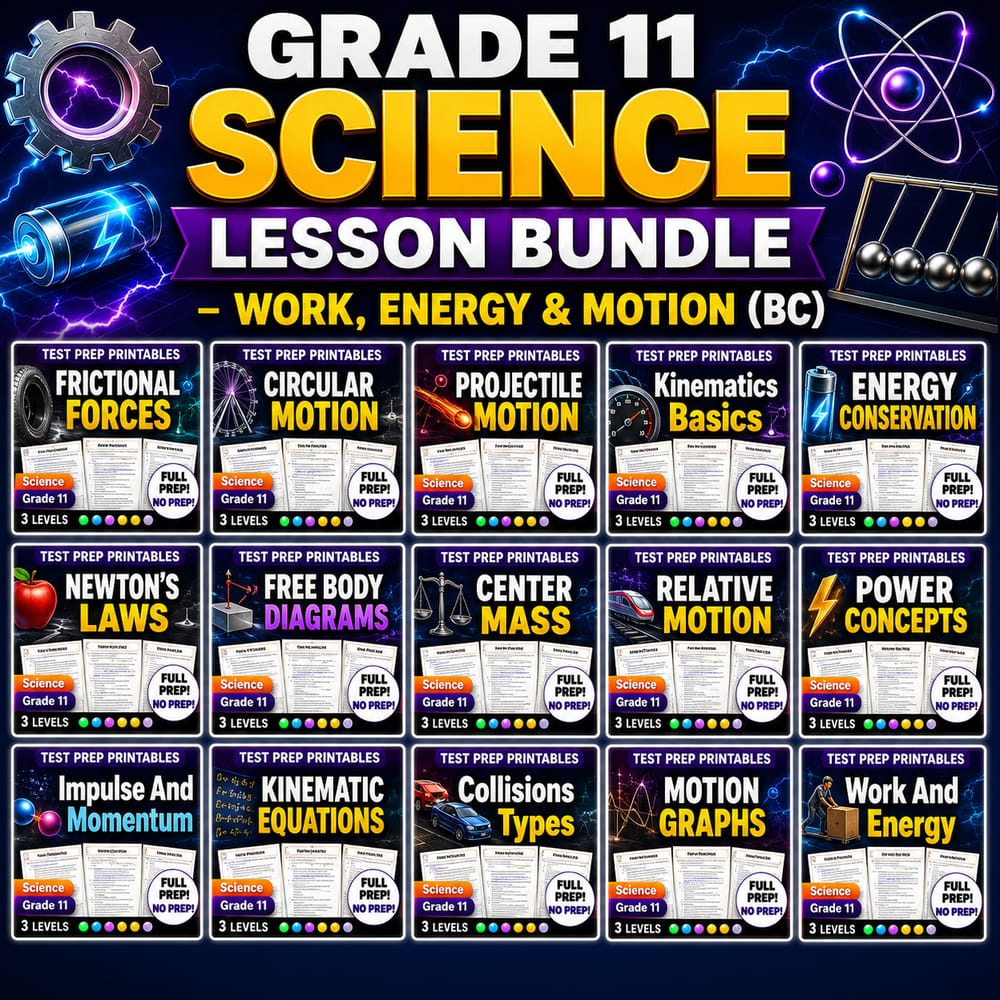
Grade 11 Science Lesson Bundle — Work, Energy & Motion (BC) — bundle cover
Grade 11 Science Lesson Bundle — Work, Energy & Motion (BC) — included worksheet 1
Grade 11 Science Lesson Bundle — Work, Energy & Motion (BC) — included worksheet 2
Grade 11 Science Lesson Bundle — Work, Energy & Motion (BC) — included worksheet 3
Grade 11 Science Lesson Bundle — Work, Energy & Motion (BC) — included worksheet 4
Grade 11 Science Lesson Bundle — Work, Energy & Motion (BC) — included worksheet 5
Grade 11 Science Lesson Bundle — Work, Energy & Motion (BC) — included worksheet 6
Grade 11 Science Lesson Bundle — Work, Energy & Motion (BC) — included worksheet 7
Grade 11 Science Lesson Bundle — Work, Energy & Motion (BC) — included worksheet 8
Grade 11 Science Lesson Bundle — Work, Energy & Motion (BC) — included worksheet 9
Grade 11 Science Lesson Bundle — Work, Energy & Motion (BC) — included worksheet 10
Grade 11 Science Lesson Bundle — Work, Energy & Motion (BC) — included worksheet 11
Grade 11 Science Lesson Bundle — Work, Energy & Motion (BC) — included worksheet 12
Grade 11 Science Lesson Bundle — Work, Energy & Motion (BC) — included worksheet 13
Grade 11 Science Lesson Bundle — Work, Energy & Motion (BC) — included worksheet 14
Grade 11 Science Lesson Bundle — Work, Energy & Motion (BC) — included worksheet 15
Grade 11 Science worksheet — Grade 11 Science Lesson Bundle — Work, Energy & Motion (BC)

Description

Overview


Work, energy, and motion in Grade 11 Science (BC) is taught through 15 ready-to-use worksheets that strengthen problem solving with forces, graphs, and conservation ideas.

This Lesson Bundle focuses on how students model motion, analyze relationships between variables, and justify conclusions with evidence-based reasoning aligned to BC expectations. Use it as a single, coherent unit from relative motion to circular motion, including impulse, momentum, energy conservation, collisions, friction, and systems thinking (center of mass).

With short practice sets and targeted prompts, learners build fluency in both conceptual understanding and calculation strategies, while you maintain clear pacing for a 1–3 week instructional block.

Note: Worksheet titles are listed exactly as included in the bundle.

What's Included


  • ✅ Work And Energy Worksheet | Grade 11 Science Practice – Practice connecting work, energy, and the physics of change.
  • ✅ Relative Motion Worksheet Pack | Grade 11 Science Activities – Solve relative motion problems using consistent reference frames.
  • ✅ Projectile Motion Worksheet | Grade 11 Science Activities – Apply motion components to predict projectile paths.
  • ✅ Power Concepts Worksheet | Grade 11 Science Practice – Use power relationships to interpret how quickly work is done.
  • ✅ Newton's Laws Worksheet | Grade 11 Science Practice – Reinforce forces, acceleration, and Newton’s Law reasoning.
  • ✅ Motion Graphs Worksheet | Grade 11 Science Activities – Read and create motion graphs to extract key information.
  • ✅ Kinematics Basics Worksheet | Grade 11 Science Activities – Build foundational kinematics skills with units and variable mapping.
  • ✅ Kinematic Equations Worksheet | Grade 11 Science Activities – Select and use kinematic equations for multi-step solutions.
  • ✅ Impulse and Momentum Worksheet | Grade 11 Science Practice – Link impulse to momentum change during collisions and impacts.
  • ✅ Friction Forces Worksheet | Grade 11 Science Practice Activities – Analyze how friction alters motion and energy outcomes.
  • ✅ Free-Body Diagrams Worksheet | Grade 11 Science Practice – Practice representing forces to support accurate calculations.
  • ✅ Energy Conservation Worksheet | Grade 11 Science Activities – Apply conservation of mechanical energy to real scenarios.
  • ✅ Collisions Types Worksheet | Grade 11 Science Practice BC Standards – Classify collision types and reason about momentum and energy.
  • ✅ Circular Motion Worksheet | Grade 11 Science Activities – Model centripetal acceleration and interpret uniform circular motion.
  • ✅ Center Of Mass Worksheet | Grade 11 Science Practice – Use center of mass ideas for system-level predictions.

Skills & Standards


Aligned to the BC science framework, this unit emphasizes disciplinary core ideas about forces and motion, energy transfer, and system interactions. Students practice crosscutting concepts such as patterns in relationships, cause and effect in dynamics, and systems thinking when analyzing multi-force situations (including collisions and friction).

Throughout the bundle, learners model motion using free-body diagrams, motion graphs, and equation-based strategies, then connect those models to evidence. They develop analytical reasoning by selecting variables, using consistent units, and explaining why a particular approach fits a problem. Students also strengthen evidence-based explanations by comparing outcomes predicted by kinematic equations, impulse-momentum reasoning, and work-energy relationships.

Specific skills built include interpreting and constructing motion graphs; determining projectile motion components; translating between force diagrams and Newton’s Laws; calculating power from work over time; using conservation of energy to check solutions; classifying collisions; reasoning about centripetal acceleration in circular motion; and applying center of mass to predict how systems behave in motion.

Perfect For


  • Teachers seeking structured instruction
  • Sub plans
  • Homework or review
  • Intervention or centers
  • Assessment preparation

How to Use


Plan this as a single, multi-day unit typically lasting 1–3 weeks. Start with quick warm-ups that review variables and units, such as brief checks using kinematics basics or interpreting motion graphs. Follow with guided practice where students build free-body diagrams, then connect the diagram to equations for Newton’s Laws, friction, and impulse-momentum situations. Use exit tickets after key worksheets (for example, projectile motion and energy conservation) to ask students to justify their method in words and include one calculation that supports a claim.

Closing


Use this Work, energy, and motion lesson bundle to help students connect models to evidence and solve mechanics problems with clarity.

Grade 11 Science Lesson Bundle — Work, Energy & Motion (BC)

$60.00$75.00Save $15.00
Prism Point Learning
·2 followers·13 sales
SubjectScienceGradeGrade 11

What’s included

15 worksheets · Save $15.00 (20%) · prices shown inside the bundle

  1. Friction Forces Worksheet | Grade 11 Science Practice Activities
    Friction Forces Worksheet | Grade 11 Science Practice Activities

    Grade 11 · Science · 32 Pages

    • Explain how static and kinetic friction oppose relative or impending motion
    • Use the coefficient of friction idea to describe how surface properties and normal force affect friction
    • Predict how changing surfaces and normal force will change the friction force and the required applied force
    $4.00$5.00
  2. Circular Motion Worksheet | Grade 11 Science Activities
    Circular Motion Worksheet | Grade 11 Science Activities

    Grade 11 · Science · 32 Pages

    • Explain how centripetal force and centripetal acceleration produce continuous changes in velocity direction during uniform circular motion
    • Differentiate radial (inward) and tangential (along the motion) forces and connect them to changes in speed or direction
    • Apply circular-motion ideas to real contexts such as banked turns and orbital motion approximations
    $4.00$5.00
  3. Projectile Motion Worksheet | Grade 11 Science Activities
    Projectile Motion Worksheet | Grade 11 Science Activities

    Grade 11 · Science · 32 Pages

    • Decompose projectile motion into independent horizontal and vertical components and describe how each component evolves over time.
    • Use kinematic relationships for the horizontal (constant velocity) and vertical (uniform acceleration) directions.
    • Predict how changing launch angle and initial speed affects range, time of flight, and maximum height.
    $4.00$5.00
  4. Kinematics Basics Worksheet | Grade 11 Science Activities
    Kinematics Basics Worksheet | Grade 11 Science Activities

    Grade 11 · Science · 31 Pages

    • Differentiate between position, displacement, speed, and velocity in one-dimensional motion.
    • Compute and interpret average speed and average velocity from distance/displacement and time.
    • Describe how instantaneous velocity and acceleration relate to motion at a moment in time.
    $4.00$5.00
  5. Energy Conservation Worksheet | Grade 11 Science Activities
    Energy Conservation Worksheet | Grade 11 Science Activities

    Grade 11 · Science · 32 Pages

    • Explain how mechanical energy conservation relates kinetic and potential energy in the absence of non-conservative work
    • Identify how friction and air resistance cause mechanical energy to decrease by transferring it to thermal forms
    • Use energy bar-chart ideas and numerical accounting to predict speeds and heights in ideal and real systems
    $4.00$5.00
  6. Newton's Laws Worksheet | Grade 11 Science Practice
    Newton's Laws Worksheet | Grade 11 Science Practice

    Grade 11 · Science

    • Explain and apply Newton’s Laws of Motion to predict changes in motion caused by forces.
    • Relate net force, mass, and acceleration using proportional reasoning and conceptual cause-and-effect.
    • Use equal-and-opposite force pairs and free-body diagrams to analyze real-world situations.
    $4.00$5.00
  7. Free-Body Diagrams Worksheet | Grade 11 Science Practice
    Free-Body Diagrams Worksheet | Grade 11 Science Practice

    Grade 11 · Science · 32 Pages

    • Describe what a free-body diagram (FBD) shows and why isolating an object is useful for solving motion problems.
    • Identify and label common forces (gravity, normal, tension, friction) in different scenarios and choose appropriate vector directions.
    • Use net force ideas to determine whether an object is in equilibrium or accelerating.
    $4.00$5.00
  8. Center Of Mass Worksheet | Grade 11 Science Practice
    Center Of Mass Worksheet | Grade 11 Science Practice

    Grade 11 · Science · 32 Pages

    • Define the center of mass as the weighted average position of mass in a system.
    • Explain how center-of-mass motion follows Newton’s laws for a system under external forces.
    • Use center-of-mass ideas to analyze recoil, explosions, and multi-body motion qualitatively.
    $4.00$5.00
  9. Relative Motion Worksheet Pack | Grade 11 Science Activities
    Relative Motion Worksheet Pack | Grade 11 Science Activities

    Grade 11 · Science

    • Explain how changing the reference frame changes the measured velocity of an object using vector addition and subtraction.
    • Solve simple relative-motion problems by combining object velocity with frame velocity (Galilean transformation for classical speeds).
    • Interpret diagrams or descriptions of motion from multiple viewpoints and translate them into consistent displacement and timing statements.
    $4.00$5.00
  10. Power Concepts Worksheet | Grade 11 Science Practice
    Power Concepts Worksheet | Grade 11 Science Practice

    Grade 11 · Science

    • Explain the difference between average rate of energy transfer and instantaneous rate of energy transfer.
    • Use relationships between force, velocity, and translational instantaneous rate to solve physics problems.
    • Interpret how power changes when force or speed changes over time.
    $4.00$5.00

Reviews & Feedback

Loading reviews...

Questions & Answers

Loading questions…

About this bundle

Related categories

Frequently asked questions

Who is Grade 11 Science Lesson Bundle — Work, Energy & Motion (BC) designed for?
Grade 11 Science Lesson Bundle — Work, Energy & Motion (BC) is designed for Grade 11 students and Science learners and can be used in classrooms, homeschool, or independent practice.
How do I download Grade 11 Science Lesson Bundle — Work, Energy & Motion (BC)?
Add it to your cart and complete checkout. After payment, you can download immediately from your account, and you'll also receive a download link by email.