
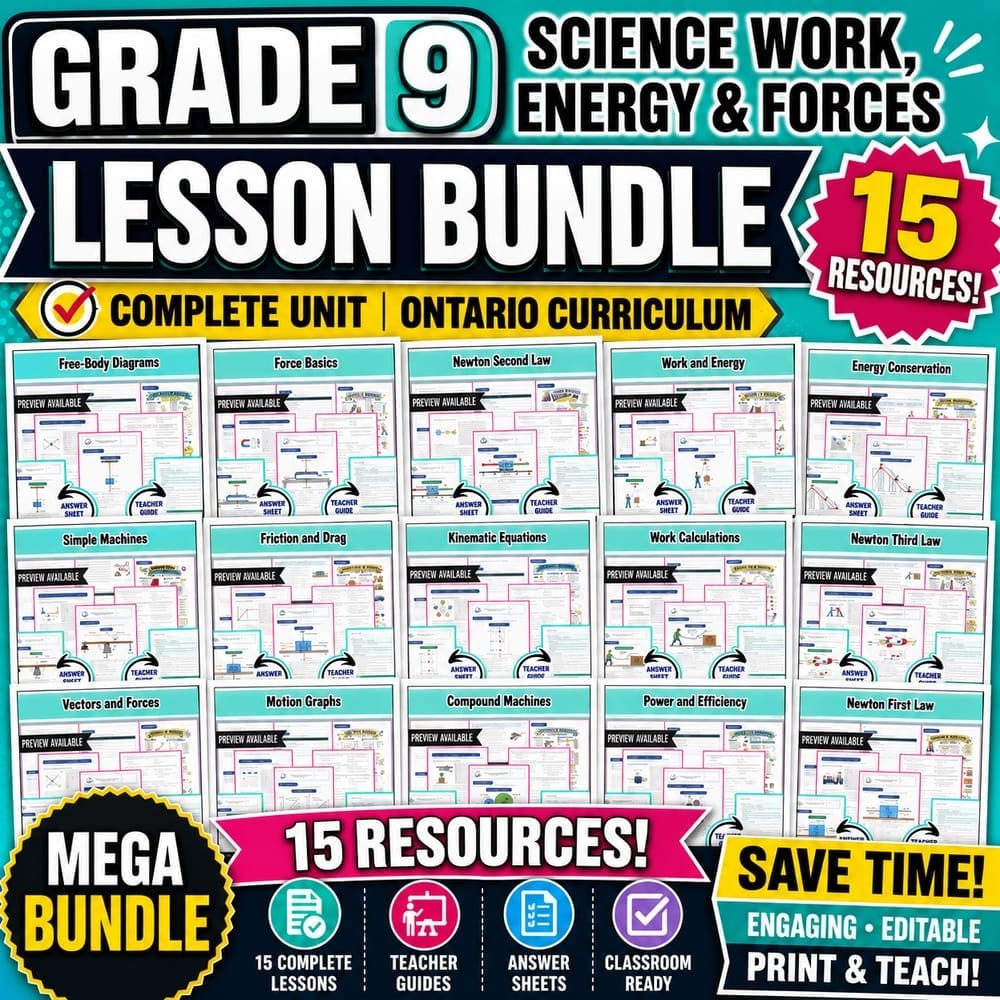


Grade 9 Science Work, Energy & Forces Lesson Bundle | Ontario
$60.00$75.00Save $15.00
Chalk and Compass
·5 followers·13 sales
SubjectScienceGradeGrade 9Pages226 Pages
What’s included
15 worksheets · 226 pages · Save $15.00 (20%) · prices shown inside the bundle
 Grade 9 Free Body Diagrams Worksheet | Net Force & Forces Ontario Science
- Construct a free-body diagram for an isolated object by identifying forces and their directions.
- Use consistent coordinate choices to compute net force and predict acceleration or equilibrium.
- Differentiate common forces on free-body diagrams, including weight, normal force, tension, and friction.
$4.00$5.00 Force Basics Contact vs Non Contact Forces Grade 9 Science Ontario
- Classify forces as contact forces or non-contact forces using common examples.
- Identify the magnitude, direction, and point of application qualitatively in everyday situations.
- Describe action–reaction pairs for forces between two interacting objects.
$4.00$5.00 Grade 9 Newton’s Second Law Worksheet | Force, Mass & Acceleration Ontario
- Explain Newton’s second law using the idea that net force is proportional to mass times acceleration.
- Distinguish mass from weight and connect the difference to acceleration using net force.
- Use vector reasoning (direction of net force and acceleration) and check units in force, mass, and acceleration problems.
$4.00$5.00 Grade 9 Science Work and Energy Worksheet | Ontario Physics Activities
- Define mechanical work as work = force × displacement in the direction of the force (scalar quantity) and apply it to constant forces.
- Distinguish kinetic energy and potential energy and relate them to energy transfer in simple systems.
- Use correct units for work, energy, and power, and interpret energy conservation in isolated systems.
$4.00$5.00 Grade 9 Energy Conservation Worksheet | Mechanical Energy | Ontario Science
- Explain how kinetic and potential energy interconvert in a system when non-conservative forces are negligible.
- Use work done by non-conservative forces to predict changes in total mechanical energy.
- Apply energy conservation ideas to height–speed situations and mass–spring situations.
$4.00$5.00 Grade 9 Simple Machines Worksheet | Mechanical Advantage & Force Ontario
- Compare how simple machines change input force, output force, and displacement.
- Explain the relationship between mechanical advantage and ideal mechanical advantage.
- Identify key parts and use cases of levers, pulleys, inclined planes, wedges, wheel and axle, and screws.
$4.00$5.00 Grade 9 Friction and Drag Worksheet | Resistive Forces Motion | Ontario
- Differentiate static friction and kinetic friction in terms of relative motion and resistance
- Describe how drag depends on speed, medium density, and cross-sectional area
- Use friction coefficients and drag regimes to reason about net force and energy dissipation
$4.00$5.00 Grade 9 Kinematic Equations Constant Acceleration Worksheet | Ontario
- Use constant-acceleration kinematic equations to relate displacement, initial velocity, final velocity, acceleration, and time.
- Apply v = u + at and s = ut + 0.5at² (and related forms) to solve 1D motion problems with consistent sign conventions.
- Distinguish between vertical free-fall and horizontal/projected motion by treating components separately.
$4.00$5.00 Grade 9 Work Calculations Worksheet | Dot Product, Cosine & Ontario Science
- Calculate work using W = F d cos(θ) for constant forces at an angle to displacement.
- Explain why the work from a variable force can be found from the area under a force–distance graph.
- Choose the correct method for computing work in everyday physics situations.
$4.00$5.00 Newton’s Third Law Action Reaction Force Pairs Worksheet Grade 9 Science
- Identify Newton’s third law action–reaction force pairs between two interacting objects
- Explain that action–reaction forces have equal magnitude and opposite direction but act on different objects
- Distinguish internal and external forces when choosing a system for momentum and Newton’s laws
$4.00$5.00
Reviews & Feedback
Loading reviews...
Questions & Answers
Loading questions…
About this bundle
Related categories
Frequently asked questions
Who is Grade 9 Science Work, Energy & Forces Lesson Bundle | Ontario designed for?
Grade 9 Science Work, Energy & Forces Lesson Bundle | Ontario is designed for Grade 9 students and Science learners and can be used in classrooms, homeschool, or independent practice.
How do I download Grade 9 Science Work, Energy & Forces Lesson Bundle | Ontario?
Add it to your cart and complete checkout. After payment, you can download immediately from your account, and you'll also receive a download link by email.
Similar Products

Physics: Forces and Energy Lesson Bundle | Grade 9 Science | Ontario
$36.00$45.00

Grade 11 Science Cross-Discipline Models of Energy, Matter & Force Lesson
$48.00$60.00

Grade 9 Work, Energy & Forces Science Daily Reading Lesson Bundle | Ontario
$48.00$60.00

Grade 9 Science Lesson Group: Energy, Forces & Motion Worksheets Bundle
$36.00$45.00

Grade 8 Fluid Pressure & Forces Science Lesson Bundle: Ontario Worksheet Set
$48.00$60.00