
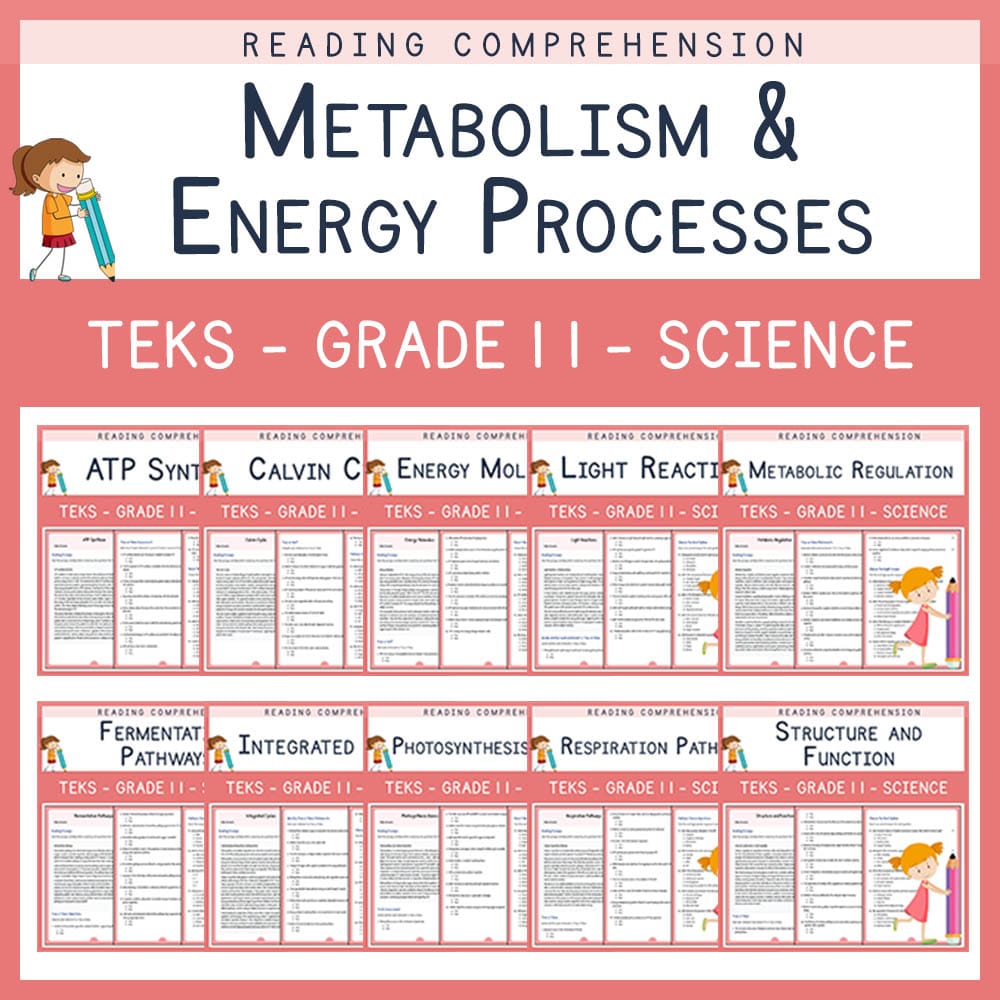
Grade 11 Science | Metabolism & Energy Processes Lesson Bundle | TEKS-aligned
$24.00$30.00Save $6.00
Lumora Learning
·3 followers·12 sales
GradeGrade 11
What’s included
10 worksheets · Save $6.00 (20%) · prices shown inside the bundle
 Grade 11 Science | Integrated Cycles Worksheet | TEKS-Aligned
- Explain how photosynthesis and cellular respiration are interconnected in energy and carbon cycling.
- Identify the biochemical pathways involved in energy transfer within organisms and ecosystems.
- Describe the role of tissue specialization and transport mechanisms in energy distribution in plants.
$2.40$3.00 Grade 11 Science | Fermentation Pathways Worksheet | TEKS-Aligned
- Explain the process of anaerobic fermentation pathways and their importance in energy production.
- Differentiate between lactic acid fermentation and alcoholic fermentation, including their outputs and implications.
- Identify key biochemical reactions involved in fermentation and their role in redox balancing and ATP synthesis.
$2.40$3.00 Grade 11 Science | Light Reactions Worksheet | TEKS-Aligned
- Describe the process of light-dependent reactions in photosynthesis.
- Identify the roles of pigments, electron transport chain, and ATP synthase in light reactions.
- Explain how light energy is converted into chemical energy (ATP and NADPH).
$2.40$3.00 Grade 11 Science | Energy Molecules Worksheet | TEKS-Aligned
- Describe the role of ATP as the primary energy carrier in cells.
- Explain how ATP is produced through substrate-level phosphorylation and oxidative phosphorylation.
- Identify the processes powered by ATP consumption such as endergonic reactions, active transport, and mechanical work.
$2.40$3.00 Grade 11 Science | Respiration Pathways Worksheet | TEKS-Aligned
- Understand the sequential biochemical pathways involved in cellular respiration.
- Identify the key molecules and their roles in glycolysis, Krebs cycle, and electron transport chain.
- Explain how electrons transfer through redox reactions to generate ATP during respiration.
$2.40$3.00 Grade 11 Science | ATP Synthase Worksheet Elena | TEKS-Aligned
- Understand the mechanism by which ATP synthase converts proton gradients into ATP.
- Describe how conformational changes in ATP synthase facilitate energy transfer.
- Explain the linkage between membrane potential, proton pumping, and ATP synthesis.
$2.40$3.00 Grade 11 Science | Calvin Cycle Worksheet | TEKS-Aligned
- Describe the processes and phases of the Calvin cycle in photosynthesis.
- Identify the key enzymes involved in carbon fixation and reduction.
- Explain how ATP and NADPH are utilized in the Calvin cycle.
$2.40$3.00 Grade 11 Science | Photosynthesis Basics Worksheet | TEKS-Aligned
- Understand the fundamental process of Photosynthesis and its key components.
- Identify the differences between light-dependent reactions and the Calvin cycle.
- Explain how cellular respiration is related to photosynthesis and their roles in energy exchange.
$2.40$3.00 Grade 11 Science | Structure and Function Worksheet | TEKS-Aligned
- Understand the relationship between organelle architecture and metabolic efficiency.
- Identify how molecular structures of enzymes and membrane components facilitate cellular processes.
- Describe how surface area and gradients influence reactions within organelles.
$2.40$3.00 Grade 11 Science | Metabolic Regulation Worksheet | TEKS-Aligned
- Understand the mechanisms of enzyme regulation in metabolic pathways.
- Describe how structural modifications influence enzyme activity and pathway function.
- Explain the roles of allosteric modulation, covalent modification, and compartmentalization in metabolism.
$2.40$3.00
Reviews & Feedback
Loading reviews...
Questions & Answers
Loading questions…
About this bundle
Related categories
Frequently asked questions
Who is Grade 11 Science | Metabolism & Energy Processes Lesson Bundle | TEKS-aligned designed for?
Grade 11 Science | Metabolism & Energy Processes Lesson Bundle | TEKS-aligned is designed for Grade 11 students and can be used in classrooms, homeschool, or independent practice.
How do I download Grade 11 Science | Metabolism & Energy Processes Lesson Bundle | TEKS-aligned?
Add it to your cart and complete checkout. After payment, you can download immediately from your account, and you'll also receive a download link by email.
Similar Products

Grade 10 Metabolism & Energy Processes Science Worksheets Bundle | TEKS
$40.00$50.00

Metabolism & Energy Processes Lesson Bundle — Grade 10 Science TEKS
$40.00$50.00

Grade 10 Cell Processes & Energy Science Daily Reading Lesson Bundle | Ontario
$38.40$48.00

Grade 9 Metabolism and Energy Processes Biology Worksheets Bundle | TEKS
$40.00$50.00

Grade 10 Science | Metabolism & Energy Processes Lesson Bundle | TEKS Aligned
$24.00$30.00