
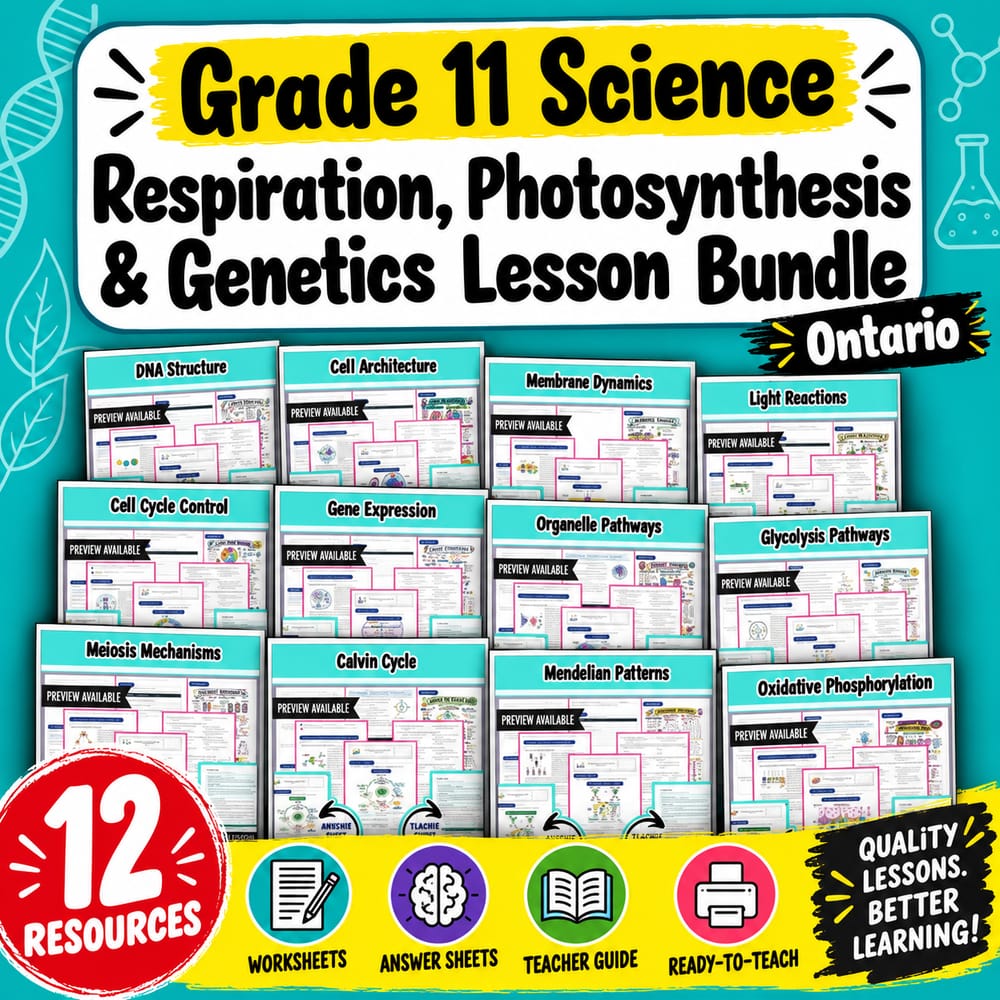


Grade 11 Science Respiration, Photosynthesis & Genetics Lesson Bundle – Ontario
$48.00$60.00Save $12.00
Chalk and Compass
·5 followers·13 sales
SubjectScienceGradeGrade 11
What’s included
12 worksheets · Save $12.00 (20%) · prices shown inside the bundle
 Grade 11 DNA Structure Worksheet | Base Pairing & Gene Information | Ontario
- Explain how nucleotide chemistry and base-pairing specificity support DNA’s double-helix structure.
- Describe antiparallel strand directionality and how it supports replication and transcription.
- Connect chromatin organization and nucleosome packing to accessibility of genetic information.
$4.00$5.00 Grade 11 Cell Architecture Worksheet | Prokaryote vs Eukaryote Cells
- Compare prokaryotic and eukaryotic cell organization using key structural features.
- Explain how organelles and cytoskeletal structures support metabolic and transport functions.
- Use microscopy-derived size and relative scale to interpret cellular architecture.
$4.00$5.00 Grade 11 Membrane Transport & Electrochemical Gradients Worksheet | Ontario
- Explain bilayer structure and how integral and peripheral proteins contribute to transport.
- Compare passive diffusion, facilitated diffusion, osmosis, and primary versus secondary active transport.
- Describe how membrane potential and electrochemical gradients drive ion movement and help maintain homeostasis.
$4.00$5.00 Grade 11 Photosynthetic Light Reactions Worksheet | Electron Flow Ontario
- Describe how photon capture triggers excitation energy transfer in photosystems.
- Explain the sequence of electron transport during light reactions and how it pumps protons.
- Compare noncyclic and cyclic electron flow and predict their effects on ATP, NADPH, and electron return.
$4.00$5.00 Grade 11 Cell Cycle Control & Genome Fidelity Worksheet | Ontario Science
- Describe the main phases of the eukaryotic cell cycle and the transitions controlled by checkpoints.
- Explain how cyclin-dependent kinases (CDKs) and regulatory factors coordinate DNA replication and mitosis.
- Evaluate how DNA damage responses, apoptosis, and tumor suppressor pathways help maintain genome integrity.
$4.00$5.00 Gene Expression Control in Eukaryotes Worksheet | Grade 11 Biology Ontario
- Describe transcription initiation, elongation, and mRNA processing in eukaryotic cells
- Explain how mRNA splicing variants and post-transcriptional control can change protein output
- Connect transcriptional regulation to phenotype differences through promoter/enhancer activity and chromatin remodeling
$4.00$5.00 Grade 11 Protein Targeting & Organelle Transport Worksheet | Ontario Science
- Explain how proteins are targeted to the endoplasmic reticulum, Golgi apparatus, lysosome, and peroxisomes using trafficking signals.
- Describe how vesicular transport connects organelles in the endomembrane system.
- Compare mitochondrial and chloroplast protein import mechanisms and why targeting is compartment-specific.
$4.00$5.00 Grade 11 Regulated Glycolysis to Pyruvate Worksheet | Ontario Science
- Trace the major glycolysis steps from glucose phosphorylation to pyruvate production.
- Explain where substrate-level phosphorylation occurs and how NAD+ is reduced to NADH.
- Describe key regulation points in glycolysis and how they support metabolic control.
$4.00$5.00 Grade 11 Meiosis I & II Worksheet | Genetic Variation | Ontario Science
- Explain how homolog pairing, synapsis, and crossing over during meiosis produce genetic variation
- Describe reductional division in meiosis I and equational division in meiosis II
- Connect chiasmata and kinetochore dynamics to allele segregation and nondisjunction risk
$4.00$5.00 Grade 11 Calvin Cycle Carbon Fixation Worksheet | Photosynthesis Ontario
- Explain the carbon fixation, reduction, and regeneration phases of the Calvin cycle.
- Describe how ATP and NADPH are used to produce triose phosphates from inorganic carbon.
- Compare C3, C4, and CAM strategies and predict their effects on photorespiration and carbon assimilation.
$4.00$5.00
Reviews & Feedback
Loading reviews...
Questions & Answers
Loading questions…
About this bundle
Related categories
Frequently asked questions
Who is Grade 11 Science Respiration, Photosynthesis & Genetics Lesson Bundle – Ontario designed for?
Grade 11 Science Respiration, Photosynthesis & Genetics Lesson Bundle – Ontario is designed for Grade 11 students and Science learners and can be used in classrooms, homeschool, or independent practice.
How do I download Grade 11 Science Respiration, Photosynthesis & Genetics Lesson Bundle – Ontario?
Add it to your cart and complete checkout. After payment, you can download immediately from your account, and you'll also receive a download link by email.
Similar Products

Grade 10 Science Unit Bundle | Energy, Photosynthesis & Cellular Respiration
$16.00$20.00

Cells, Photosynthesis, Respiration & Microbes Lesson Bundle – Grade 10 Science
$48.00$60.00

Grade 10 Science Lesson Bundle: Photosynthesis & Cellular Respiration TEKS
$24.00$30.00

Grade 10 Metabolism & Energy Processes Science Worksheets Bundle | TEKS
$40.00$50.00

Grade 11 Photosynthesis and Respiration Science Lesson Bundle | TEKS
$40.00$50.00