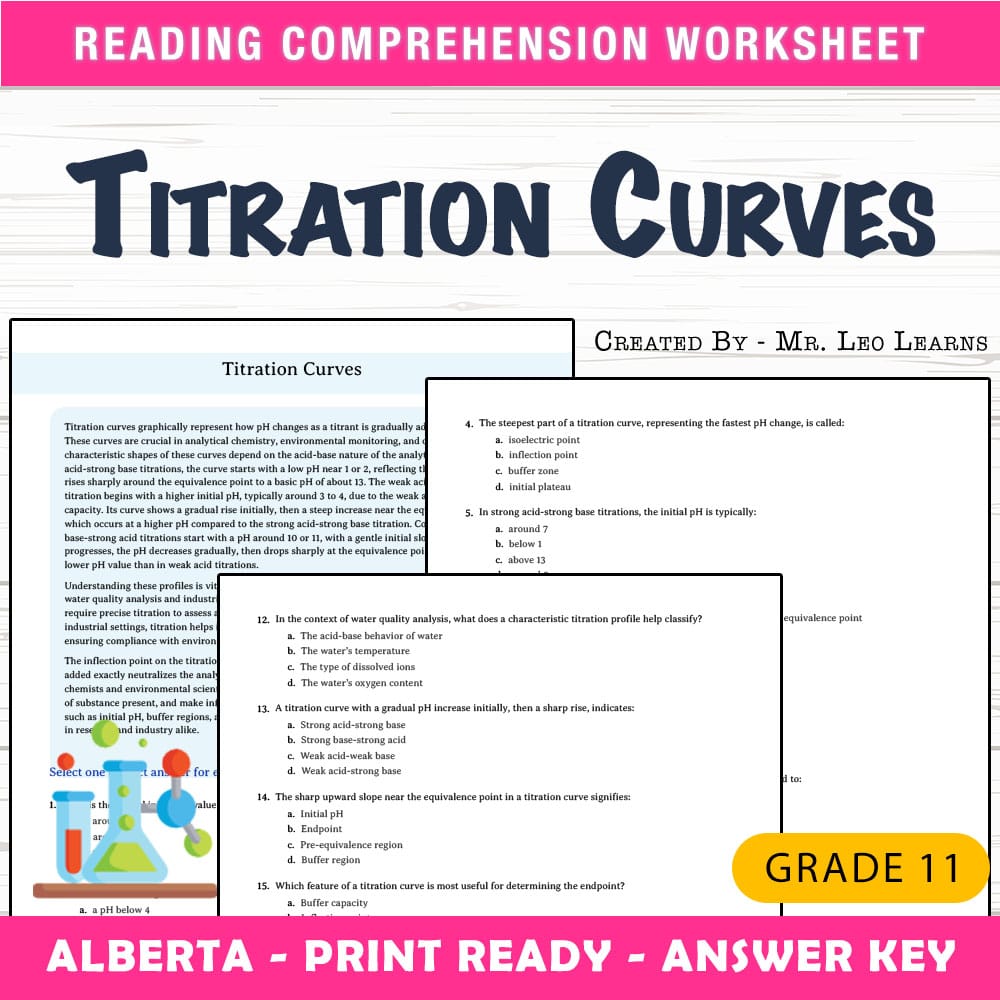
Imagine standing in your classroom, students eagerly working through their practice questions on titration curves, trying to interpret the graphical data and understand how pH changes during titration. Some students may feel overwhelmed by the concept, unsure of how to connect the graph with the underlying chemistry. This worksheet provides a straightforward, printable resource to help clarify those challenging ideas by guiding students through key questions and visual data associated with titration curves, all in a clear and structured format.
What This Resource Helps Students Do
This worksheet is designed to enhance students' understanding of titration curves, emphasizing both the interpretation of graphs and the fundamental concepts behind acid-base titrations. It encourages independent reasoning as students analyze various pH changes during titration, helping them connect the visual data with theoretical principles. Students gain confidence in reading graph trends, identifying key points like the equivalence point and initial pH, and applying this knowledge to typical titration scenarios. By working through multiple choice questions based on a reading passage, students develop critical thinking skills and reinforce their grasp of the topic in a structured, self-guided way.
Inside the PDF
• 1 reading passage explaining titration curves and their significance
• 25 multiple choice questions testing understanding of pH changes and titration concepts
• A clean, print-ready format suitable for immediate classroom use
• Layout optimized for photocopying and student annotation
• An answer key with rubric provided for quick assessment and review
How It Improves Learning
This worksheet improves student learning by offering a clear, visual approach to understanding titration curves, making complex concepts more accessible. The reading passage introduces key ideas in a straightforward way, setting a solid foundation for the multiple choice questions that follow. This structure helps students build confidence in interpreting data and understanding the significance of points like the initial pH and equivalence point. The variety of questions encourages students to apply their knowledge, analyze graphical information, and improve their reasoning skills. It promotes active engagement, helps identify misconceptions, and reinforces crucial chemistry principles through focused practice. The immediate feedback from the answer key supports independent learning and self-assessment, fostering a sense of mastery and clarity.
Core Skills Students Will Develop
- ➡️ Graphical data interpretation in titration scenarios
- ➡️ Understanding acid-base chemistry principles
- ➡️ Identifying key points on titration curves
- ➡️ Applying theoretical concepts to practical problems
Ways Teachers Use This Worksheet
Teachers can incorporate this worksheet into their lesson plans as a class activity, assign it as homework to reinforce understanding, or use it for quick formative assessments during review sessions. It’s also valuable for small-group work, where students can discuss and analyze titration graphs collaboratively. Additionally, the worksheet supports early finishers who need extra practice, or serves as a formative check to gauge how well students grasp the concepts before moving on to more complex topics.
Why This PDF Saves Time
This resource is ready to print and distribute, reducing preparation time for teachers. Its straightforward, print-and-go format ensures consistency in delivery and allows for easy classroom setup. With the included answer key and rubric, teachers can quickly evaluate student progress without additional grading materials or extensive prep work, providing a reliable tool for regular assessment and practice.
End your teaching session with confidence knowing this worksheet is designed to be student-friendly, classroom-ready, and supportive in helping students master the essentials of titration curves. It’s a practical addition to your chemistry toolkit that encourages independent thinking while saving valuable preparation time. 😊