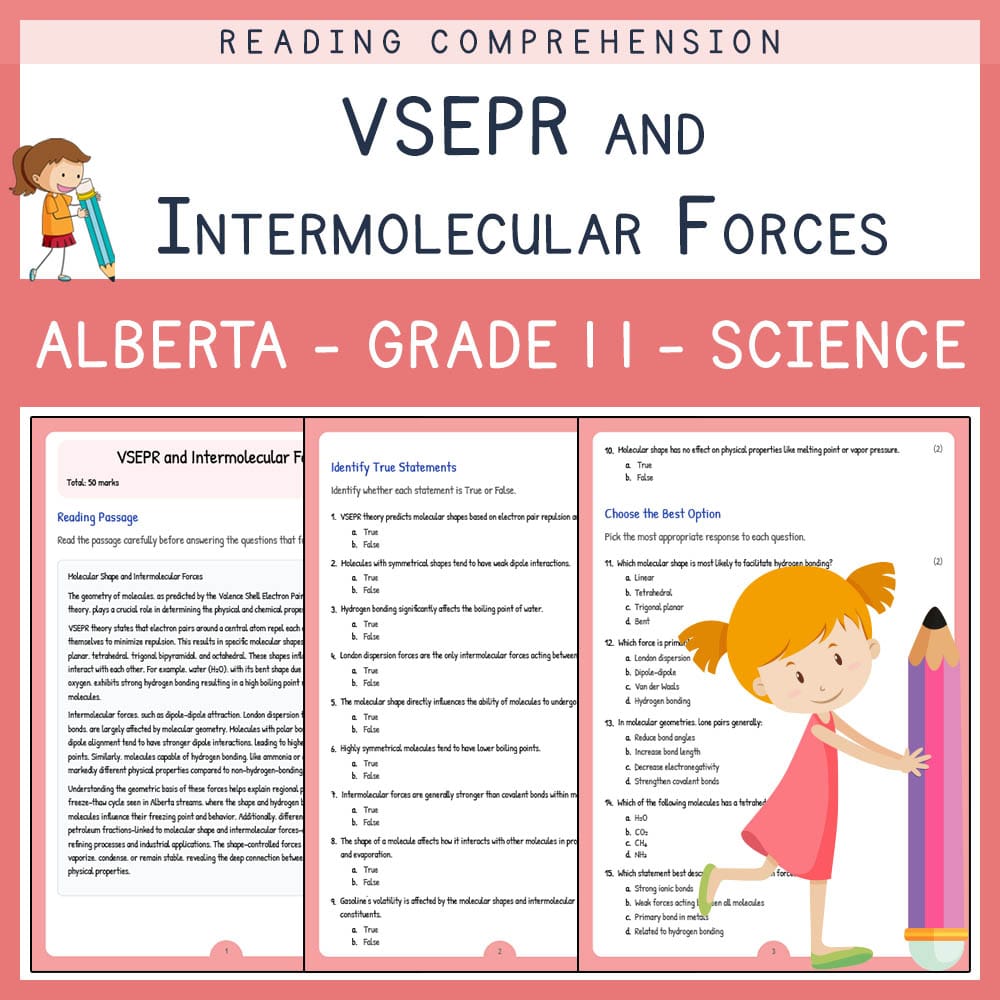
Are your Grade 11 students exploring the intricacies of molecular shape and intermolecular forces?
🌿 This Worksheet Elena is expertly designed to build understanding of VSEPR theory and the forces that influence molecular interactions, aligned with Alberta science standards. Perfect for enhancing both conceptual knowledge and practical skills in high school chemistry, this comprehensive PDF resource equips teachers with ready-to-use materials to support student learning and conceptual mastery.
What's Included
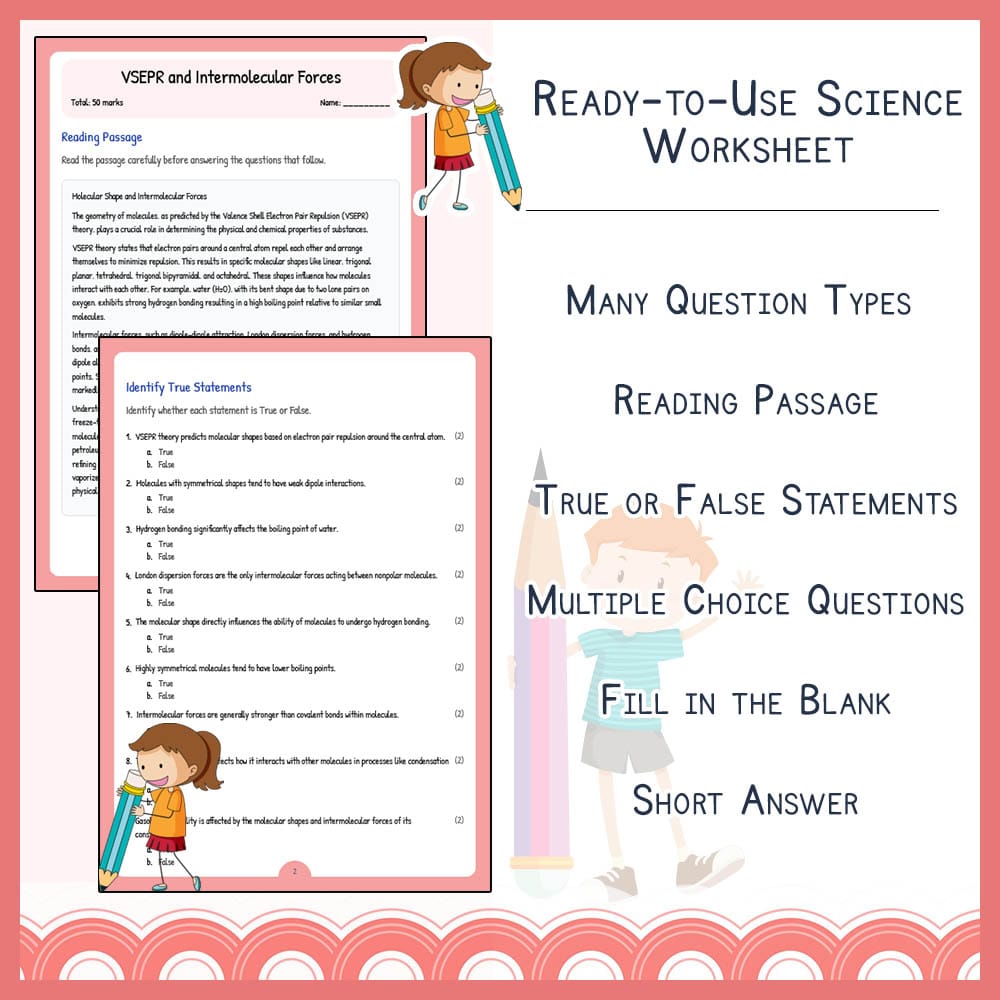
✅ One engaging reading passage that introduces the fundamental concepts of VSEPR and intermolecular forces, with guiding questions to facilitate comprehension
✅ Ten true or false questions that reinforce understanding of key principles like electron pair repulsions and molecular shapes
✅ Five multiple-choice questions focusing on molecular geometry and hydrogen bonding to strengthen conceptual clarity
✅ Five fill-in-the-blank questions designed to deepen understanding of molecular properties and behaviors
✅ Five short-answer questions prompting students to explain and connect concepts critically
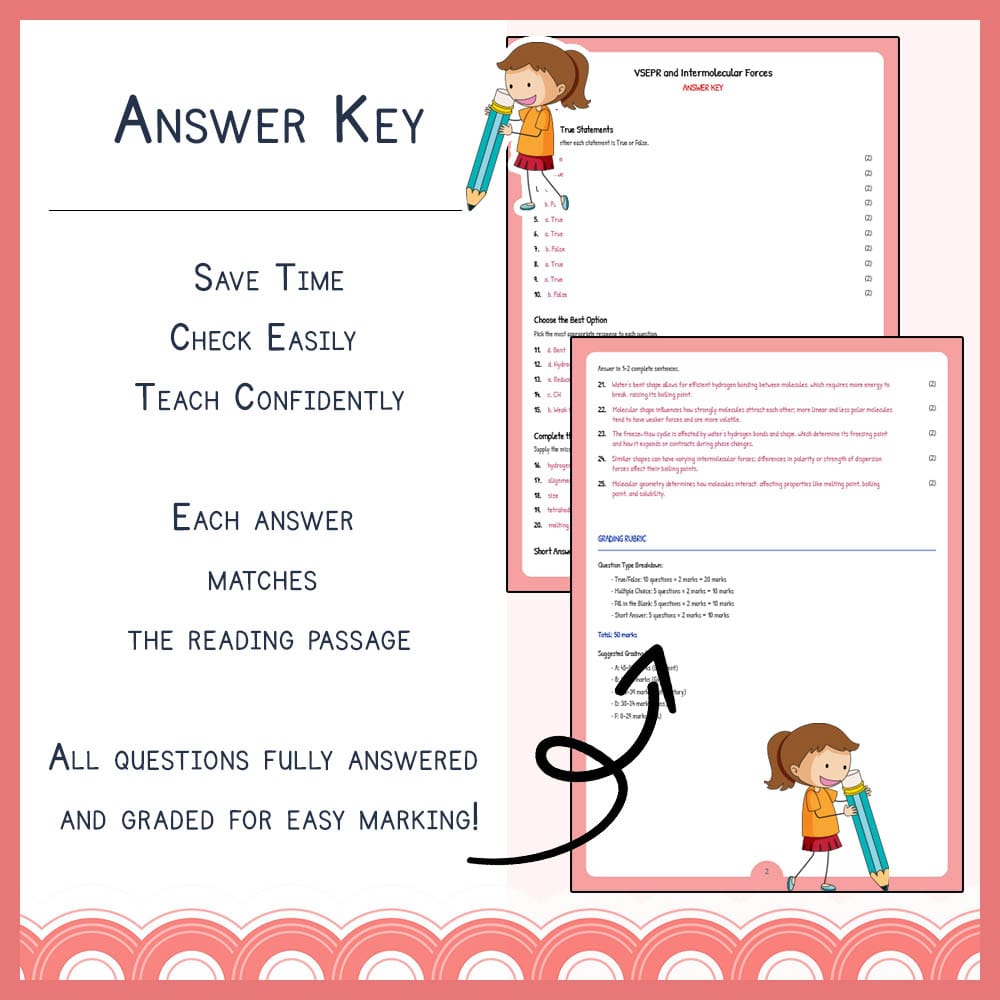
✅ PDF worksheet and accompanying PDF answer key with rubric for easy grading and assessment
✅ All components are neatly organized in PDF format for effortless printing and classroom distribution, with no digital or editable versions included
Key Concepts Covered
➡️ Molecular shape and geometry – Understanding how electron pairs influence the 3D structure of molecules
➡️ VSEPR theory – Explaining how electron pair repulsions determine molecular shape
➡️ Intermolecular forces – Exploring hydrogen bonding, dipole-dipole, and London dispersion forces and their impact on physical properties
➡️ Physical and chemical properties – Linking molecular shape and forces to melting points, boiling points, and solubility
➡️ Real-world applications – Connecting molecular geometry to phenomena such as climate cycles and material properties
Question Types / Formats
1. Reading passage with discussion questions
2. True or false questions
3. Multiple choice questions
4. Fill-in-the-blank sentences
5. Short answer written responses
Teacher Benefits
✅ Offers a comprehensive, ready-to-print PDF worksheet and answer key aligned with Alberta standards
✅ Supports differentiated instruction through varied question types that assess different levels of understanding
✅ Facilitates quick and efficient classroom implementation with a clear, organized format
✅ Helps track student progress with targeted questions that promote critical thinking and application
✅ Enhances student engagement through thoughtfully designed activities connecting theory to real-world phenomena
Student Benefits
✅ Encourages deep understanding of molecular shapes and forces essential for advanced chemistry studies
✅ Develops critical thinking and explanatory skills through varied response formats
✅ Reinforces learning with immediate feedback via answer keys and rubrics
✅ Builds confidence in applying theoretical knowledge to practical and real-world situations
✅ Prepares students for lab work, exams, and future science coursework with solid conceptual foundations
Perfect For
➡️ In-class instruction and guided lessons
✅ Homework and reinforcement activities
➡️ Substitutes or review sessions
✅ Study guides for exam preparation
➡️ Science clubs or enrichment programs
✅ Classroom independent or collaborative projects
Ready to enhance your Science teaching? Download this dynamic worksheet today and inspire your students to master molecular shape principles and intermolecular forces! 🚀