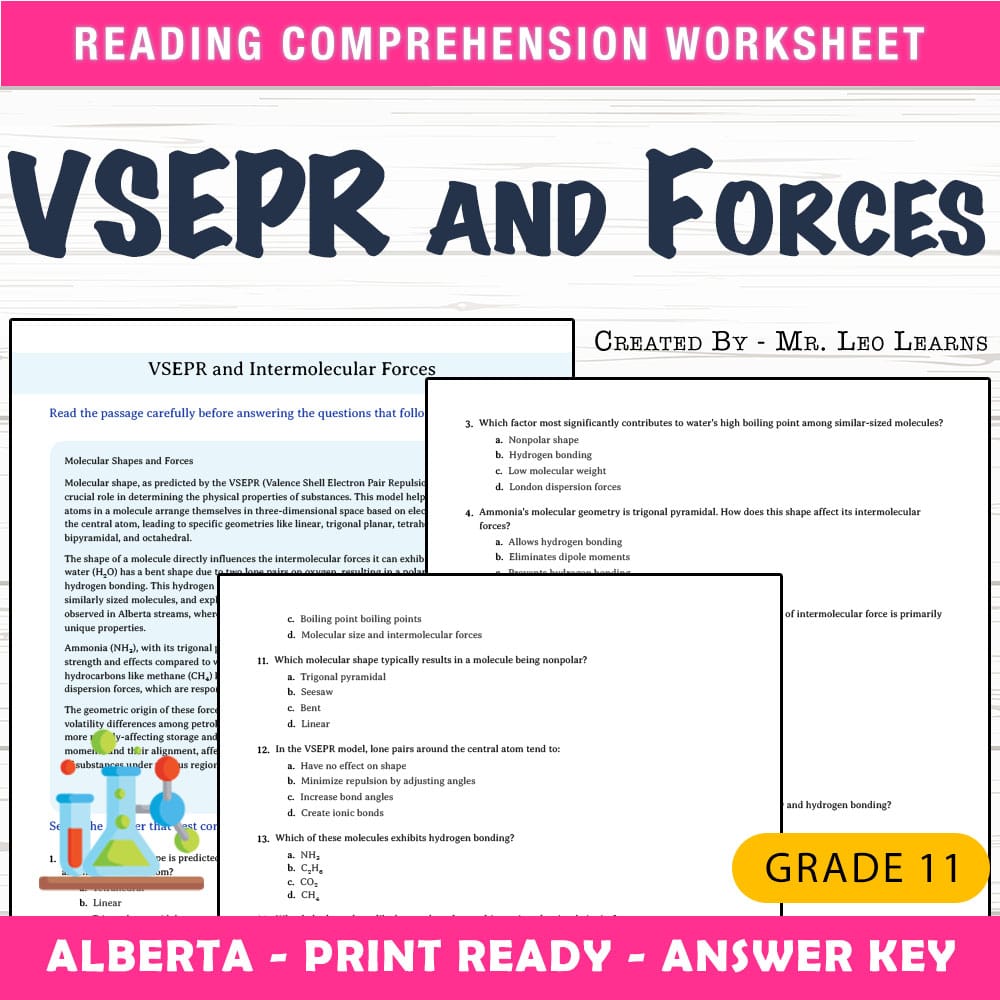
Imagine walking into your classroom and seeing students focused intently on a VSEPR and intermolecular forces worksheet, trying to identify molecular shapes and understand the forces between molecules. This worksheet provides a straightforward, print-ready resource to help students engage with complex chemistry concepts confidently. It simplifies the process of practicing multiple-choice questions related to molecular geometry and intermolecular interactions, offering structured questions that guide students step-by-step through key topics.
What This Resource Helps Students Do
This worksheet is designed to deepen students' understanding of molecular shapes predicted by the VSEPR model and how intermolecular forces influence properties like boiling point, solubility, and state of matter. It encourages independent thinking by presenting questions that challenge students to apply their knowledge of electron pair repulsions, molecular geometry, and hydrogen bonding. By working through these multiple-choice questions, students reinforce their comprehension of abstract concepts in a clear and accessible way, building confidence in their ability to analyze molecular structures and interactions.
Inside the PDF
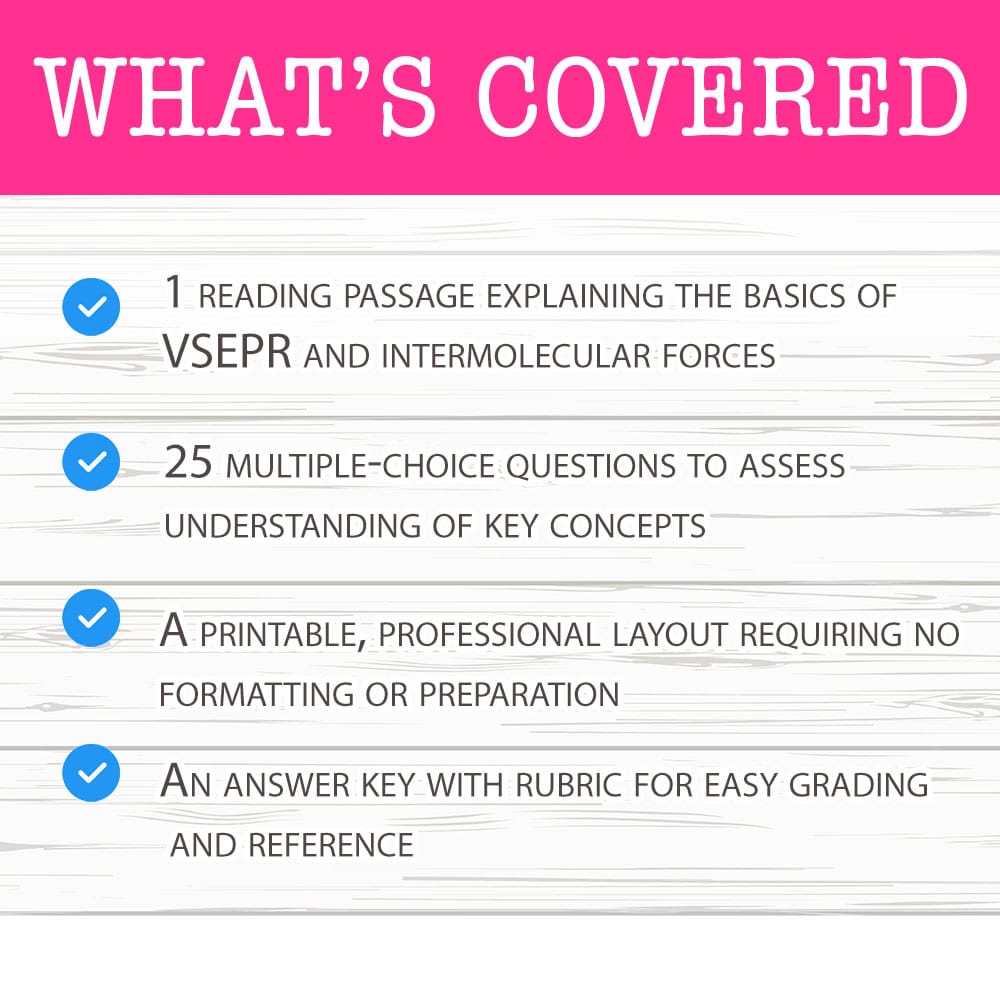
• 1 reading passage explaining the basics of VSEPR and intermolecular forces
• 25 multiple-choice questions to assess understanding of key concepts
• A printable, professional layout requiring no formatting or preparation
• An answer key with rubric for easy grading and reference
• Designed for quick photocopying and classroom use
How It Improves Learning
This worksheet promotes clarity by breaking down complex topics into manageable questions that build on each other, helping students move from basic recognition to applying concepts. The multiple-choice format encourages critical thinking, as students must analyze each option carefully before selecting their answer. The questions are crafted to reinforce core ideas like molecular shape prediction via VSEPR and the role of hydrogen bonds, anchoring these fundamental ideas in practical examples. The answer key with rubric provides immediate feedback, helping students recognize areas for improvement and solidify their understanding. Overall, this resource transforms abstract ideas into concrete knowledge, empowering students to approach chemistry problems with greater confidence and reasoning skills.
Core Skills Students Will Develop
- ➡️ Understanding molecular geometry and electron pair repulsion
- ➡️ Applying VSEPR theory to predict molecular shapes
- ➡️ Understanding intermolecular forces and hydrogen bonding
- ➡️ Analyzing molecular structure and properties based on questions
Ways Teachers Use This Worksheet
This worksheet is a versatile tool that can be used as classwork to reinforce lecture material, assigned as homework for independent practice, or employed as an assessment to gauge student understanding. It works well for small-group review sessions or as an early finisher activity, providing meaningful practice while saving prep time. Many teachers incorporate it into review sessions before exams, ensuring students are familiar with core concepts in a structured format. Its print-and-go design makes it easy to implement immediately in any classroom setting, supporting ongoing learning and mastery of VSEPR and intermolecular forces.
Why This PDF Saves Time
The ready-to-print format of this worksheet means teachers can effortlessly incorporate it into their lesson plans without concern about formatting or content creation. Its straightforward layout allows for quick photocopying and distribution, streamlining classroom management. The included answer key ensures grading is efficient and consistent, providing clear benchmarks for evaluating student responses. This resource reduces preparation time while maintaining high-quality practice opportunities, making it a reliable tool for immediate classroom use.
Remember, this worksheet is fully prepared to support your teaching of molecular shapes and forces. It’s classroom-friendly, grade-appropriate, and designed to foster student confidence in understanding complex chemistry concepts. Simply print, distribute, and watch your students engage with these important ideas. 😊