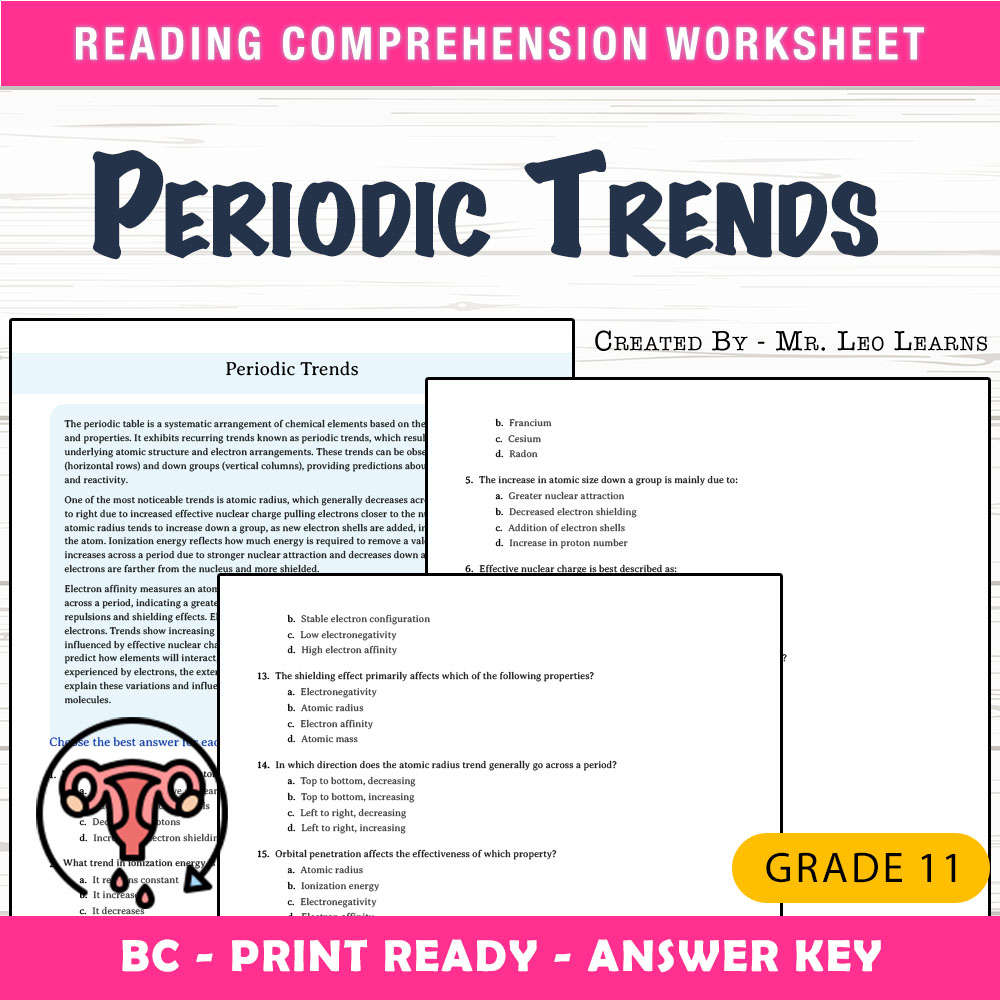
Imagine stepping into your classroom as students settle into their seats, ready to tackle complex concepts about the periodic table. Some students may feel unsure about how atomic size and ionization energy relate to the periodic trends, leading to hesitation during discussions. This worksheet provides a clear, straightforward way to reinforce their understanding through focused multiple-choice questions that align with the BC science standards. It encourages independent thinking and helps clarify these fundamental concepts, setting students up for success in their assessments and deeper learning.
What This Resource Helps Students Do
This worksheet is designed to guide students through key aspects of periodic trends, focusing on atomic radius and ionization energy. By engaging with carefully crafted questions, students develop their ability to analyze how these trends vary across periods and down groups. The MCQs prompt students to connect theoretical knowledge with visual patterns on the periodic table, fostering critical thinking and recall. Additionally, this resource supports self-practice, enabling students to identify areas for improvement and build confidence in their grasp of the periodic table’s organization and underlying principles.
Inside the PDF
• 1 reading passage introducing periodic table concepts
• 25 multiple-choice questions focusing on periodic trends
• An easy-to-use, print-ready layout requiring no setup
• A comprehensive answer key with rubric to facilitate quick assessment
• Designed for efficient photocopying and classroom distribution
How It Improves Learning
This worksheet enhances student understanding by providing targeted questions that reinforce key concepts about periodic trends. As students read the passage and answer questions, they clarify their understanding of why atomic radius decreases across periods or why ionization energy increases up a group. The multiple-choice format encourages engagement and active reasoning, prompting students to think critically about relationships within the periodic table. Repeated practice with these questions helps solidify their knowledge, making it easier to retrieve and apply in exams or further lessons. The clear layout and answer key streamline the review process, saving preparation time and enabling quick feedback, which supports ongoing learning and confidence building.
Core Skills Students Will Develop
- ➡️ Understanding periodic table trends
- ➡️ Analyzing relationships between atomic structure and element properties
- ➡️ Applying concepts to interpret periodic data
- ➡️ Using reasoning to eliminate incorrect options
Ways Teachers Use This Worksheet
This resource can be effectively used as part of a classroom lesson, as homework to reinforce class learning, or in small-group review sessions. It serves well as an assessment tool to gauge understanding after teaching the periodic table or as a quick practice for students preparing for tests. Teachers can also use it to provide extra practice for students who need additional reinforcement or as early finisher activities to keep learners engaged and productive. Its adaptable format makes it suitable for multiple instructional contexts, providing flexible support for diverse classroom needs.
Why This PDF Saves Time
Designed for immediate use, this print-ready PDF requires no additional preparation. Teachers can simply photocopy and distribute the worksheet, making it a reliable resource for busy schedules. The included answer key allows for quick, consistent assessment without the need for creating new questions, helping teachers save valuable time in planning and grading. Its straightforward layout ensures clarity and ease of use, reducing administrative workload and allowing more focus on student interaction and instruction.
Remember, this worksheet is ready to print and implement directly into your classroom routine. It helps students build a solid understanding of periodic trends with confidence, making your teaching more effective and your students more prepared. 😊