
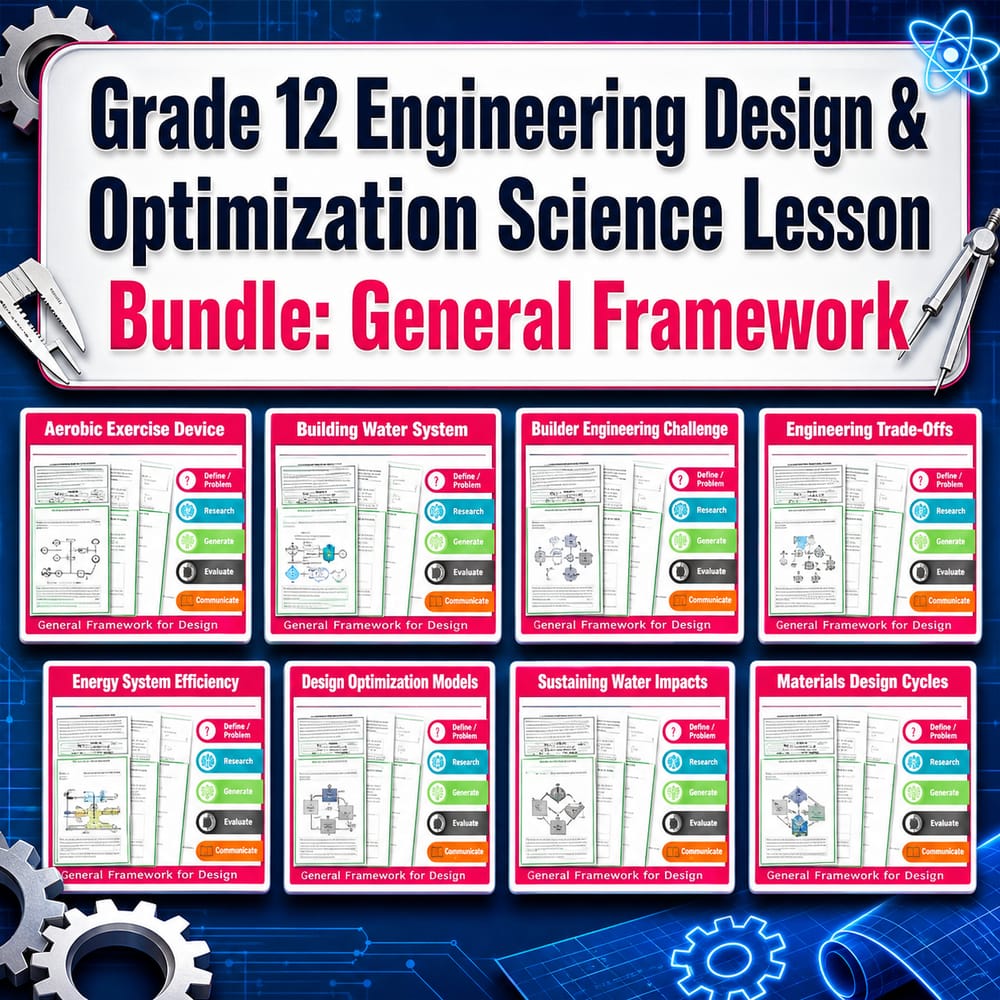
Grade 12 Engineering Design & Optimization Science Lesson Bundle: General Framework
$32.00$40.00Save $8.00
Prism Point Learning
·2 followers·13 sales
SubjectScienceGradeGrade 12
What’s included
8 worksheets · Save $8.00 (20%) · prices shown inside the bundle
 Materials Selection Criteria Assessment | Standards-Aligned Grade 12 Science
- Explain how material properties (strength, toughness, corrosion resistance, thermal conductivity, and environmental durability) map to functional engineering requirements.
- Evaluate how operating conditions and failure risks (fatigue, moisture, and chemical exposure) influence materials selection.
- Compare materials such as aluminum, steel, and polymer composites using life-cycle trade-offs and safety margins.
$4.00$5.00 Modeling Under Constraints Assessment for Grade 12 Science | Standards-Aligned
- Explain how models help predict outcomes when constraints limit geometry, materials, power, or time
- Use simplified relationships to reason about how changes in inputs affect outputs in scientific/engineering systems
- Evaluate uncertainty and assumptions when interpreting model predictions for reliability and design tolerances
$4.00$5.00 Societal Engineering Outcomes Assessment | General Grade 12 Science
- Explain how engineered safety standards relate known failure modes to public risk outcomes.
- Analyze how reliability and maintenance planning affect long-term costs, trust, and community resilience.
- Evaluate how sustainability decisions influence lifecycle resource use, emissions, and end-of-life outcomes.
$4.00$5.00 Engineering Trade-Offs Assessment for Grade 12 Science – Standards-Aligned
- Explain how engineering trade-offs involve balancing cost, performance, and risk using data and reasoning
- Evaluate design alternatives by considering long-term operating and maintenance effects, not just initial purchase price
- Use models or assumptions to compare options and justify a recommended choice
$4.00$5.00 Energy System Efficiency Assessment | General Standards Grade 12 Science
- Explain energy system efficiency and identify common loss pathways in real systems
- Evaluate how design choices (insulation, surface area, and control systems) affect useful energy output
- Apply the efficiency concept to a solar-thermal collector by linking absorber and surface properties to stored thermal energy
$4.00$5.00 Design Optimization Metrics Assessment for Grade 12 Science | Standards-Aligned
- Identify measurable performance metrics and explain how they connect to engineering goals and constraints
- Evaluate how optimization trade-offs and design margins help systems remain effective under varying conditions
- Use metrics to justify design choices and communicate reasoning using scientific language
$4.00$5.00 Technology Choice Impacts Assessment | General Grade 12 Science Standards
- Explain how technology choices affect efficiency, safety, sustainability, and reliability in real-world systems.
- Evaluate trade-offs among efficiency, safety, sustainability, and reliability when selecting or upgrading technology.
- Use evidence-based reasoning to justify technology decisions for systems operating under real conditions.
$4.00$5.00 Iterative Design Cycles Assessment | General Standards Grade 12 Science
- Explain how iterative design cycles use criteria, constraints, and evidence to improve a solution.
- Identify the difference between early assumptions and evidence-based revisions in an engineering design process.
- Apply iterative design reasoning to a real-world product problem, such as preventing leaks in a sports water bottle lid.
$4.00$5.00
Reviews & Feedback
Loading reviews...
Questions & Answers
Loading questions…
About this bundle
Related categories
Frequently asked questions
Who is Grade 12 Engineering Design & Optimization Science Lesson Bundle: General Framework designed for?
Grade 12 Engineering Design & Optimization Science Lesson Bundle: General Framework is designed for Grade 12 students and Science learners and can be used in classrooms, homeschool, or independent practice.
How do I download Grade 12 Engineering Design & Optimization Science Lesson Bundle: General Framework?
Add it to your cart and complete checkout. After payment, you can download immediately from your account, and you'll also receive a download link by email.
Similar Products

Grade 12 Engineering Design Optimization Science Lesson Bundle: General
$32.00$40.00

Grade 8 Engineering Design: Science Lesson Bundle (General Framework)
$14.40$18.00

Grade 9 Science Engineering Design Lesson Bundle | NGSS Framework
$16.00$20.00

Grade 7 Science Structural Engineering Design & Materials Lesson Bundle |Ontario
$48.00$60.00

Grade 9 Engineering Design Cycle Science Lesson Bundle: General Framework
$24.00$30.00