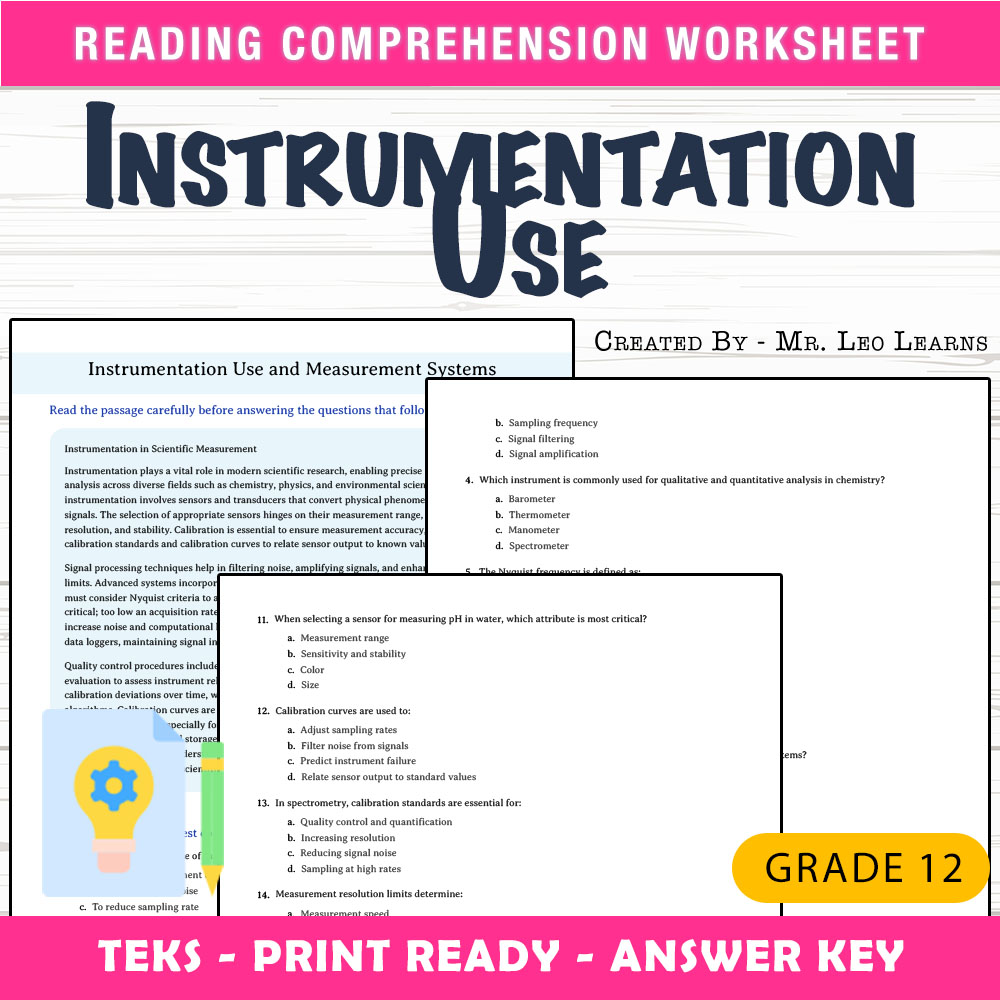
Imagine entering a classroom where students are eager to understand complex scientific measurement concepts, but quickly become overwhelmed by technical jargon and confusing explanations. As a teacher, guiding them to grasp the intricacies of instrumentation use and measurement systems can be challenging. This printable PDF worksheet provides a straightforward, structured approach to help students master essential concepts related to scientific data collection and measurement accuracy. With focused questions and real-world scenarios, it breaks down the topic into manageable steps, offering clarity and confidence during guided practice or independent review.
What This Resource Helps Students Do
This worksheet encourages students to actively engage with key aspects of instrumentation and measurement systems required by the TEKS standard. It supports skills such as understanding calibration processes, identifying sampling criteria, and interpreting measurement data. The multiple-choice questions are designed to reinforce foundational knowledge and develop critical thinking, such as distinguishing between proper calibration methods and understanding the importance of sample criteria. As students work through the worksheet, they build confidence in applying theoretical concepts to practical scientific scenarios. The question format promotes independent problem-solving, while the detailed passage helps clarify complex ideas in an accessible manner.
Inside the PDF
• 25 structured questions designed for step-by-step understanding
• A print-ready format that requires no preparation
• PDF answer key with rubric for easy grading
• Layout optimized for copying and classroom distribution
How It Improves Learning
This worksheet provides a clear pathway for students to develop a solid understanding of instrumentation use and measurement systems. The structured questions guide students to think critically about how data is collected and measured accurately. The inclusion of real-world scenarios encourages application of concepts, helping students connect textbook knowledge to practical laboratory and field settings. The process of answering multiple-choice questions builds their reasoning skills, enabling them to differentiate between effective and flawed measurement practices. As students progress through the worksheet, they gain self-assurance and clarity, reducing confusion and fostering a sense of mastery in scientific measurement techniques.
Core Skills Students Will Develop
- ➡️ Understanding calibration procedures and their importance
- ➡️ Analyzing data sampling and avoiding aliasing
- ➡️ Interpreting measurement system data and scenarios
- ➡️ Applying measurement concepts to real-world scientific experiments
Ways Teachers Use This Worksheet
This worksheet is a versatile resource for use during a variety of instructional moments. It works well as classwork to reinforce new content, homework for independent practice, or an assessment tool to gauge student understanding. Teachers often incorporate it into small-group activities or use it as a review in preparation for exams. It’s especially helpful for early finishers or as a reinforcement activity after lessons on instrumentation, data collection, or measurement accuracy. Its clear format makes it easy to assign and review in a classroom setting, ensuring consistency across lessons.
Why This PDF Saves Time
The printable format of this worksheet means no additional preparation is needed—teachers can distribute it immediately. Its structured layout simplifies photocopying and classroom organization. The included answer key with rubric streamlines grading, helping teachers provide prompt, reliable feedback. With its ready-to-use design, this PDF reduces planning time and offers a dependable tool for consistent instruction and assessment of measurement skills in a high school science classroom.
Designed for clarity and classroom practicality, this worksheet is ready to print and use to help students deepen their understanding of instrumentation and measurement systems. It provides a solid foundation for mastering scientific data collection, enabling students to approach measurement tasks with confidence and accuracy. This resource is an essential addition to your science teaching toolkit. 😊