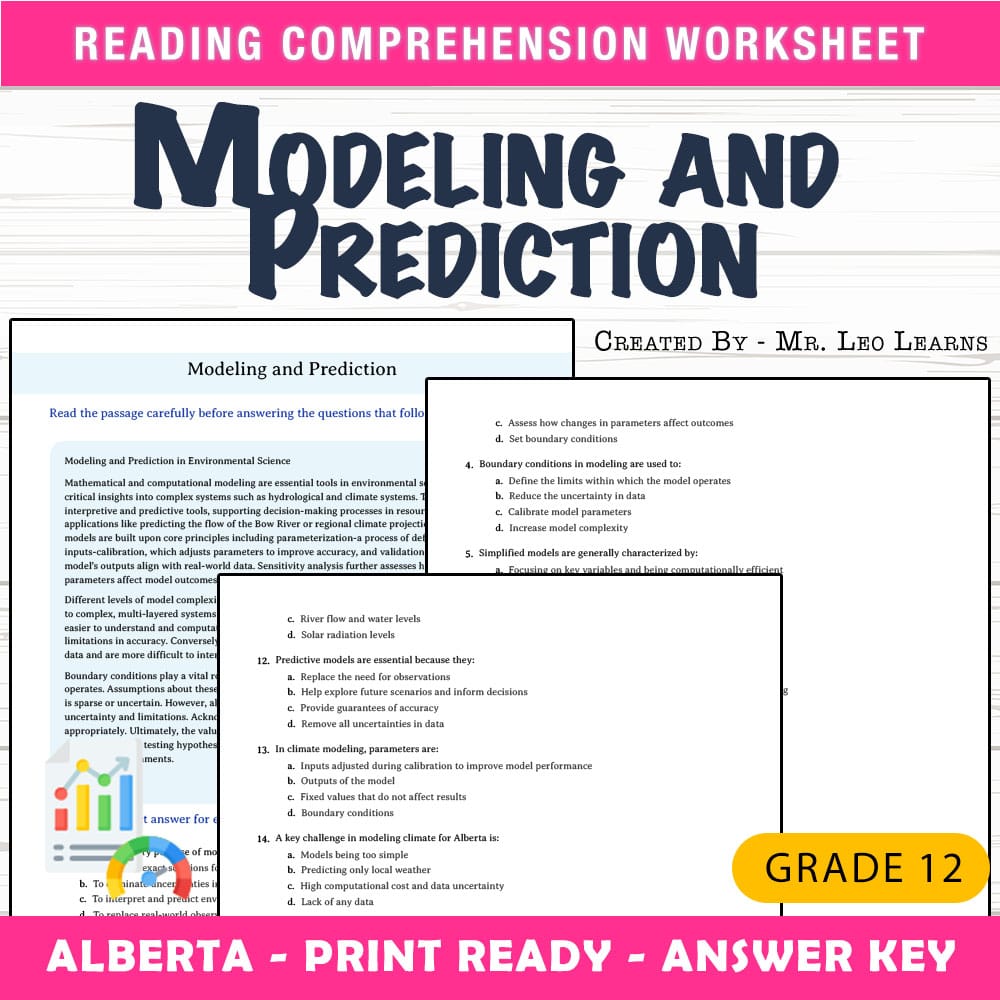
In a busy classroom setting, teachers often seek resources that support student understanding and foster confidence in complex topics like modeling and prediction in science. As students work through abstract concepts, they may find it challenging to grasp how models are developed and used effectively in environmental science. This worksheet provides a clear, structured approach to reinforce these key ideas through multiple-choice questions, helping students develop critical thinking and practical skills while engaging with real-world applications.
What This Resource Helps Students Do
This worksheet guides students through essential concepts in environmental modeling and prediction, promoting both comprehension and independent application. It helps students understand the purpose of mathematical and computational models, encouraging them to analyze how models simulate environmental systems. The multiple-choice format supports active learning by prompting students to evaluate different processes involved in creating and refining models. By working through these questions, students strengthen their ability to interpret scientific data, comprehend the role of predictions in environmental management, and grasp the importance of adjusting models for accuracy. This resource also fosters confidence as students learn to connect theoretical concepts with practical scenarios, preparing them for classroom discussions and assessments.
Inside the PDF
• 1 reading passage providing context for modeling and prediction in environmental science
• 25 multiple-choice questions designed to reinforce understanding
• A print-ready format that requires no additional preparation
• Clear, well-organized layout for easy photocopying and classroom distribution
How It Improves Learning
This worksheet enhances students’ understanding by breaking down complex ideas into manageable questions that encourage critical thinking. The reading passage offers foundational information, setting the stage for the multiple-choice questions, which challenge students to apply their knowledge actively. The questions are crafted to target key skills like identifying the main purpose of models, understanding the process of model calibration, and recognizing different types of environmental predictions. As students navigate these questions, they gain clarity on the role of models and develop reasoning skills necessary to interpret scientific data accurately. The variety of question formats also aids in reinforcing content and building confidence, ensuring students are better prepared for assessments and real-world problem solving.
Core Skills Students Will Develop
- ➡️ Analyzing the purpose and function of models in science
- ➡️ Interpreting data and scientific information
- ➡️ Understanding the process of model calibration and adjustment
- ➡️ Applying critical thinking to scientific scenarios
Ways Teachers Use This Worksheet
This worksheet is versatile in the classroom, supporting a variety of instructional strategies. It can serve as a classwork activity to introduce key concepts or as an independent practice for students to reinforce their learning after a lesson. Teachers also use it for homework assignments, review sessions, or small-group work to deepen understanding. Additionally, the worksheet provides an effective assessment tool to gauge student progress and identify areas needing further explanation. Its ready-to-use format simplifies lesson planning and offers a consistent resource that can be reused for multiple classes or review sessions.
Why This PDF Saves Time
The printable PDF is designed for immediate use, reducing the time teachers spend preparing materials. Its clear, straightforward layout allows for quick photocopying and distribution, ensuring minimal planning needed. The included answer key with rubric offers a reliable way to assess student performance, saving valuable grading time. The print-and-go format supports seamless integration into busy schedules, providing a dependable resource that maintains consistency in delivering core content.
Overall, this worksheet offers a practical and classroom-friendly tool for strengthening students’ understanding of modeling and prediction in environmental science. Its clear structure, targeted questions, and ready-to-use design make it an ideal addition to any science curriculum. Teachers can confidently implement this resource to support student success with minimal preparation, knowing that it aligns with key learning objectives and promotes active engagement. 😊