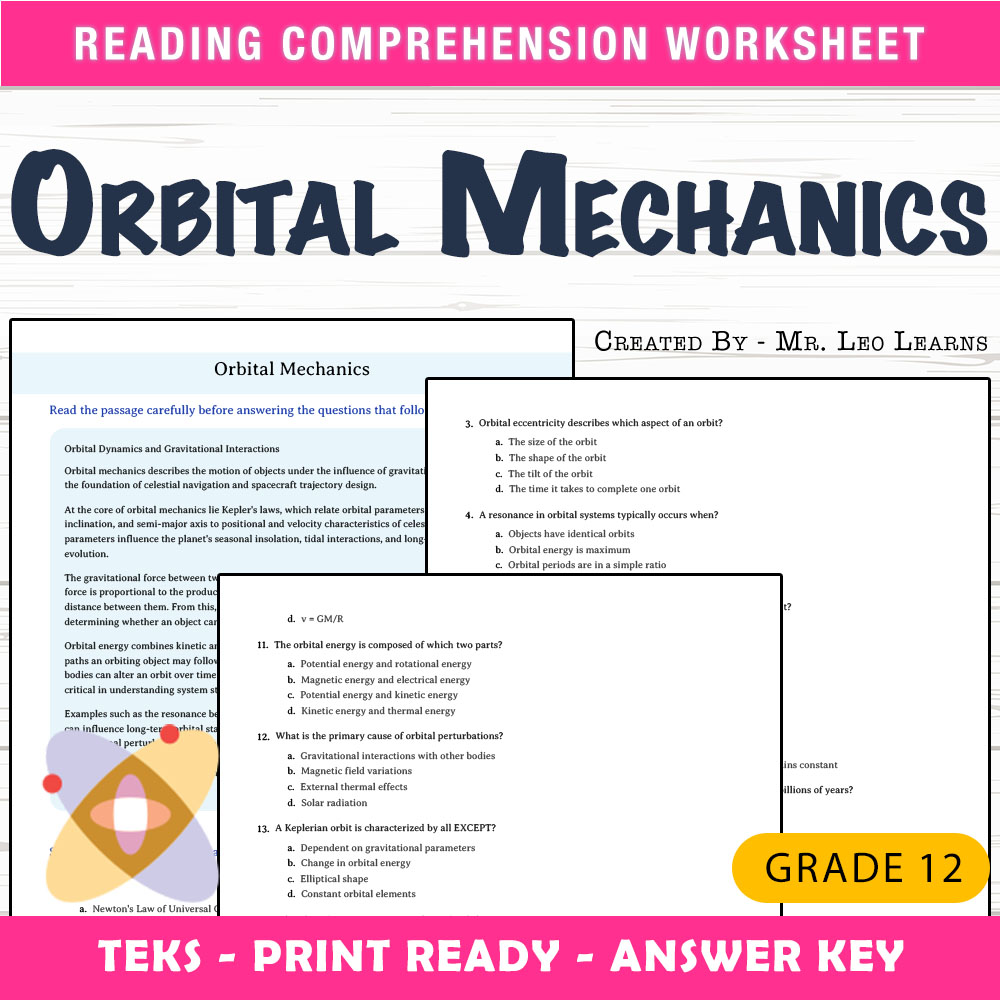
Imagine walking into your classroom and seeing students grappling with complex concepts about the movement of celestial bodies. Some may be confused about how planets orbit or why objects require different velocities to escape planetary gravity. This worksheet offers a straightforward, print-and-go resource designed to clarify these topics, providing clear explanations and focused practice to help students deepen their understanding of orbital mechanics.
What This Resource Helps Students Do
This worksheet guides students in exploring the fundamental principles that govern how objects move in space under gravitational influence. It encourages active engagement through reading passages, followed by multiple-choice questions that reinforce key concepts. The format supports independent learning and helps students develop critical reasoning skills related to orbital motion, laws of planetary motion, and escape velocity. By working through these questions, students can strengthen their ability to analyze complex scenarios and apply theoretical knowledge to real-world astrodynamics.
Inside the PDF
• A detailed reading passage explaining orbital mechanics and relevant laws
• 25 multiple-choice questions assessing comprehension and application
• A printable, ready-to-use format that requires no additional preparation
• An answer key with rubric included for quick assessment
• Designed layout for easy photocopying and classroom distribution
How It Improves Learning
This worksheet enhances student understanding by combining knowledge acquisition with active practice. The reading passage introduces core concepts clearly, helping students grasp how gravitational forces influence orbital motion and why laws such as Kepler's are fundamental. The multiple-choice questions reinforce students' comprehension and encourage reasoning through real-world applications. As they work through each question, students are guided from initial confusion to confident understanding, with opportunities to reflect on their answers and deepen their grasp of complex physics principles. The straightforward design ensures students can focus on learning without distractions, making the concepts accessible and reinforcing retention.
Core Skills Students Will Develop
- ➡️ Understanding gravitational forces and their effects on orbiting objects
- ➡️ Applying Kepler's laws to planetary motion
- ➡️ Calculating escape velocities from planetary surfaces
- ➡️ Interpreting diagrams and data related to orbital paths
Ways Teachers Use This Worksheet
This worksheet can serve multiple instructional purposes: it’s ideal for classroom activities, homework assignments, or formative assessments that gauge student understanding. Teachers often use it for small-group discussions or independent review after delivering lectures on planetary motion. It also functions well as an early finisher challenge or reinforcement tool, helping students consolidate complex information in a structured, supportive manner. The printable format makes it easy to incorporate into existing lesson plans and provides a consistent resource for student practice over time.
Why This PDF Saves Time
The detailed, print-ready PDF offers a ready-to-use resource that requires no additional prep. It ensures teachers have a reliable, consistent tool for delivering focused practice on orbital mechanics topics. The clear formatting allows for quick photocopying and distribution, saving valuable planning time. With a comprehensive answer key included, teachers can efficiently assess student progress and provide immediate feedback without creating new materials from scratch.
Ultimately, this worksheet is designed to support student success with a classroom-friendly, practical resource. It helps students build confidence and mastery in understanding the laws and principles of orbital mechanics, equipping them with skills that are essential for more advanced study in physics and astronomy. Ready to print and use immediately, it’s a dependable addition to any high school science curriculum. 😊