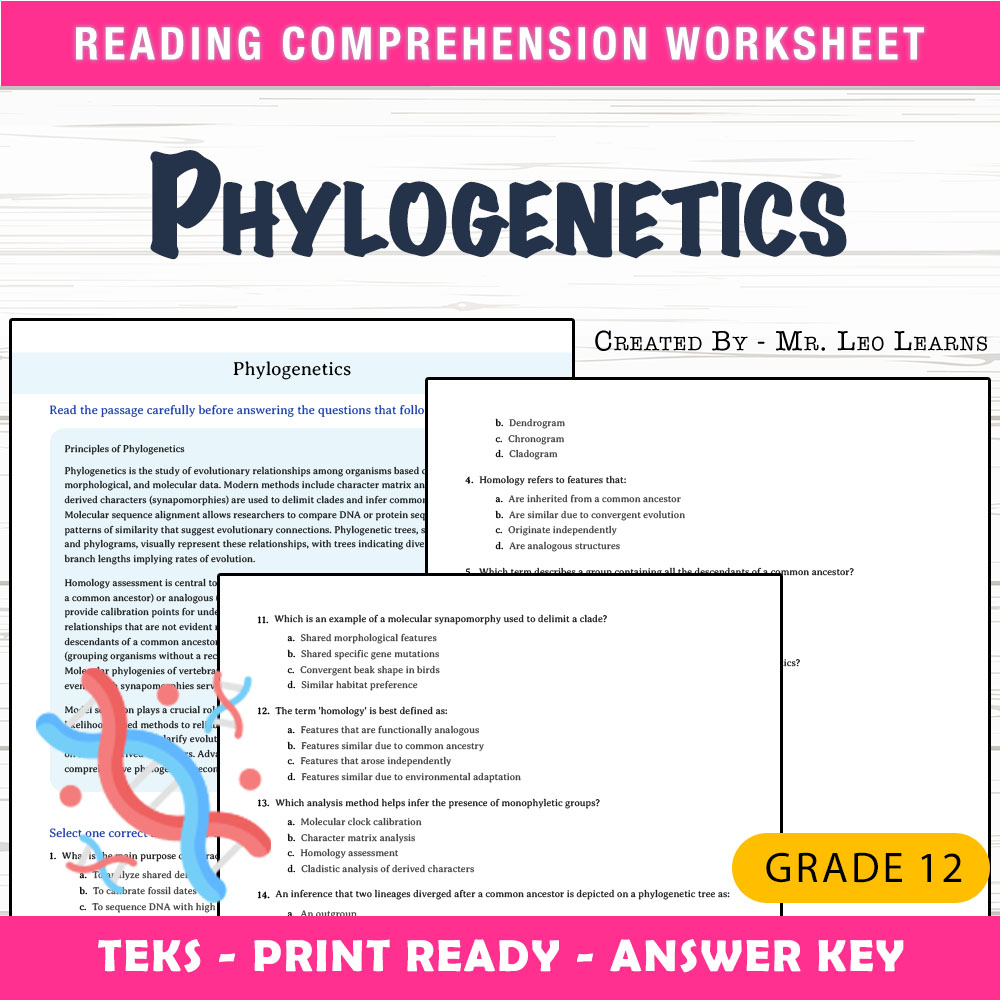
Imagine standing at the front of your classroom, watching students grapple with understanding how scientists trace the evolutionary history of various organisms. They might find the concept of phylogenetics abstract, especially when it involves analyzing complex genetic and morphological data. This worksheet comes in to provide a clear, structured approach to exploring phylogenetics, guiding students step-by-step through key concepts and skills. Designed to facilitate independent learning and reinforce understanding, it simplifies this intricate topic into manageable questions and activities that can be completed efficiently in class or as homework, ensuring students gain confidence in their grasp of evolutionary relationships.
What This Resource Helps Students Do
This worksheet supports students in developing a solid understanding of phylogenetics, including how evolutionary relationships are determined and represented. It walks students through reading comprehension of a concise passage about the basics of phylogenetics, then provides multiple-choice questions that challenge them to identify core ideas and data analysis techniques used in the field. The worksheet encourages critical thinking and helps students connect theoretical concepts to practical data interpretation. Through this structured practice, students improve skills in analyzing scientific data, understanding genetic and morphological similarities, and applying their knowledge to interpret evolutionary trees and character matrices, laying a strong foundation for further study in biology and evolution.
Inside the PDF
• A comprehensive reading passage explaining the fundamentals of phylogenetics
• 25 multiple-choice questions focused on understanding and analyzing phylogenetic data
• A print-ready format that requires no additional preparation
• A detailed answer key with rubric to support assessment and review
• Designed for easy photocopying and classroom use, making lesson planning straightforward
How It Improves Learning
This worksheet improves student learning by breaking down the complex topic of phylogenetics into clear, digestible parts. As students read the passage, they gain foundational knowledge about how evolutionary relationships are studied and represented through genetic and morphological data. The multiple-choice questions reinforce this understanding and develop their analytical skills, encouraging reasoning about different data types and analysis techniques. The structured format builds confidence, helping students move from initial confusion to a clearer grasp of phylogenetic methods. Over time, this practice deepens their ability to interpret evolutionary trees and character matrices, essential skills for advanced biological study. You can trust this worksheet to enhance comprehension and support independent learning with clarity and precision.
Core Skills Students Will Develop
- ➡️ Interpretation of phylogenetic trees and diagrams
- ➡️ Understanding genetic and morphological data in evolution
- ➡️ Analyzing character matrix data
- ➡️ Critical thinking about evolutionary relationships
Ways Teachers Use This Worksheet
This worksheet serves multiple practical purposes in the classroom. It can be used as a guided in-class activity to introduce students to phylogenetics, or as a homework assignment to reinforce concepts after a lecture. It is ideal for assessment review, providing a quick and effective way to gauge understanding of evolutionary relationships. Teachers might also utilize it in small-group settings for collaborative analysis or assign it as early finisher work to keep students engaged. Its straightforward, print-ready format makes it easy to implement for various instruction styles, supporting student comprehension and confidence alike.
Why This PDF Saves Time
This resource is designed to reduce preparation time for teachers by providing a complete worksheet in a print-ready PDF format. There is no need to create activities from scratch or prepare additional materials. The clear layout ensures consistency across uses and simplifies copying and distribution. You can quickly implement it into your lesson plan, knowing it contains targeted questions that reinforce essential concepts of phylogenetics, saving valuable planning time while maintaining instructional quality.
This worksheet is ready to print and integrate seamlessly into your classroom routine. Its structured approach and practical design support student learning and give you a reliable tool to clarify complex biological concepts. With this resource, you can confidently guide your students through understanding evolution’s history and the methods scientists use to uncover it. Happy teaching! 😊