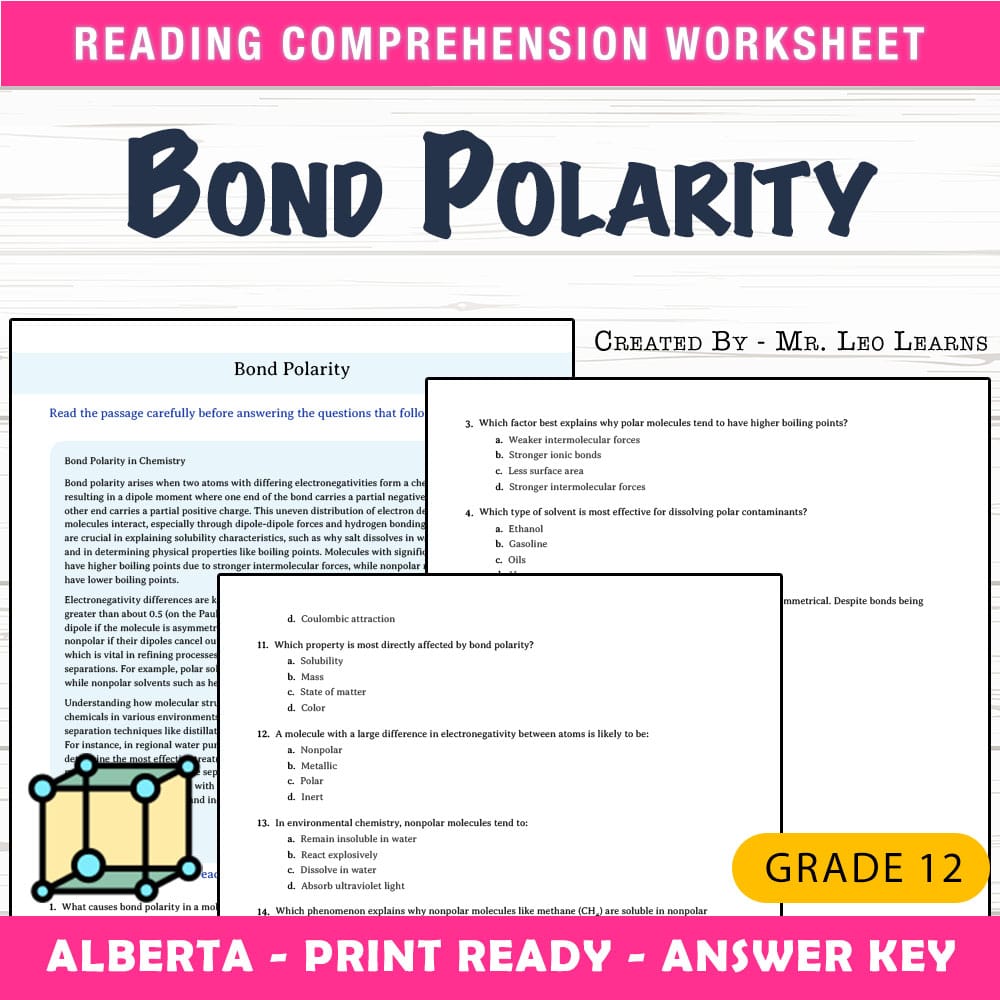
Imagine entering your classroom as students settle into their seats, ready to deepen their understanding of bond polarity. You notice some students struggle with the concept of how electronegativities influence bond formation, often confusing polar and nonpolar bonds. This worksheet provides a straightforward, printable resource to clarify these ideas, offering guided practice through multiple-choice questions based on a clear reading passage about bond polarity. It’s designed to help students confidently grasp the key principles of molecular dipoles and electronegativity differences, turning confusion into comprehension.
What This Resource Helps Students Do
This worksheet guides students through essential concepts of bond polarity, helping them interpret information from a reading passage and apply it through multiple-choice questions. It encourages independent analysis by asking students to identify causes of bond polarity and classify molecules based on their dipole moments. The structure supports skill-building in understanding chemical bonding, interpreting scientific language, and making connections between properties and molecular behavior. By working through this resource, students develop critical thinking and reinforce their grasp of how electronegativity differences influence bond type and molecular polarity.
Inside the PDF
• 1 detailed reading passage explaining bond polarity and related concepts
• 25 multiple-choice questions focusing on causes and classifications of molecular dipoles
• A clean, print-ready layout suited for immediate classroom use
• An answer key with rubric for quick grading and assessment
How It Improves Learning
This worksheet enhances student understanding by offering clear explanations paired with targeted practice questions. The reading passage breaks down complex ideas into manageable parts, guiding students step-by-step through the criteria that create bond polarity. The multiple-choice questions then reinforce these concepts, encouraging students to analyze scenarios and apply what they’ve learned. This process builds confidence as students move from initial misconceptions to accurate understanding, while the answer key allows teachers to quickly assess comprehension and provide feedback. Overall, it offers structured, focused review to strengthen foundational chemistry skills effectively.
Core Skills Students Will Develop
- ➡️ Understanding how electronegativity differences create bond polarity
- ➡️ Identifying polar and nonpolar bonds based on molecular structure
- ➡️ Classifying molecules by their overall dipole moment
- ➡️ Reading and analyzing scientific passages for key information
Ways Teachers Use This Worksheet
This resource can serve multiple classroom purposes, such as a warm-up activity to introduce the concept of bond polarity, a quick assessment after a lesson, or extra practice for students needing reinforcement. It’s useful for independent work, small-group review, and homework assignments designed to reinforce lesson content. Teachers may also use it as an early finisher activity or as part of a formative assessment to gauge student understanding before moving to more complex topics. Its print-and-go format makes it a practical addition to any science curriculum, saving prep time while providing meaningful practice opportunities.
Why This PDF Saves Time
The design of this worksheet makes it ready to print and distribute immediately, reducing the time spent creating assessment materials from scratch. Its clear layout ensures consistency in presentation, allowing teachers to quickly assign high-quality, standards-aligned practice. The included answer key simplifies grading and feedback, helping teachers track student progress efficiently without extra preparation. This resource offers a reliable, classroom-friendly tool that supports ongoing assessment and review without added workload.
Remember, this worksheet is prepared to help students master bond polarity confidently and clearly. It’s printable, easy to use, and engineered to boost understanding in a supportive way—ready to make your teaching easier and your students’ learning more effective. 😊