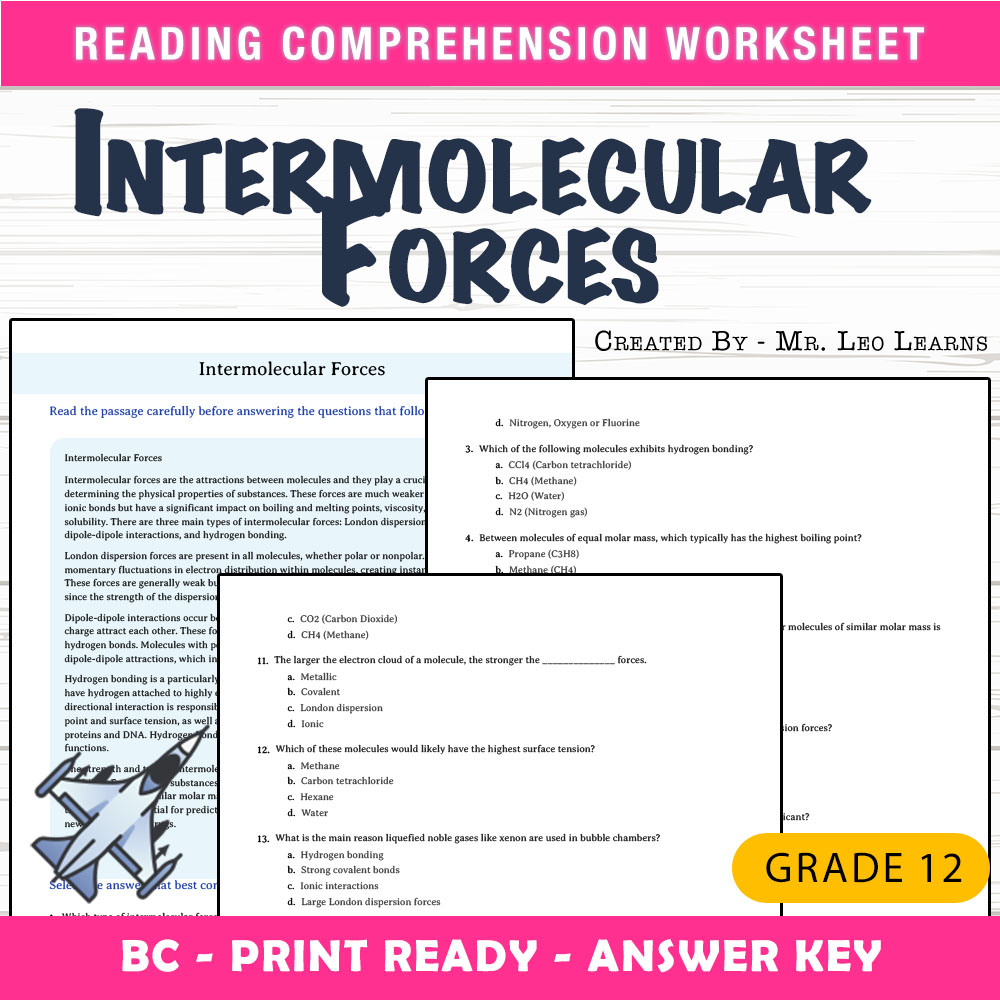
Imagine standing in your classroom, watching students struggle to understand how different molecules interact—the tension between their confusion and clarity underscore the need for a straightforward, reliable resource. When it comes to mastering the concept of intermolecular forces, many students find it challenging to differentiate between types such as London dispersion, dipole-dipole, and hydrogen bonds. This Grade 12 Science worksheet provides a clear, structured approach that helps students deepen their understanding through focused multiple-choice questions and a reading passage, making complex concepts more accessible and encouraging independent review.
What This Resource Helps Students Do
This worksheet guides students through essential concepts related to intermolecular forces, reinforcing their understanding through targeted practice. It begins with a reading passage that introduces and explains the role of intermolecular attractions, setting a solid foundation. The multiple-choice questions then build on this knowledge, prompting students to analyze and identify specific types of forces, such as hydrogen bonding and London dispersion. The guided questions promote critical thinking by encouraging students to connect theoretical concepts with real-world examples, helping them develop confident understanding and improved problem-solving skills. It serves as an effective tool for practicing recall, comprehension, and application of key facts about molecular interactions in a straightforward, step-by-step manner.
Inside the PDF
• 25 structured questions designed for step-by-step learning
• A print-ready format that requires no preparation
• PDF answer key with rubric for quick assessment
• Clear layout optimized for easy photocopying and classroom use
How It Improves Learning
This worksheet enhances student learning by providing a focused review of intermolecular forces, helping students move from initial misconceptions to accurate understanding. The reading passage offers a concise, accessible overview of the topic, ensuring that learners grasp foundational ideas before tackling the questions. The multiple-choice format allows students to practice identifying different types of forces, reinforcing their ability to distinguish between them in various contexts. The structure of questions promotes reasoning and critical thinking, encouraging students to analyze each option carefully. With this resource, students gain confidence in their understanding of molecular interactions, making it easier for them to apply concepts to real-world scenarios and exam questions. Teachers will appreciate its clarity and effectiveness in supporting meaningful skill development.
Core Skills Students Will Develop
- ➡️ Understanding types of intermolecular forces
- ➡️ Analyzing molecular attraction interactions
- ➡️ Applying concepts to different substances
- ➡️ Improving multiple-choice question strategies
Ways Teachers Use This Worksheet
This worksheet is ideal for use as classwork during lessons on molecular interactions or as homework to reinforce learning outside of class. It can also serve as part of an assessment review to gauge student understanding, or as a small-group activity for targeted support. Additionally, it’s useful for early finishers seeking extra practice or as a quick quiz on intermolecular forces. Its print-and-go format allows for seamless integration into a variety of instructional settings, supporting different teaching strategies with minimal preparation.
Why This PDF Saves Time
Designed with busy teachers in mind, this worksheet provides a ready-made, print-friendly document that saves valuable preparation time. Its clear layout and comprehensive content mean you can distribute it immediately, confident it covers key concepts efficiently. The included answer key allows for quick grading and feedback, helping you maintain consistency and focus on other instructional priorities. Because it requires no customization or formatting, this resource offers a reliable, time-saving solution for reinforcing student understanding of intermolecular forces in the classroom.
Keep this resource handily available to support your teaching on molecular interactions. It’s a dependable, classroom-friendly tool that helps students develop their understanding persuasively and confidently—ready to print and use today! 😊