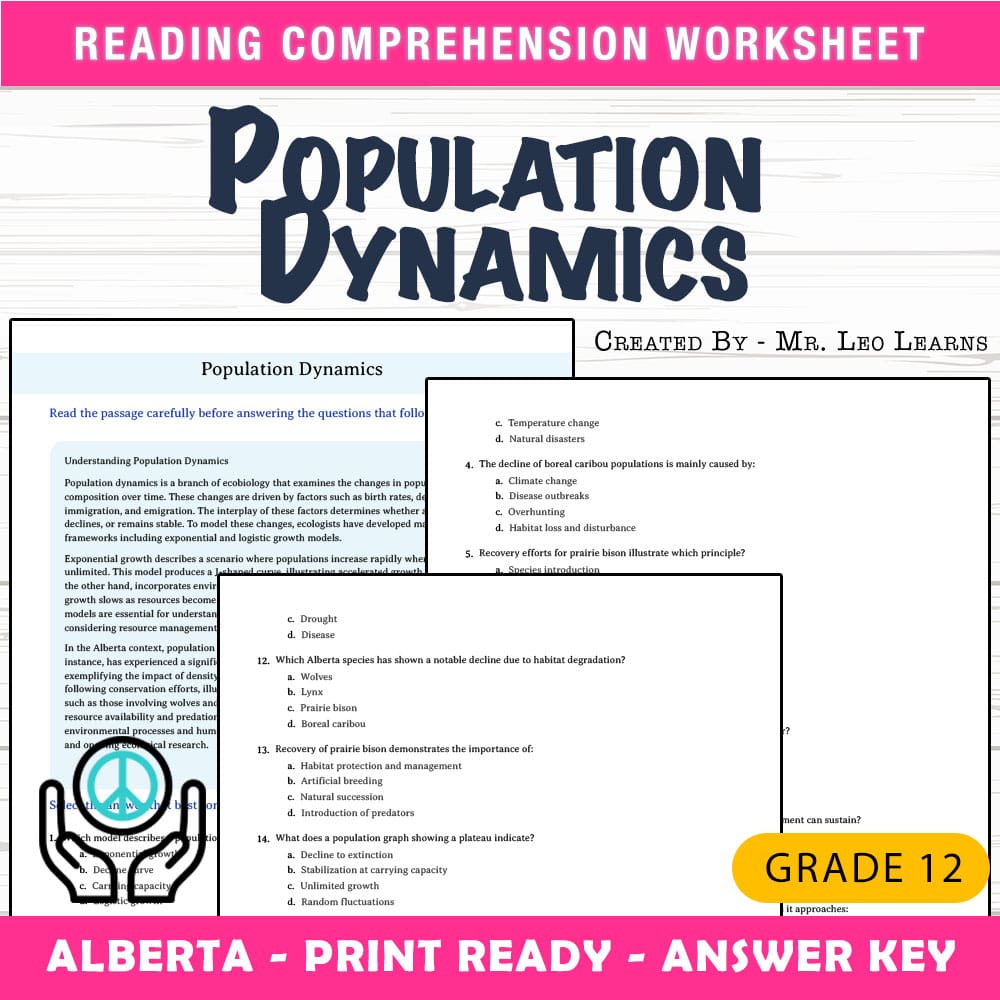
Imagine standing at the front of your classroom, guiding a group of students as they explore the complexities of population dynamics. Some students might be uncertain about how populations grow or stabilize, often finding it challenging to connect concepts like exponential and logistic growth. This worksheet offers a straightforward, printable solution that makes these foundational ideas clearer. By providing a focused set of multiple-choice questions built around a detailed reading passage, it helps clarify these key ideas and brings confidence to student understanding.
What This Resource Helps Students Do
This worksheet helps students develop a deeper understanding of population change and the factors that influence it. The reading passage introduces critical concepts such as growth models, carrying capacity, and environmental limits, providing context for the questions that follow. The multiple-choice questions are designed to reinforce understanding, encourage reasoning, and promote independent thinking. Students practice identifying different population growth patterns, while also strengthening their ability to interpret ecological data and models. This worksheet encourages active engagement and assists students in connecting theoretical ideas to real-world ecological processes.
Inside the PDF
• 1 reading passage that introduces key concepts of population dynamics
• 25 multiple-choice questions to evaluate understanding
• A print-ready format requiring no preparation
• Designed layout suitable for photocopying and classroom use
• Clear, easy-to-read formatting that supports student focus
How It Improves Learning
This worksheet enhances learning by providing a logical progression from reading to comprehension, allowing students to process information at their own pace. The detailed passage offers necessary background, which the questions then reinforce through application and analysis. Since the questions target different levels of thinking—from recalling facts to applying concepts—students develop critical reasoning skills. The quiz format also builds confidence by offering immediate opportunities to assess comprehension. Teachers can use this resource to identify misconceptions and guide subsequent instruction, ensuring students gain mastery over the dynamic nature of population changes in ecological systems.
Core Skills Students Will Develop
- ➡️ Understanding population growth models
- ➡️ Interpreting ecological data and graphs
- ➡️ Applying concepts of carrying capacity
- ➡️ Analyzing the factors that influence population stability
Ways Teachers Use This Worksheet
This worksheet can serve multiple classroom purposes, including as an engaging classwork activity to introduce or review population concepts. It’s also useful as a homework assignment to reinforce lesson content. Teachers often use it for assessment review, to gauge student understanding of ecological principles. It can be incorporated into small-group discussions or used as an early finisher activity for students who move through the curriculum quickly. Its printable, straightforward format makes it easy to implement either during instruction or as part of a larger unit on ecology and ecosystems.
Why This PDF Saves Time
This resource provides a ready-made, print-and-go worksheet that minimizes prep time. The clear format ensures smooth distribution in class, and the included answer key with rubric provides quick, reliable grading support. Its self-contained design eliminates the need for teachers to create questions from scratch, offering a consistent tool to assess student understanding of population dynamics. Simply print the PDF, and the worksheet is prepared for immediate use, saving valuable planning time while maintaining educational quality.
Designed to support classroom instruction and student mastery of ecological concepts, this worksheet combines clarity with practicality. It’s ready to print, easy to incorporate into your lessons, and aimed at helping students succeed with confidence. Use it to foster understanding, develop key skills, and support diverse learning environments. 😊