
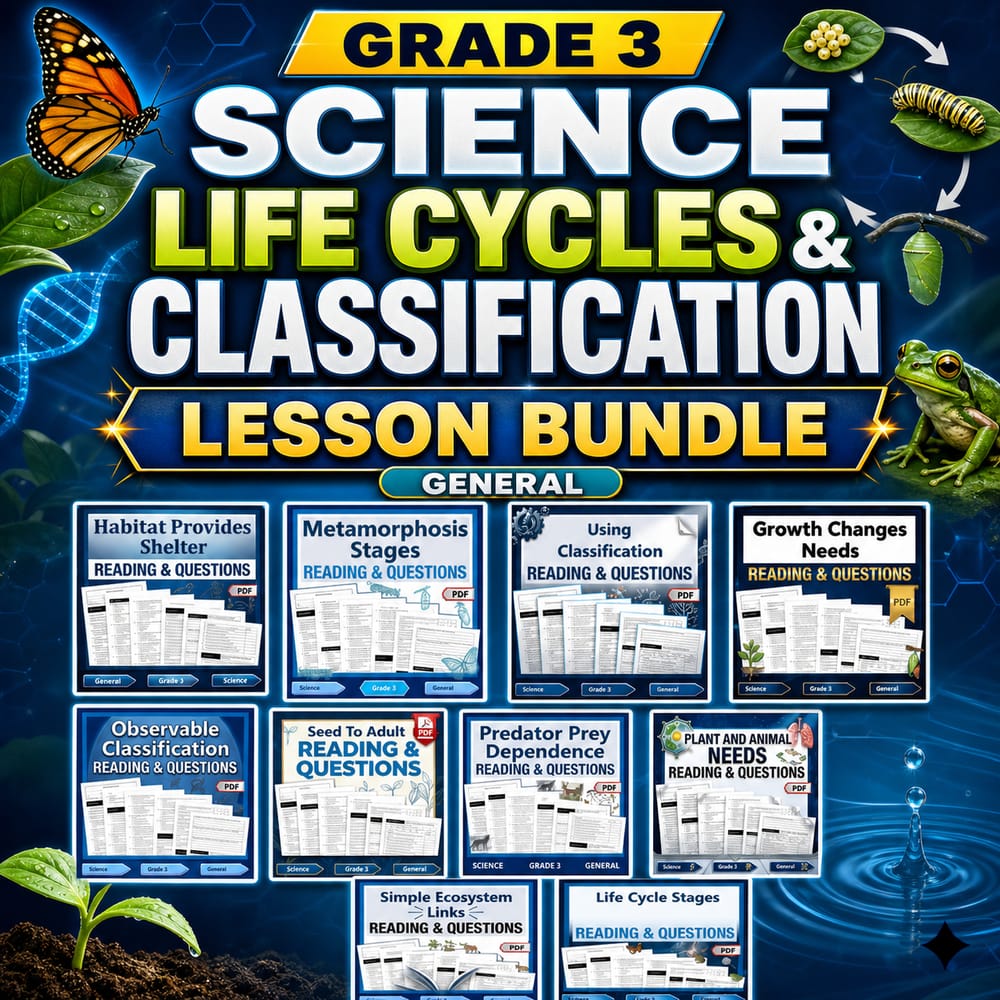
Grade 3 Life Cycles & Classification Science Lesson Bundle: General
$32.00$40.00Save $8.00
Evergreen Desk Education
·2 followers·17 sales
SubjectScienceGradeGrade 3
What’s included
10 worksheets · Save $8.00 (20%) · prices shown inside the bundle
 Grade 3 Science Worksheet | Habitat Provides Shelter (PDF)
- Explain how a habitat provides shelter, food, water, and environmental conditions for living things.
- Identify examples of shelter in different habitats (forest floor, pond, field).
- Describe how living things in the same habitat interact when their needs overlap.
$3.20$4.00 Grade 3 Science Worksheet | Metamorphosis Stages Practice (PDF)
- Identify the four main stages of insect metamorphosis: egg, larva, pupa, and adult.
- Describe how body changes help animals meet different needs at each stage.
- Explain why stage changes are important for survival and reproduction.
$3.20$4.00 Grade 3 Science Worksheet | Using Classification Rules (PDF)
- Explain how classification rules use visible traits to group organisms clearly.
- Use a step-by-step set of features to place organisms into the correct group.
- Evaluate whether a new organism fits a group by checking the same rule features.
$3.20$4.00 Grade 3 Science Worksheet | Growth Changes Needs (PDF)
- Explain how an organism’s survival needs can change as it grows and develops.
- Describe examples of changing needs in plants and animals at different life stages.
- Use evidence from a text to identify relationships between growth and resources.
$3.20$4.00 Grade 3 Science | Observable Classification Worksheet (PDF)
- Explain what a classification rule is and why it must be based on observable features.
- Use visible traits (such as body covering, leaf shape, number of legs, or seed coat) to group organisms.
- Compare two organisms by describing similarities and differences using shared observable features.
$3.20$4.00 Grade 3 Science | Seed to Adult Life Cycle Worksheet (PDF)
- Describe the main stages in a plant life cycle from seed to adult plant.
- Explain how water and air help a seed during early germination.
- Explain how light helps an adult plant make energy and grow leaves.
$3.20$4.00 Grade 3 Science Worksheet | Predator Prey Dependence (PDF)
- Explain how predators and prey depend on each other within an ecosystem.
- Describe how changes in prey population can affect predator survival and behavior.
- Use evidence to support how food and shelter needs connect different organisms in a habitat.
$3.20$4.00 Grade 3 Science Worksheets | Needs of Plants and Animals (PDF)
- Explain how plants get water, minerals, air, and light to survive.
- Describe how animals get food, water, air, and shelter to survive.
- Compare how different species can use different body structures to meet the same needs.
$3.20$4.00 Grade 3 Science – Simple Ecosystem Links Worksheet (PDF)
- Explain how living things in a simple ecosystem are connected through food and habitat needs.
- Identify producers, consumers, and predators/prey relationships in a shared habitat.
- Describe how animals and plants affect each other through seed spreading and growth.
$3.20$4.00 Grade 3 Science | Life Cycle Stages Worksheet (PDF) – General Standards
- Explain that organisms go through distinct life cycle stages (such as germination, growth, and adulthood).
- Describe how an organism’s needs change from one life cycle stage to another.
- Use examples to connect life cycle stages to how populations continue from one generation to the next.
$3.20$4.00
Reviews & Feedback
Loading reviews...
Questions & Answers
Loading questions…
About this bundle
Related categories
Frequently asked questions
Who is Grade 3 Life Cycles & Classification Science Lesson Bundle: General designed for?
Grade 3 Life Cycles & Classification Science Lesson Bundle: General is designed for Grade 3 students and Science learners and can be used in classrooms, homeschool, or independent practice.
How do I download Grade 3 Life Cycles & Classification Science Lesson Bundle: General?
Add it to your cart and complete checkout. After payment, you can download immediately from your account, and you'll also receive a download link by email.
Similar Products

Grade 4 Science Lesson Group Bundle | Ecosystems, Life Cycles & Classification
$21.60$27.00

Grade 3 Science Life Cycles Habitats & Classification Worksheets Bundle
$24.00$30.00

Plant Growth and Life Cycles Lesson Bundle – Grade 3 Science Ontario
$32.00$40.00

Grade 5 Ecosystems and Life Cycles Science Lesson Bundle: General
$32.00$40.00