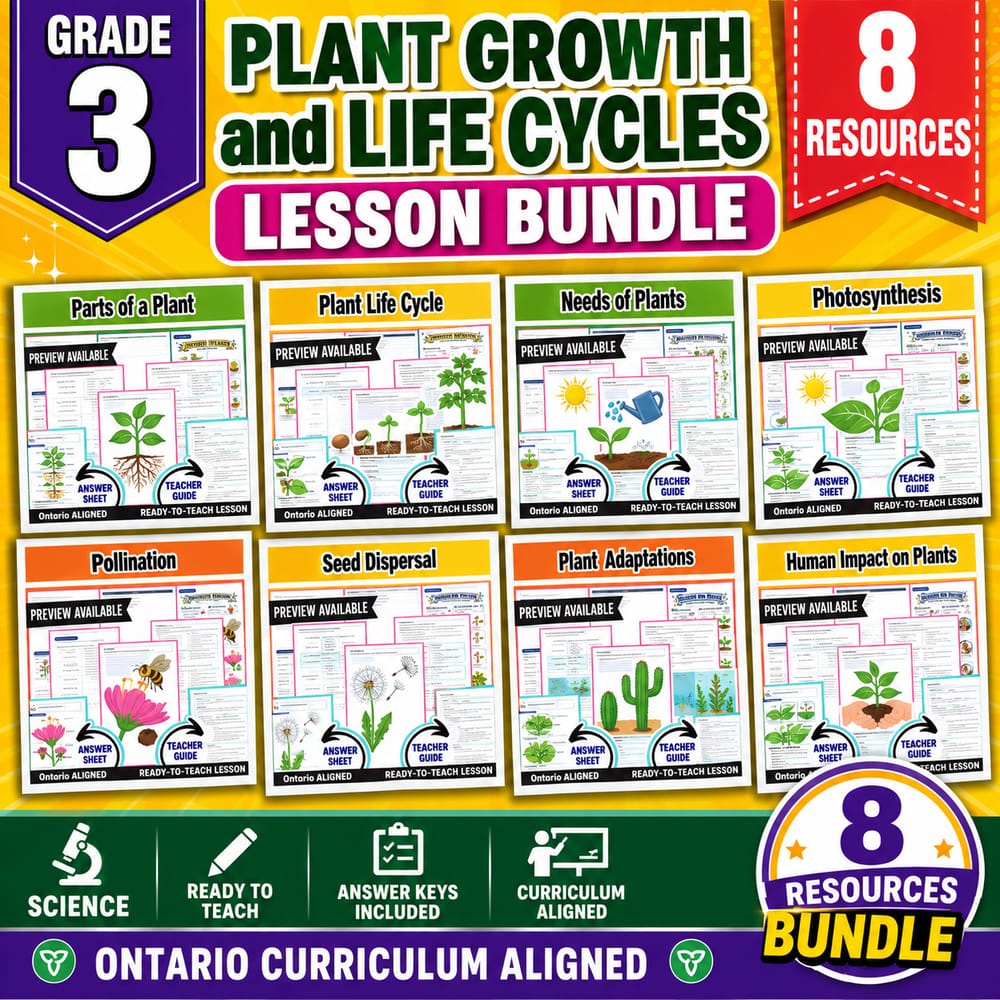
Plant Growth and Life Cycles Lesson Bundle – Grade 3 Science Ontario — bundle cover
Plant Growth and Life Cycles Lesson Bundle – Grade 3 Science Ontario — included worksheet 1
Plant Growth and Life Cycles Lesson Bundle – Grade 3 Science Ontario — included worksheet 2
Plant Growth and Life Cycles Lesson Bundle – Grade 3 Science Ontario — included worksheet 3
Plant Growth and Life Cycles Lesson Bundle – Grade 3 Science Ontario — included worksheet 4
Plant Growth and Life Cycles Lesson Bundle – Grade 3 Science Ontario — included worksheet 5
Plant Growth and Life Cycles Lesson Bundle – Grade 3 Science Ontario — included worksheet 6
Plant Growth and Life Cycles Lesson Bundle – Grade 3 Science Ontario — included worksheet 7
Plant Growth and Life Cycles Lesson Bundle – Grade 3 Science Ontario — included worksheet 8
Grade 3 Science worksheet — Plant Growth and Life Cycles Lesson Bundle – Grade 3 Science Ontario

Description

Overview


Grade 3 Science Plant Growth and Life Cycles provides a print-only unit worksheet pack for Ontario science learners, focusing on how plants transport water, survive through adaptations, and develop from seeds. This bundle includes 8 classroom-ready worksheet PDFs plus PDF answer keys with a rubric, supporting guided instruction, independent practice, and end-of-unit checks within a single topic.

Across the sequence, students move from observing plant structures to explaining life-cycle patterns, then apply what they know to real-world variables such as environmental conditions and seed dispersal.

What’s Included


  • ✅ Stem Transport, Xylem and Phloem – Identify how water and nutrients move through plant stems using evidence from diagrams.
  • ✅ Root Adaptations for Water, Nutrients, and Anchorage – Explain how different root features help plants meet needs and stay secured.
  • ✅ Functions of Plant Parts in Vascular Plants – Match plant parts to their roles in support, transport, and growth.
  • ✅ Life Cycle Patterns in Seed Plants – Describe stages of a seed plant’s life cycle using a clear sequence.
  • ✅ Seed Germination Stages and Needs – Use cause-and-effect reasoning to connect germination needs to what students observe.
  • ✅ Flower Parts and Reproduction – Use plant-part functions to explain how flowering supports reproduction in seed plants.
  • ✅ How Environmental Factors Affect Plant Growth – Predict and justify how light, water, and other factors influence growth.
  • ✅ Seed Dispersal Strategies and Plant Population Spread – Compare dispersal strategies and explain how they affect where new plants establish.

Skills & Standards


Designed for Ontario expectations ({standards}), this unit emphasizes scientific thinking through observation, representation, and evidence-based explanation. Students practice identifying patterns across plant life stages, using models (such as labeled plant diagrams and life-cycle sequencing) to interpret how structures support functions. They build explanatory reasoning by connecting cause-and-effect relationships—like how root adaptations support water uptake or how environmental factors influence germination and growth. As they progress, learners strengthen disciplinary core ideas about plant systems and interactions by explaining how parts work together (roots, stems, vascular transport, flowers, seeds) to support survival and reproduction. Routine prompts also support clear, organized communication of claims using evidence from the worksheets.

Perfect For


  • Teachers seeking structured instruction
  • Sub plans
  • Homework or review
  • Intervention or centers
  • Assessment preparation

How to Use


Plan this as a typical 1–3 week unit within your Grade 3 Science schedule, using the worksheets in order to build understanding from plant transport to life cycles, then to growth factors and dispersal. Consider: (1) start each class with a 5-minute warm-up that previews the day’s plant concept using a quick label-and-compare prompt from the relevant worksheet; (2) use guided practice after reading the lesson context, where students complete the diagrams or sequencing items and then discuss evidence-based responses; (3) finish with exit tickets that target the unit’s explanatory focus (for example, “What need or factor would most directly change germination?” or “Which dispersal strategy helps seeds spread farther and why?”). Use the provided PDF answer keys and rubric to streamline grading and integrate quick checks for skill progression.

Closing


Bring coherence to your plant unit with ready-to-print Grade 3 Science Plant Growth and Life Cycles worksheets that support confident assessment from concept to application.

Plant Growth and Life Cycles Lesson Bundle – Grade 3 Science Ontario

$32.00$40.00Save $8.00
Chalk and Compass
·5 followers·13 sales
SubjectScienceGradeGrade 3

What’s included

8 worksheets · Save $8.00 (20%) · prices shown inside the bundle

  1. Grade 3 Flower Parts and Reproduction Worksheet | Ontario Science Activity
    Grade 3 Flower Parts and Reproduction Worksheet | Ontario Science Activity

    Grade 3 · Science · 14 Pages

    • Identify major flower parts and describe what roles sepals, petals, stamens, and pistils play in reproduction
    • Explain how pollen is produced, how stigma receives pollen, and how fertilization leads to seeds
    • Compare wind pollination and animal pollination and describe how nectar, scent, and color can help pollinators
    $4.00$5.00
  2. Grade 3 Seed Germination Stages & Plant Needs Science Worksheet Ontario
    Grade 3 Seed Germination Stages & Plant Needs Science Worksheet Ontario

    Grade 3 · Science · 15 Pages

    • Name the major stages of seed germination, including imbibition, radicle emergence, hypocotyl and epicotyl growth, and true leaf emergence.
    • Explain how seed reserves support early growth until the plant can make its own food.
    • Describe how moisture, temperature, and oxygen help seeds germinate successfully.
    $4.00$5.00
  3. Grade 3 Life Cycle Patterns in Seed Plants Science Worksheet Ontario
    Grade 3 Life Cycle Patterns in Seed Plants Science Worksheet Ontario

    Grade 3 · Science · 15 Pages

    • Compare annual, biennial, perennial, and woody plant life cycles by timing of germination, flowering, seed set, and dormancy.
    • Explain how seed banking and seasonal cues help plant populations survive through unfavorable seasons.
    • Describe how environmental variability and human land-use can favor certain life histories and affect population persistence.
    $4.00$5.00
  4. Grade 3 Plant Parts Worksheet | Functions of Vascular Plants | Ontario
    Grade 3 Plant Parts Worksheet | Functions of Vascular Plants | Ontario

    Grade 3 · Science · 15 Pages

    • Identify the main parts of vascular plants: roots, stems, leaves, and flowers
    • Describe how each plant part helps the plant survive, grow, and reproduce
    • Use examples such as taproots, woody stems, broad leaves, and composite flowers to explain plant part functions
    $4.00$5.00
  5. Grade 3 Root Adaptations Worksheet | Ontario Science Plants & Root Systems
    Grade 3 Root Adaptations Worksheet | Ontario Science Plants & Root Systems

    Grade 3 · Science

    • Compare fibrous and taproot root systems and explain how each helps a plant survive.
    • Describe how root hairs and mycorrhizal associations improve water and nutrient uptake.
    • Explain how storage and aerial roots support plant survival in different environments.
    $4.00$5.00
  6. Grade 3 Plant Growth Worksheet | Environmental Factors Science Ontario
    Grade 3 Plant Growth Worksheet | Environmental Factors Science Ontario

    Grade 3 · Science

    • Explain how soil, light, water, temperature, and nutrients affect germination and plant growth
    • Describe how soil compaction and salinity can reduce plant survival
    • Use real-world examples to show how agricultural practices like crop rotation and irrigation change where plants can grow
    $4.00$5.00
  7. Grade 3 Stem Transport Xylem and Phloem Science Worksheet | Ontario
    Grade 3 Stem Transport Xylem and Phloem Science Worksheet | Ontario

    Grade 3 · Science · 15 Pages

    • Describe how xylem moves water using transpiration pull and how phloem moves sugars to support plant growth.
    • Compare herbaceous and woody stems, including vascular bundle arrangement and secondary growth in trees.
    • Explain how lignified tissues strengthen stems and how structure helps plants handle mechanical stress.
    $4.00$5.00
  8. Grade 3 Seed Dispersal Strategies Worksheet | Ontario Science Activities
    Grade 3 Seed Dispersal Strategies Worksheet | Ontario Science Activities

    Grade 3 · Science · 15 Pages

    • Identify different seed dispersal strategies such as wind, animal, water, and ballistic ejection.
    • Explain why dispersal helps plants colonize new areas over generations.
    • Describe how dispersal patterns can affect gene flow and the spatial distribution of plant populations.
    $4.00$5.00

Reviews & Feedback

Loading reviews...

Questions & Answers

Loading questions…

About this bundle

Related categories

Frequently asked questions

Who is Plant Growth and Life Cycles Lesson Bundle – Grade 3 Science Ontario designed for?
Plant Growth and Life Cycles Lesson Bundle – Grade 3 Science Ontario is designed for Grade 3 students and Science learners and can be used in classrooms, homeschool, or independent practice.
How do I download Plant Growth and Life Cycles Lesson Bundle – Grade 3 Science Ontario?
Add it to your cart and complete checkout. After payment, you can download immediately from your account, and you'll also receive a download link by email.