
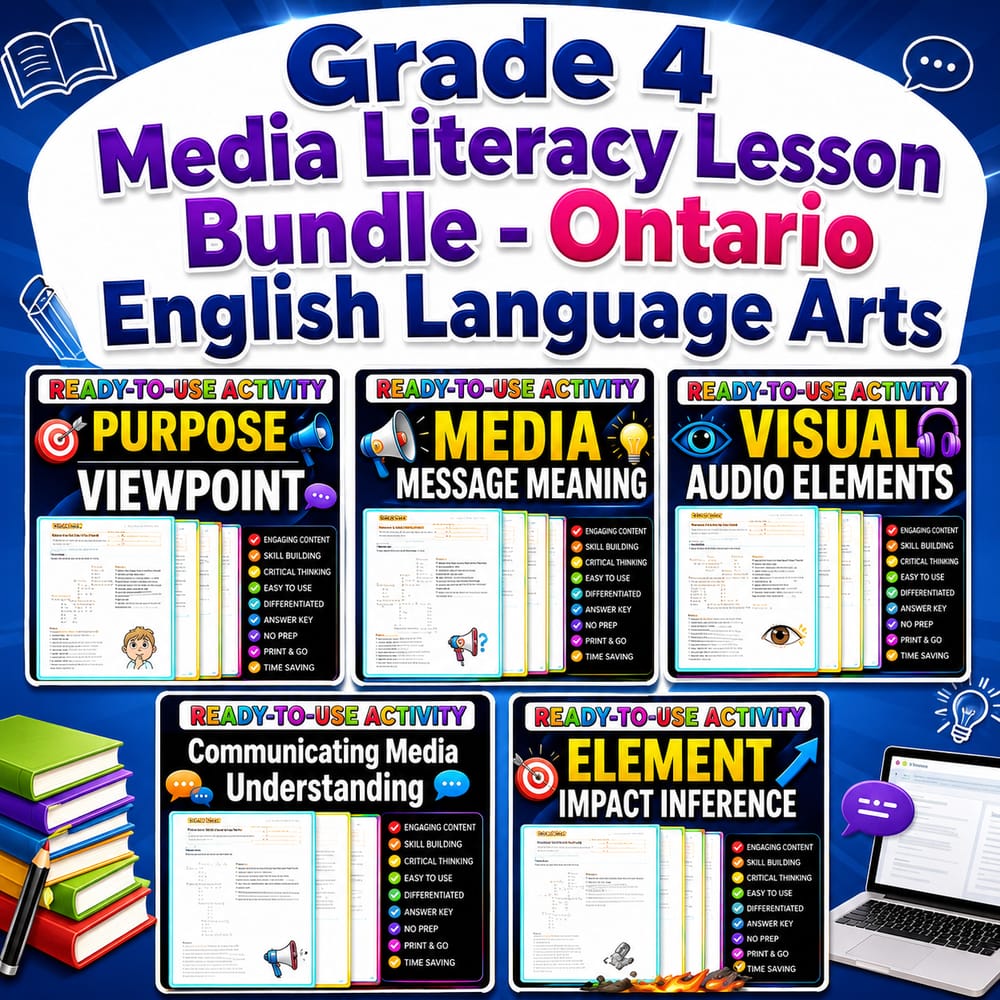
Grade 4 Media Literacy Lesson Bundle – Ontario English Language Arts
$12.00$15.00Save $3.00
Sunny Desk Resources
·2 followers·18 sales
SubjectELAGradeGrade 4Pages55 Pages
What’s included
5 worksheets · 55 pages · Save $3.00 (20%) · prices shown inside the bundle
 Grade 4 Purpose and Viewpoint Worksheet | Ontario ELA Reading Skills
- Explain how media messages can inform, persuade, or entertain
- Identify a text’s point of view and what details are emphasized or left out
- Use evidence from tone, topic selection, and framing to describe an author’s intent
$2.40$3.00 Grade 4 Media Message Meaning Worksheet | Ontario ELA Media Literacy Skills
- Identify the central idea of a media message.
- Distinguish factual information from persuasive claims in commercials, PSAs, and news clips.
- Explain how wording and context shape meaning, including direct statements and implied meaning.
$2.40$3.00 Grade 4 Visual & Audio Elements Worksheet | Ontario ELA Media Literacy
- Explain how visual elements (color, size, camera distance, and text placement) influence what an audience notices.
- Describe how audio elements (voice tone, sound effects, and music) help create meaning in a message.
- Use evidence from an infographic, thumbnail, or short audio clip to identify how design choices guide attention.
$2.40$3.00 Grade 4 Ontario ELA Communicating Media Understanding Worksheet
- Summarize the message of a media piece using accurate details as evidence.
- Explain how purpose and viewpoint shape what is communicated in a media message.
- Use precise vocabulary (tone, audience, key phrase, image detail) to support claims about media features.
$2.40$3.00 Grade 4 Element Impact Inference Worksheet | Ontario ELA Reading Skills
- Infer how visual and audio choices in media shape tone and urgency.
- Use evidence from camera angles, editing pace, music, and voice emphasis to explain an inferred impact on the audience.
- Evaluate credibility by connecting media techniques to the way information is presented.
$2.40$3.00
Reviews & Feedback
Loading reviews...
Questions & Answers
Loading questions…
About this bundle
Related categories
Frequently asked questions
Who is Grade 4 Media Literacy Lesson Bundle – Ontario English Language Arts designed for?
Grade 4 Media Literacy Lesson Bundle – Ontario English Language Arts is designed for Grade 4 students and ELA learners and can be used in classrooms, homeschool, or independent practice.
How do I download Grade 4 Media Literacy Lesson Bundle – Ontario English Language Arts?
Add it to your cart and complete checkout. After payment, you can download immediately from your account, and you'll also receive a download link by email.
Similar Products

Grade 12 ELA Media Literacy Worksheets | Ontario Media Literacy
$14.40$18.00

Grade 4 Media Literacy Lesson Bundle | Ontario ELA Worksheets
$12.00$15.00

Grade 12 ELA Daily Reading & Literary Media Literacy Lesson Bundle | Ontario
$112.00$160.00

Grade 6 ELA Media Literacy Worksheets | Framing & Bias | Ontario
$12.00$15.00

Media Literacy Lesson Bundle | Grade 9 ELA | Ontario Framework
$25.60$32.00