
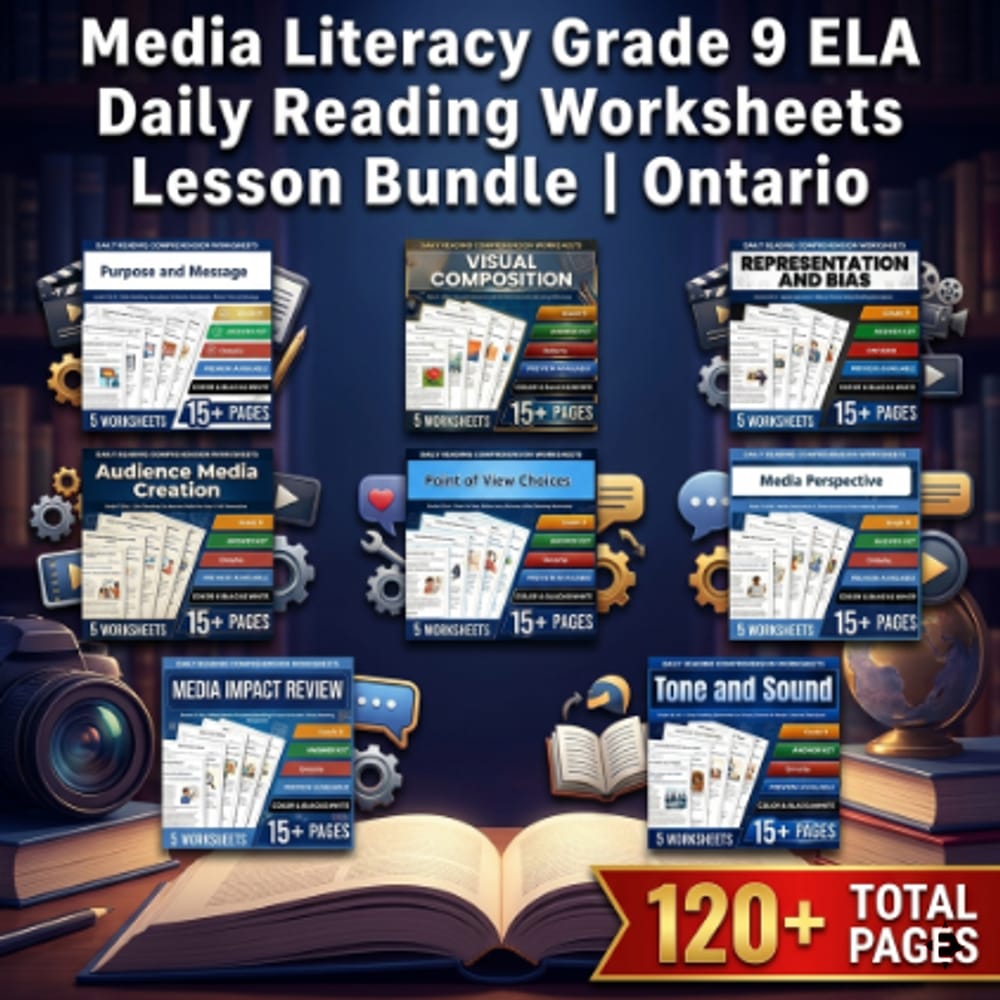
Media Literacy Lesson Bundle | Grade 9 ELA | Ontario Framework
$25.60$32.00Save $6.40
Quiet Forest Education
·3 followers·20 sales
SubjectELAGradeGrade 9Pages247 Pages
What’s included
8 worksheets · 247 pages · Save $6.40 (20%) · prices shown inside the bundle
 Grade 9 ELA – Daily Reading Worksheet & Ontario Standards |Media Texts & Message
- Recognize the main purpose of media texts (informing, persuading, entertaining, calling for action).
- Identify how details, framing, and repeated wording contribute to a message.
- Analyze headlines, slogans, and themes to understand the text’s intent.
$3.20$4.00 Grade 9 ELA – Visual Composition & Advertising | Daily Reading Worksheet
- Understand key concepts related to ELA
- Apply knowledge through practice questions
- Demonstrate comprehension of the material
$3.20$4.00 Grade 9 ELA – Representation & Bias in Media Daily Reading Worksheet
- Identify different types of media representation
- Analyze how bias manifests in media portrayals
- Compare coverage of the same topic across different sources
$3.20$4.00 Grade 9 ELA – Daily Reading & Audience Media Creation | PDF Worksheet
- Understand the importance of identifying audience needs when creating media messages.
- Learn how audience influences message format, vocabulary, and evidence used.
- Recognize how tone, visuals, and supporting details are tailored for specific audiences.
$3.20$4.00 Grade 9 ELA – Point of View & Narrative Choices | Daily Reading Worksheet
- Identify first-person and third-person narration in texts
- Understand how narration influences reader perception
- Recognize visual perspectives and their effects on storytelling
$3.20$4.00 Grade 9 ELA – Media Perspective & News Analysis | Daily Reading Worksheet
- Understand how media presents different viewpoints
- Identify signs of bias in news stories
- Analyze tone and evidence to determine perspective
$3.20$4.00 Grade 9 ELA – Media Impact Review & Reading Comprehension | Daily Worksheet
- Analyze media messages to assess clarity of purpose
- Identify tone and credibility in media content
- Evaluate supporting evidence and visual claims
$3.20$4.00 Grade 9 ELA – Daily Worksheet on Tone & Sound in Media | Ontario Standards
- Identify different tones in spoken and written language
- Recognize the effects of sound choices on tone
- Analyze how language, pacing, and sound influence reader/emotional response
$3.20$4.00
Reviews & Feedback
Loading reviews...
Questions & Answers
Loading questions…
About this bundle
Related categories
Frequently asked questions
Who is Media Literacy Lesson Bundle | Grade 9 ELA | Ontario Framework designed for?
Media Literacy Lesson Bundle | Grade 9 ELA | Ontario Framework is designed for Grade 9 students and ELA learners and can be used in classrooms, homeschool, or independent practice.
How do I download Media Literacy Lesson Bundle | Grade 9 ELA | Ontario Framework?
Add it to your cart and complete checkout. After payment, you can download immediately from your account, and you'll also receive a download link by email.
Similar Products

Grade 12 ELA Media Literacy Worksheets | Ontario Media Literacy
$14.40$18.00

Grade 3 ELA Media Literacy Lesson Bundle | Alberta Framework
$12.00$15.00

Grade 4 Media Literacy Lesson Bundle | Ontario ELA Worksheets
$12.00$15.00

Grade 6 Media Literacy Lesson Bundle: ELA Alberta Framework
$16.80$21.00

Grade 6 Media Literacy in ELA Lesson Bundle for Alberta Framework
$28.00$35.00