
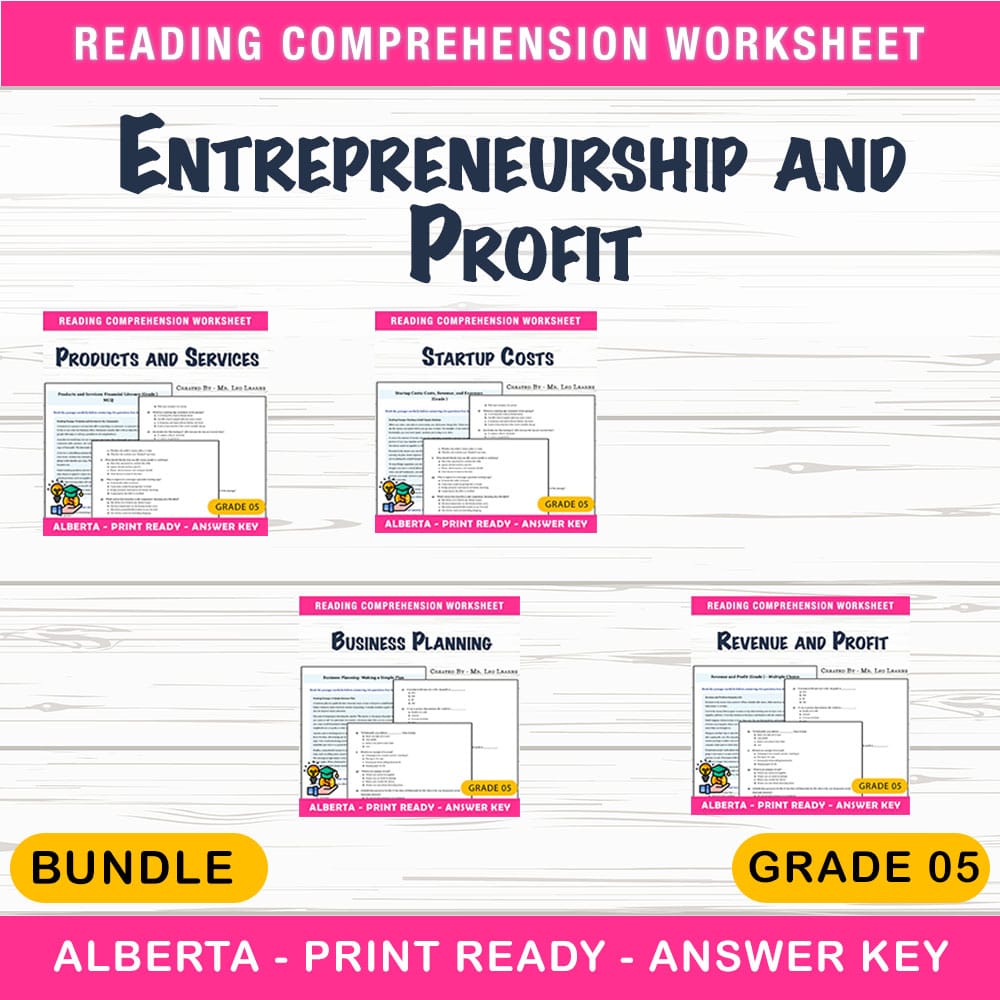
Grade 5 Entrepreneurship and Profit Unit Bundle | Financial Literacy | Alberta
$8.40$12.00Save $3.60
The Resource Hub
·2 followers·9 sales
GradeGrade 5Pages32 Pages
What’s included
4 worksheets · 32 pages · Save $3.60 (30%) · prices shown inside the bundle
 Grade 5 Financial Literacy Revenue and Profit Multiple Choice Worksheet
- Define revenue, cost, profit, and loss using simple examples.
- Identify the correct calculation and relationship between revenue, cost, and margin.
- Choose whether a situation shows profit or loss based on given amounts.
$2.10$3.00 Grade 5 Products & Services Financial Literacy MCQ Worksheet | Alberta
- Identify the difference between a product and a service in a business scenario
- Use key vocabulary words (business, product, service, customer, idea) to explain what a business offers
- Match customer needs to the correct product or service and choose the best business support
$2.10$3.00 Grade 5 Startup Costs Worksheet | Costs, Revenue & Expenses Financial Literacy
- Explain what startup costs are and why they happen before earning revenue.
- Identify revenue and expenses in simple money situations.
- Use vocabulary such as startup, cost, revenue, expense, and supply to describe a budget.
$2.10$3.00 Grade 5 Financial Literacy Business Planning Simple Plan Worksheet
- Explain key business planning vocabulary: plan, market, customer, advertise, and goal.
- Choose appropriate steps for creating a simple business plan for selling something.
- Identify how market and customers affect what a business decides to sell and how to advertise.
$2.10$3.00
Reviews & Feedback
Loading reviews...
Questions & Answers
Loading questions…
About this bundle
Related categories
Frequently asked questions
Who is Grade 5 Entrepreneurship and Profit Unit Bundle | Financial Literacy | Alberta designed for?
Grade 5 Entrepreneurship and Profit Unit Bundle | Financial Literacy | Alberta is designed for Grade 5 students and can be used in classrooms, homeschool, or independent practice.
How do I download Grade 5 Entrepreneurship and Profit Unit Bundle | Financial Literacy | Alberta?
Add it to your cart and complete checkout. After payment, you can download immediately from your account, and you'll also receive a download link by email.
