
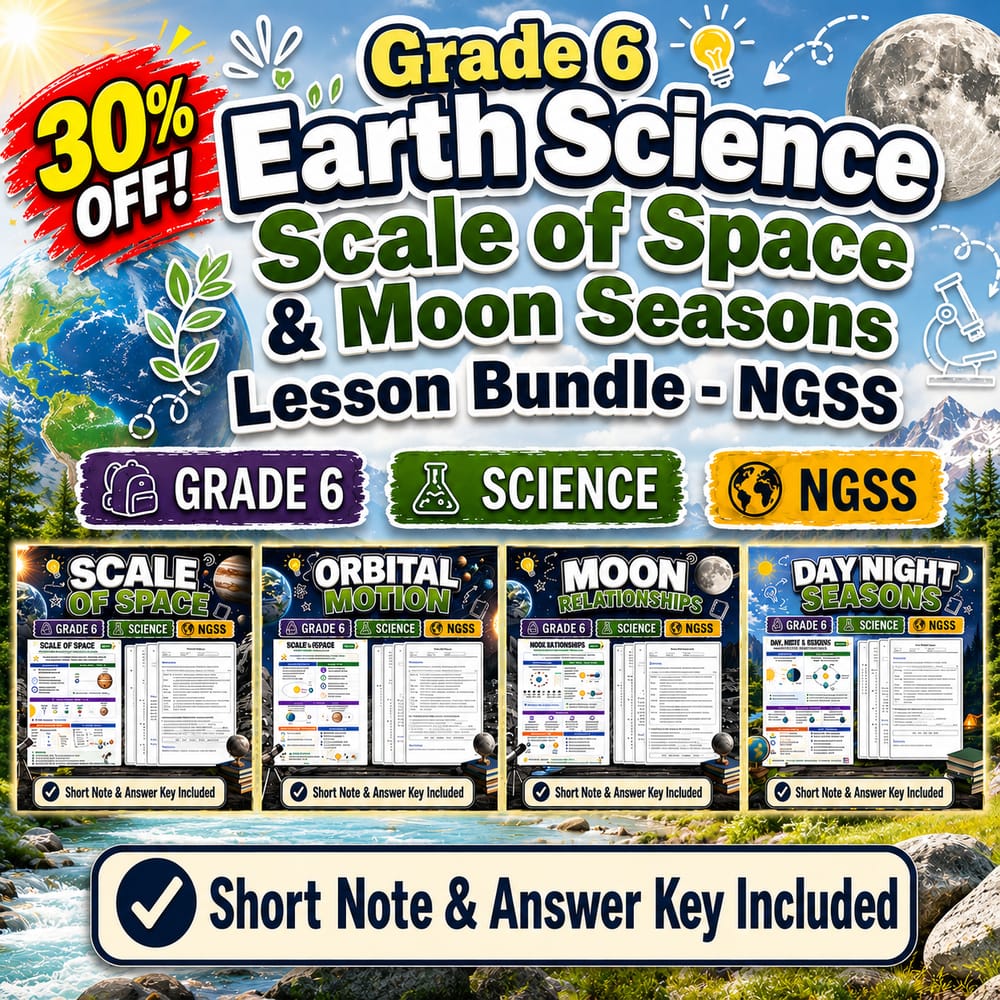
Grade 6 Earth Science Scale of Space & Moon Seasons Lesson Bundle – NGSS
$16.00$20.00Save $4.00
Northstar Worksheets
New·0 followers·0 sales
SubjectScienceGradeGrade 6
What’s included
4 worksheets · Save $4.00 (20%) · prices shown inside the bundle
 Grade 6 Scale of Space Worksheet | NGSS Earth Science Activity & Answer Key
- Use astronomical units (AU) to compare the Earth–Sun distance to other distances in the solar system.
- Compare relative planetary sizes (such as Earth vs. Jupiter) using radii or diameter ratios.
- Interpret tables and charts using orders of magnitude to describe large-scale solar system relationships.
$4.00$5.00 Grade 6 Orbital Motion Worksheet | NGSS Earth Science Activity & Answer Key
- Explain how gravitational attraction controls the motion of planets and satellites.
- Describe how gravity between the Sun and planets creates elliptical orbits and changes orbital speed.
- Connect orbital period and orbital speed to how distance affects gravitational pull.
$4.00$5.00 Grade 6 Moon Relationships Worksheet | NGSS Earth Science Activity & Answer Key
- Explain how the relative positions of Earth, Moon, and Sun create lunar phases and eclipses.
- Describe the sequence of primary lunar phases and how illumination changes during the month.
- Identify the conditions for solar and lunar eclipses using line-of-sight and shadow explanations.
$4.00$5.00 Grade 6 Day Night Seasons Worksheet | NGSS Earth Science Activity & Answer Key
- Explain how Earth’s rotation causes day and night.
- Describe how Earth’s orbit and 23.5° axial tilt lead to seasons.
- Use solstices and equinoxes as observable markers for seasonal change.
$4.00$5.00
Reviews & Feedback
Loading reviews...
Questions & Answers
Loading questions…
About this bundle
Related categories
Frequently asked questions
Who is Grade 6 Earth Science Scale of Space & Moon Seasons Lesson Bundle – NGSS designed for?
Grade 6 Earth Science Scale of Space & Moon Seasons Lesson Bundle – NGSS is designed for Grade 6 students and Science learners and can be used in classrooms, homeschool, or independent practice.
How do I download Grade 6 Earth Science Scale of Space & Moon Seasons Lesson Bundle – NGSS?
Add it to your cart and complete checkout. After payment, you can download immediately from your account, and you'll also receive a download link by email.
Similar Products

Space & Earth Systems Lesson Bundle | Grade 10 Science | Florida NGSSS
$36.00$45.00

Grade 12 Science Lesson Bundle: Space, Earth Systems, and Climate (General)
$16.00$20.00

Grade 7 Science Space, Gravity, and Earth History Lesson Bundle | NGSS
$16.00$20.00

Grade 7 Space, Gravity & Earth Processes Science Lesson Bundle (NGSS)
$12.80$16.00

Grade 11 Space & Earth Systems Science Daily Reading Lesson Bundle | General
$22.40$28.00