
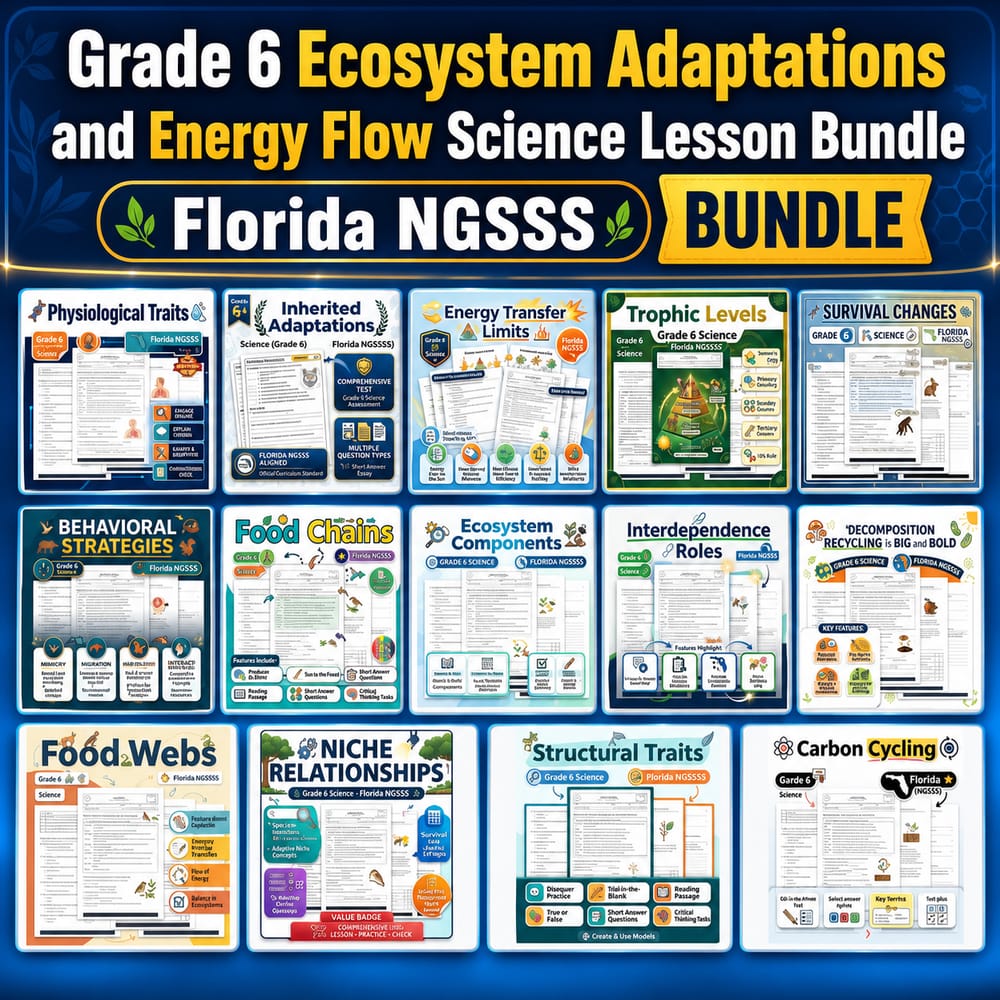


Grade 6 Ecosystem Adaptations and Energy Flow Science Lesson Bundle | Florida NGSSS
$56.00$70.00Save $14.00
J.S Sheets
New·3 followers·24 sales
SubjectScienceGradeGrade 6
What’s included
14 worksheets · Save $14.00 (20%) · prices shown inside the bundle
 Physiological Traits Worksheet for Grade 6 Science | Standards-Aligned Practice
- Understand the concept of physiological adaptations and their importance for survival.
- Identify examples of internal processes that help organisms adapt to their environments.
- Analyze how internal traits influence an organism's habitat and stress tolerance.
$4.00$5.00 Inherited Adaptations Worksheet for Grade 6 Science | Standards-Aligned Practice
- Understand the concept of inherited adaptations and their role in survival.
- Identify different types of adaptations in various organisms.
- Explain how adaptations match environmental conditions to improve survival.
$4.00$5.00 Energy Transfer Limits Worksheet | Florida NGSSS Grade 6 Science Assessment
- Understand how energy transfer in ecosystems is not perfectly efficient.
- Explain the concept of trophic levels and energy loss.
- Describe how energy loss affects food webs and predator populations.
$4.00$5.00 Trophic Levels Worksheet | Standards-Aligned Grade 6 Science Practice
- Understand the concept of trophic levels and their role in ecosystems.
- Identify producers, consumers, and decomposers within a food chain.
- Explain how energy flows through different trophic levels.
$4.00$5.00 Grade 6 Science Worksheet Survival Changes | Standards-Aligned Practice
- Understand how environmental changes influence the usefulness of traits in organisms.
- Describe how populations respond to shifts in resources and conditions through natural selection.
- Explain the connection between adaptation, ecosystem change, and resilience.
$4.00$5.00 Behavioral Strategies Worksheet | Standards-Aligned Grade 6 Science Practice
- Understand different behavioral adaptations and their roles in survival.
- Identify examples of behaviors like migration, hibernation, nest building, and burrowing.
- Explain how seasonal behaviors help organisms cope with environmental changes.
$4.00$5.00 Food Chains Worksheet for Grade 6 Science | Standards-Aligned Practice
- Understand the concept of food chains and their role in energy transfer.
- Identify producers, consumers, and trophic levels within a food chain.
- Explain how energy moves through different organisms in an ecosystem.
$4.00$5.00 Ecosystem Components Worksheet | Standards-Aligned Grade 6 Science Practice
- Understand the different components that make up an ecosystem.
- Explain the roles of abiotic and biotic factors in ecosystems.
- Identify examples of various ecosystems and their features.
$4.00$5.00 Interdependence Roles Worksheet | Standards-Aligned Science Assessment Grade 6
- Understand how organisms depend on each other in an ecosystem.
- Identify examples of predator-prey relationships, competition, and mutualism.
- Explain how changes in one population can affect the entire community.
$4.00$5.00 Decomposition Recycling Worksheet | Standards-Aligned Grade 6 Science Practice
- Understand the role of decomposers in recycling nutrients in ecosystems.
- Describe the process of decomposition and its importance for environmental health.
- Identify organisms involved in decomposition and their functions.
$4.00$5.00
Reviews & Feedback
Loading reviews...
Questions & Answers
Loading questions…
About this bundle
Related categories
Frequently asked questions
Who is Grade 6 Ecosystem Adaptations and Energy Flow Science Lesson Bundle | Florida NGSSS designed for?
Grade 6 Ecosystem Adaptations and Energy Flow Science Lesson Bundle | Florida NGSSS is designed for Grade 6 students and Science learners and can be used in classrooms, homeschool, or independent practice.
How do I download Grade 6 Ecosystem Adaptations and Energy Flow Science Lesson Bundle | Florida NGSSS?
Add it to your cart and complete checkout. After payment, you can download immediately from your account, and you'll also receive a download link by email.
Similar Products

Grade 6 Ecosystems, Adaptations & Energy Transfer Lesson Bundle | Florida science standards
$56.00$70.00

Ecosystem Models & Energy Flow Lesson Bundle | Grade 10 Science | NGSS
$19.60$28.00

Grade 7 Ecosystem Energy Flows Science Lesson Bundle - General Framework
$28.80$36.00

Ecosystem Dynamics & Energy Flow Lesson Bundle | Grade 8 Science | Alberta
$56.00$70.00

Grade 8 Biology Systems & Ecosystem Adaptations Science Lesson Bundle – General
$32.00$40.00