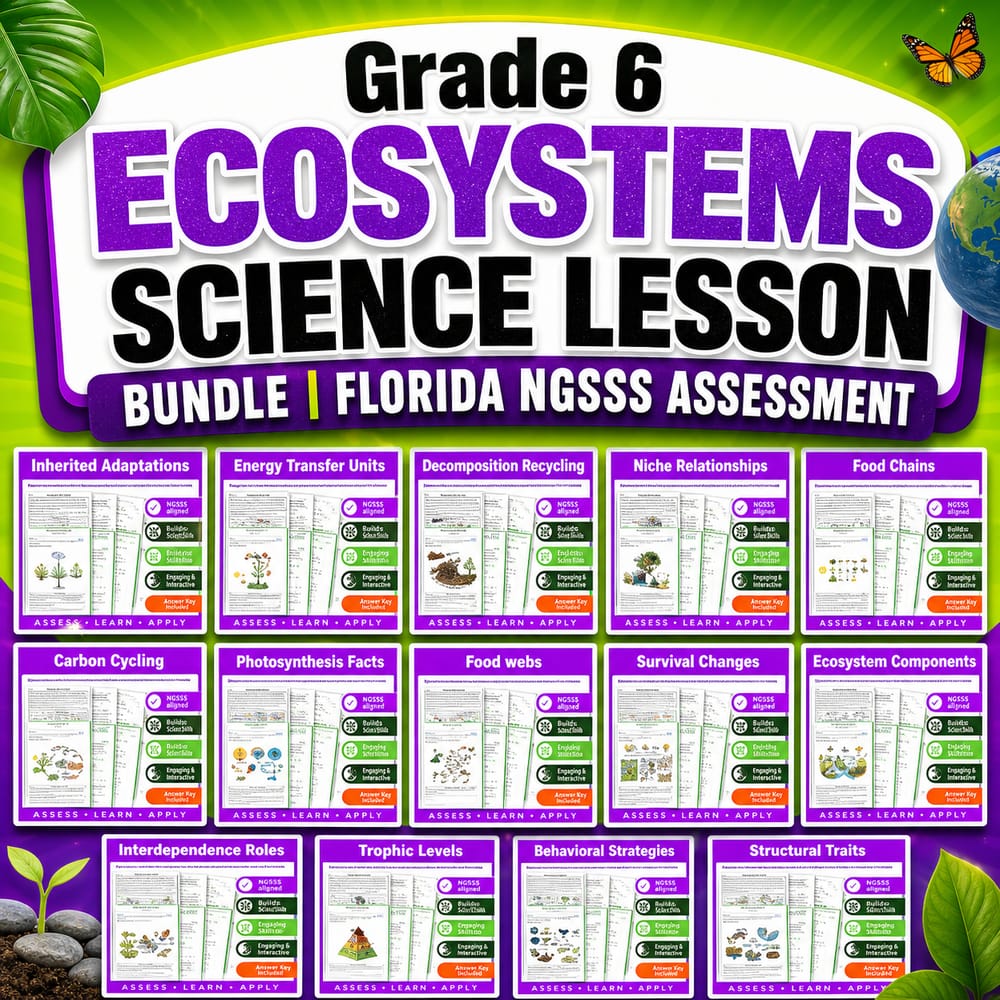
Grade 6 Ecosystems Science Lesson Bundle | Florida NGSSS Assessment — bundle cover
Grade 6 Ecosystems Science Lesson Bundle | Florida NGSSS Assessment — included worksheet 1
Grade 6 Ecosystems Science Lesson Bundle | Florida NGSSS Assessment — included worksheet 2
Grade 6 Ecosystems Science Lesson Bundle | Florida NGSSS Assessment — included worksheet 3
Grade 6 Ecosystems Science Lesson Bundle | Florida NGSSS Assessment — included worksheet 4
Grade 6 Ecosystems Science Lesson Bundle | Florida NGSSS Assessment — included worksheet 5
Grade 6 Ecosystems Science Lesson Bundle | Florida NGSSS Assessment — included worksheet 6
Grade 6 Ecosystems Science Lesson Bundle | Florida NGSSS Assessment — included worksheet 7
Grade 6 Ecosystems Science Lesson Bundle | Florida NGSSS Assessment — included worksheet 8
Grade 6 Ecosystems Science Lesson Bundle | Florida NGSSS Assessment — included worksheet 9
Grade 6 Ecosystems Science Lesson Bundle | Florida NGSSS Assessment — included worksheet 10
Grade 6 Ecosystems Science Lesson Bundle | Florida NGSSS Assessment — included worksheet 11
Grade 6 Ecosystems Science Lesson Bundle | Florida NGSSS Assessment — included worksheet 12
Grade 6 Ecosystems Science Lesson Bundle | Florida NGSSS Assessment — included worksheet 13
Grade 6 Ecosystems Science Lesson Bundle | Florida NGSSS Assessment — included worksheet 14
Grade 6 Science worksheet — Grade 6 Ecosystems Science Lesson Bundle | Florida NGSSS Assessment

Description

Overview


Grade Grade 6 Science Mini Bundle focused on ecosystems and adaptations assessments supports a printable classroom unit aligned to Florida (NGSSS). Use these standards-aligned unit resources independently for checkpoints or alongside your full-year curriculum to maintain consistent topic coverage across the school year. 📘

Grade | Subject | Framework | Lessons Included | Total Resources | Resource Type Grade 6 | Science | Florida (NGSSS) | 14 assessment lessons | 14 total resources | Assessment worksheet PDFs


What’s Included


This collection includes 14 lessons and 14 Assessment resources.

  • ✅ Trophic Levels Assessment for Grade 6 Science | Florida NGSSS Standard – Check understanding of how energy moves through trophic levels.
  • ✅ Survival Changes Assessment | NGSSS Grade 6 Science Standards – Assess how traits can improve survival in changing conditions.
  • ✅ Structural Traits Assessment | Florida NGSSS Grade 6 Science Worksheet – Evaluate knowledge of structure and how it supports function.
  • ✅ Physiological Traits Assessment | Standards-Aligned Assessment Grade 6 Science – Measure comprehension of internal processes linked to traits.
  • ✅ Niche Relationships Assessment for Grade 6 Science | Florida NGSSS – Determine whether students can explain niche roles in ecosystems.
  • ✅ Interdependence Roles Assessment | Florida NGSSS Grade 6 Science – Practice evidence-based explanations of relationships among organisms.
  • ✅ Inherited Adaptations Assessment | NGSSS Grade 6 Science Standards – Assess how inherited adaptations affect populations over time.
  • ✅ Food Webs Assessment | Florida NGSSS Grade 6 Science – Evaluate ability to interpret connections across a food web.
  • ✅ Food Chains Assessment for Grade 6 Science | Florida NGSSS Standards – Check understanding of correct food chain sequencing and energy flow.
  • ✅ Energy Transfer Limits Assessment | NGSSS Grade 6 Science – Assess reasoning about why energy transfer decreases at each level.
  • ✅ Ecosystem Components Assessment | Florida NGSSS Standards Grade 6 Science – Measure mastery of biotic and abiotic ecosystem components.
  • ✅ Decomposition Recycling Assessment | Florida NGSSS Grade 6 Science – Confirm student understanding of decomposers and nutrient cycling.
  • ✅ Carbon Cycling Assessment | NGSSS Standards Grade 6 Science – Evaluate how carbon moves through living and nonliving parts of Earth systems.
  • ✅ Behavioral Strategies Assessment | Florida NGSSS Standards Grade 6 Science – Assess how behavior can increase survival and resource use.

All materials are provided in PDF format only.


Skills & Standards Alignment


These assessments build mastery by moving from structure/function and traits to ecology-focused systems thinking within Florida (NGSSS). Students are asked to use crosscutting concepts such as systems and system models, structure and function, and cause and effect to explain how organisms interact. Disciplinary core ideas related to life science ecology are reinforced through evidence-based explanations about survival, adaptation, and interdependence. Modeling is supported when learners interpret food chains and food webs, while analytical reasoning is emphasized through prompts that require students to justify claims using details from the scenario or diagram.


Perfect For


  • Teachers seeking structured instruction
  • Sub plans
  • Homework or review
  • Intervention or centers
  • Assessment preparation

How to Use


Use this lesson bundle as a multi-day assessment sequence: administer one worksheet per day or rotate them through small groups, then review answers using the included teacher support materials to plan the next round of instruction. Pair each assessment with a prior mini-lesson on the same target (for example, food chains before food webs, or adaptations before niche relationships) and keep a running error log to guide reteaching. Since these are printable classroom unit resources in PDF form, they’re ready for immediate differentiation in centers, intervention blocks, or homework review without adding new digital workflows.


Closing


Choose this curriculum-aligned lesson collection to check progress efficiently and keep your Florida NGSSS ecosystems instruction topic-focused.

Grade 6 Ecosystems Science Lesson Bundle | Florida NGSSS Assessment

$56.00$70.00Save $14.00
Prism Point Learning
·2 followers·13 sales
SubjectScienceGradeGrade 6

What’s included

14 worksheets · Save $14.00 (20%) · prices shown inside the bundle

  1. Inherited Adaptations Assessment | NGSSS Grade 6 Science Standards
    Inherited Adaptations Assessment | NGSSS Grade 6 Science Standards

    Grade 6 · Science · 8 Pages

    • Explain how inherited adaptations help organisms survive and reproduce in specific environments.
    • Identify examples of adaptations related to feeding, protection, and tolerance to temperature or moisture.
    • Distinguish inherited adaptations from individual behaviors or short-term responses.
    $4.00$5.00
  2. Energy Transfer Limits Assessment | NGSSS Grade 6 Science
    Energy Transfer Limits Assessment | NGSSS Grade 6 Science

    Grade 6 · Science · 8 Pages

    • Explain why energy transfer between trophic levels is inefficient
    • Describe how heat loss affects the amount of energy available to organisms at higher levels
    • Predict how removing a species or food source can impact populations across a food web
    $4.00$5.00
  3. Decomposition Recycling Assessment | Florida NGSSS Grade 6 Science
    Decomposition Recycling Assessment | Florida NGSSS Grade 6 Science

    Grade 6 · Science

    • Explain how decomposers break down dead organisms and waste into simpler materials.
    • Describe how decomposition returns nutrients to the environment for producers to use again.
    • Connect decomposition to matter cycling and ecosystem stability over time.
    $4.00$5.00
  4. Niche Relationships Assessment for Grade 6 Science | Florida NGSSS
    Niche Relationships Assessment for Grade 6 Science | Florida NGSSS

    Grade 6 · Science

    • Explain what a niche is and how it describes an organism’s role in an ecosystem.
    • Identify how different niches can allow two species to coexist in the same habitat.
    • Analyze how niche overlap can increase competition when resources become limited.
    $4.00$5.00
  5. Food Chains Assessment for Grade 6 Science | Florida NGSSS Standards
    Food Chains Assessment for Grade 6 Science | Florida NGSSS Standards

    Grade 6 · Science

    • Identify the roles of producers and consumers in a food chain
    • Explain how energy transfers between trophic levels
    • Describe why real ecosystems often form food webs instead of single pathways
    $4.00$5.00
  6. Carbon Cycling Assessment | NGSSS Standards Grade 6 Science
    Carbon Cycling Assessment | NGSSS Standards Grade 6 Science

    Grade 6 · Science · 8 Pages

    • Explain how carbon moves through living systems using photosynthesis, respiration, feeding, and decomposition.
    • Identify the roles of producers, consumers, and decomposers in the carbon cycle.
    • Describe how carbon can be stored in organic matter and soil and later used again.
    $4.00$5.00
  7. Physiological Traits Assessment | Standards-Aligned Assessment Grade 6 Science
    Physiological Traits Assessment | Standards-Aligned Assessment Grade 6 Science

    Grade 6 · Science

    • Explain how physiological adaptations help organisms survive in specific environments
    • Identify examples of internal traits related to water balance, metabolism, and ion regulation
    • Interpret statements about physiological adaptations as true or false
    $4.00$5.00
  8. Food Webs Assessment | Florida NGSSS Grade 6 Science
    Food Webs Assessment | Florida NGSSS Grade 6 Science

    Grade 6 · Science

    • Explain what a food web is and how it shows feeding relationships in an ecosystem
    • Use food web ideas to describe how energy moves between trophic levels
    • Predict effects of changes to one organism on other organisms in a community
    $4.00$5.00
  9. Survival Changes Assessment | NGSSS Grade 6 Science Standards
    Survival Changes Assessment | NGSSS Grade 6 Science Standards

    Grade 6 · Science

    • Explain how environmental conditions affect which traits help organisms survive and reproduce.
    • Describe how changes in survival and reproduction can shift traits in a population over generations.
    • Connect adaptation to ecosystem change and resilience when resources or conditions shift.
    $4.00$5.00
  10. Ecosystem Components Assessment | Florida NGSSS Standards Grade 6 Science
    Ecosystem Components Assessment | Florida NGSSS Standards Grade 6 Science

    Grade 6 · Science

    • Identify abiotic factors and explain how they affect where organisms can live.
    • Distinguish biotic factors (producers, consumers, decomposers) by their roles in an ecosystem.
    • Use ecosystem component vocabulary to describe how ecosystem structure can vary by location.
    $4.00$5.00

Reviews & Feedback

Loading reviews...

Questions & Answers

Loading questions…

About this bundle

Related categories

Frequently asked questions

Who is Grade 6 Ecosystems Science Lesson Bundle | Florida NGSSS Assessment designed for?
Grade 6 Ecosystems Science Lesson Bundle | Florida NGSSS Assessment is designed for Grade 6 students and Science learners and can be used in classrooms, homeschool, or independent practice.
How do I download Grade 6 Ecosystems Science Lesson Bundle | Florida NGSSS Assessment?
Add it to your cart and complete checkout. After payment, you can download immediately from your account, and you'll also receive a download link by email.