
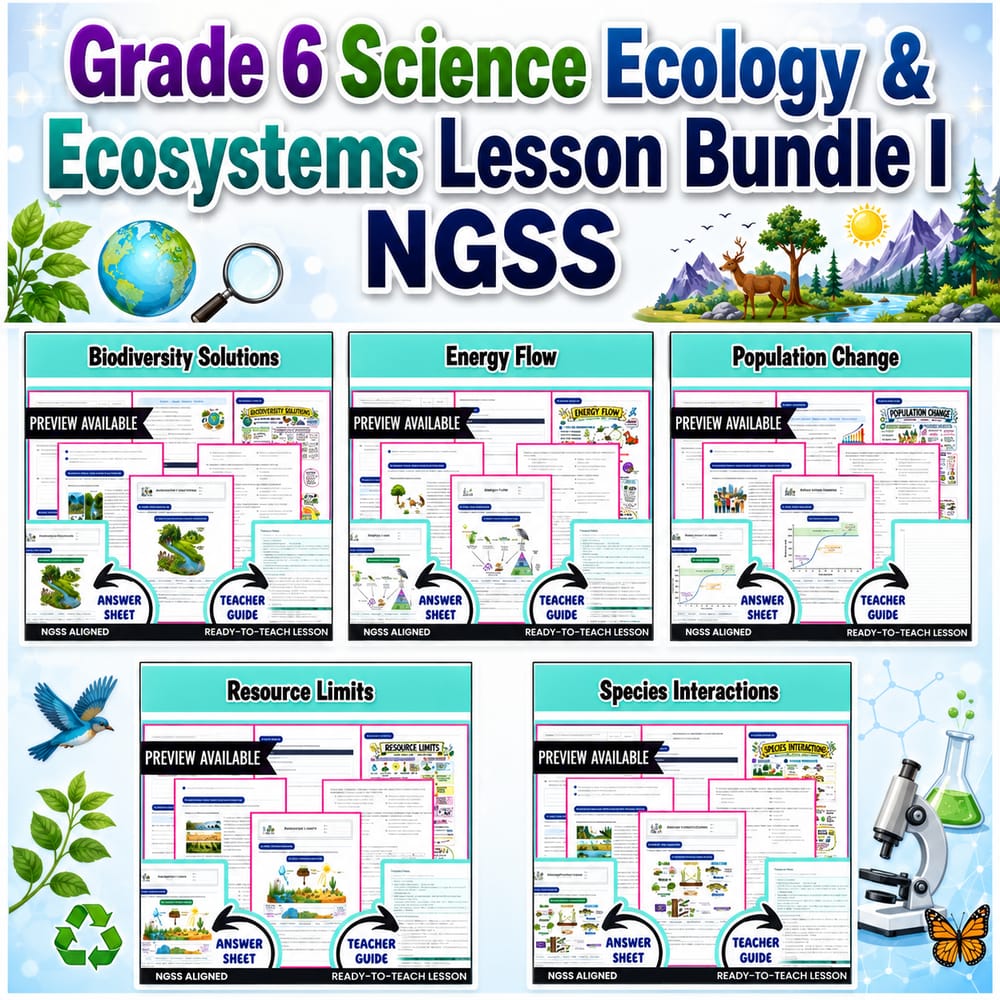
Grade 6 Science Ecology & Ecosystems Lesson Bundle | NGSS
$20.00$25.00Save $5.00
Amber Owl Education
New·0 followers·1 sales
SubjectScienceGradeGrade 6Pages82 Pages
What’s included
5 worksheets · 82 pages · Save $5.00 (20%) · prices shown inside the bundle
 Biodiversity Solutions Worksheet | NGSS Grade 6 Ecology Activity
- Compare conservation, habitat restoration, protected-area design, and invasive-species management as solutions to maintain biodiversity.
- Evaluate trade-offs in ecosystem services such as pollination, water purification, and nutrient cycling.
- Use case studies to explain how different strategies can affect species persistence under changing environmental pressures.
$4.00$5.00 Energy Flow Worksheet & Doodle Notes | NGSS Grade 6 Ecosystems
- Explain how energy moves through food webs from producers to consumers and decomposers.
- Use energy pyramids and trophic transfer efficiency to describe why energy decreases at higher trophic levels.
- Describe how photosynthesis and cellular respiration contribute to an organism’s energy budget.
$4.00$5.00 Population Change Worksheet | NGSS Grade 6 Ecology Activity & Notes
- Use data such as birth rate, death rate, and age structure to explain how populations change over time.
- Construct evidence-based claims linking ecosystem component changes (predators, invasive species, habitat, disease) to population increases or declines.
- Describe how trophic cascades and recovery or collapse patterns can occur in both terrestrial and aquatic systems.
$4.00$5.00 Resource Limits Worksheet | NGSS Grade 6 Ecology Activity & Doodle Notes
- Explain how limiting resources (like water, soil nutrients, and light) affect individual organisms and population sizes
- Interpret quantitative observations (counts and patterns across habitats) to describe how carrying capacity relates to resource availability
- Use data and spatial patterns to make claims about species distribution in marsh, desert, and forest environments
$4.00$5.00 Species Interactions Worksheet | NGSS Grade 6 Ecology Activity + Notes
- Construct explanations for patterns of species interactions across forest, grassland, and freshwater ecosystems.
- Identify mutualism, competition, predation, and parasitism as recurrent interaction types and describe their outcomes.
- Use niche overlap, resource availability, and behavioral strategies to predict interaction strength under different abiotic conditions.
$4.00$5.00
Reviews & Feedback
Loading reviews...
Questions & Answers
Loading questions…
About this bundle
Related categories
Frequently asked questions
Who is Grade 6 Science Ecology & Ecosystems Lesson Bundle | NGSS designed for?
Grade 6 Science Ecology & Ecosystems Lesson Bundle | NGSS is designed for Grade 6 students and Science learners and can be used in classrooms, homeschool, or independent practice.
How do I download Grade 6 Science Ecology & Ecosystems Lesson Bundle | NGSS?
Add it to your cart and complete checkout. After payment, you can download immediately from your account, and you'll also receive a download link by email.
Similar Products

Grade 11 Ecosystem Ecology Science Lesson Bundle Daily Reading Worksheets | NGSS
$19.20$24.00

Grade 9 Science Ecosystems Lesson Bundle | NGSS Interactions & Energy
$12.00$15.00

Grade 9 Science Lesson Bundle: Ecosystems and Ecology Worksheets
$24.00$30.00

Grade 10 Ecosystem Dynamics Lesson Bundle | NGSS Science Ecology
$28.00$35.00

Grade 9 Evolution, Genetics & Ecology Lesson Bundle | Florida NGSSS
$52.00$65.00