
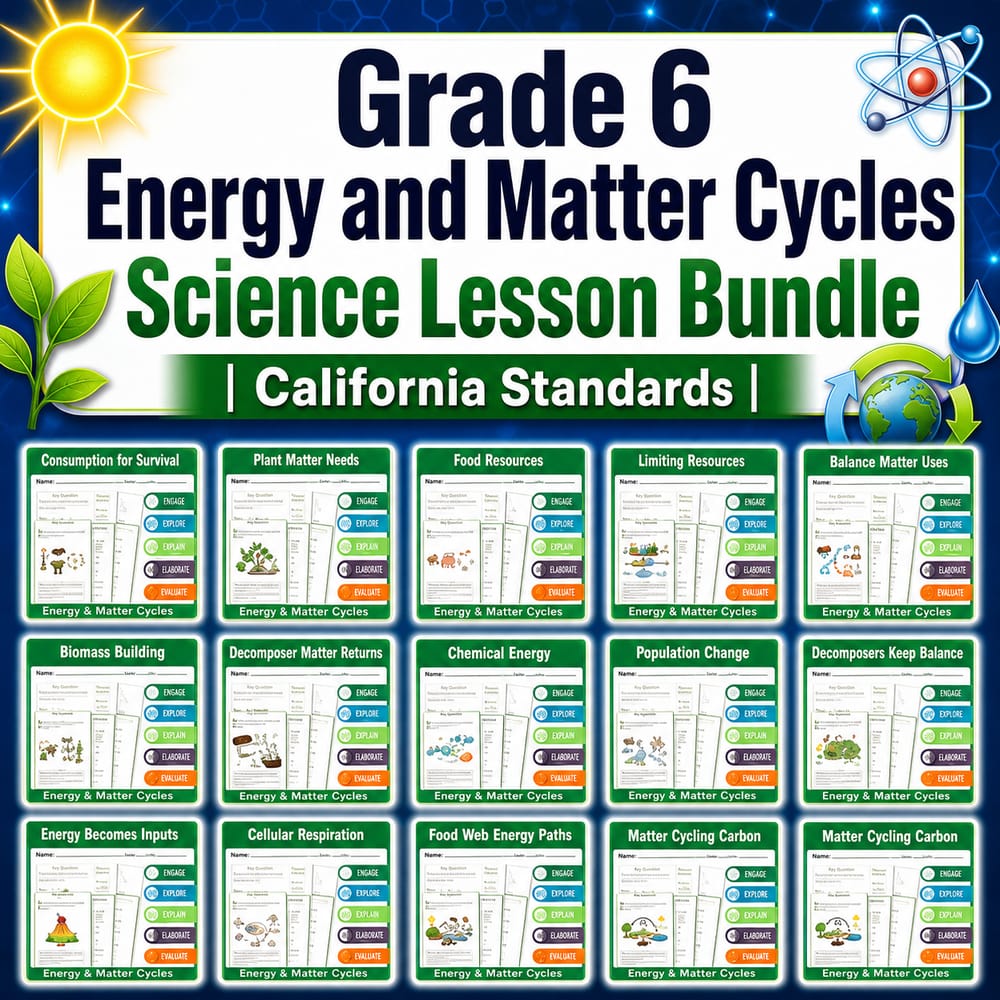


Grade 6 Energy and Matter Cycles Science Lesson Bundle | California Standards
$60.00$75.00Save $15.00
Prism Point Learning
·2 followers·13 sales
SubjectScienceGradeGrade 6
What’s included
15 worksheets · Save $15.00 (20%) · prices shown inside the bundle
 Competition for Survival Assessment | California Standards Grade 6 Science
- Explain how competition for limited resources can affect survival and reproduction
- Describe direct and indirect competition and give examples
- Use cause-and-effect reasoning to connect resource availability to population changes
$4.00$5.00 Plant Matter Inputs Assessment | California Standards Grade 6 Science
- Explain how carbon dioxide, water, and gases from the atmosphere provide raw materials for plant growth
- Describe how roots, leaves, and plant cells use environmental inputs to build biomass
- Use evidence from text to answer questions about matter entering and leaving plant systems
$4.00$5.00 Food Molecules Assessment for Grade 6 Science | Standards-Aligned
- Explain how food molecules provide both building materials and stored energy in the body.
- Describe how digestion breaks large food molecules into smaller molecules that can be absorbed.
- Identify how different food molecules (proteins, carbohydrates, fats) meet different needs of cells.
$4.00$5.00 Limiting Resources Assessment | California Standards Grade 6 Science
- Explain how limiting resources affect population size in ecosystems.
- Identify examples of limiting resources such as water, nutrients, or space.
- Describe how organisms may respond to scarcity, but why population growth eventually slows.
$4.00$5.00 Animals Matter Use Assessment | California Standards Grade 6 Science
- Explain how animals need both matter and energy to live, grow, and function
- Describe how food provides matter that becomes parts of an animal’s body
- Describe how food provides energy that supports life processes such as movement and maintaining body temperature
$4.00$5.00 Biomass Building Assessment for Grade 6 Science | California Standards
- Explain how photosynthesis provides carbon-based molecules that plants use to build new tissues.
- Describe how carbohydrates, proteins, and fats contribute to plant structure and function.
- Connect plant biomass growth to a continuous supply of matter and energy through chemical processes.
$4.00$5.00 Decomposer Matter Return Assessment Grade 6 Science | California Standards
- Explain how decomposers recycle matter in ecosystems by breaking down dead organisms and waste
- Describe how atoms and nutrients move from living things to nonliving parts of an ecosystem (soil and water) and back to producers
- Compare the roles of decomposers and producers in maintaining ecosystem functioning
$4.00$5.00 Chemical Energy Release Assessment | California Standards Grade 6 Science
- Explain how chemical energy in food molecules is transformed to power life processes.
- Describe how energy is conserved in organisms as it changes form (useful energy and heat).
- Use evidence from a scientific passage to support claims about how feeding supports sustained functioning.
$4.00$5.00 Population Change Assessment | California Standards Grade 6 Science
- Explain how birth rates and death rates affect population size over time
- Describe how resource availability can increase or decrease populations
- Use population data patterns to infer changes in environmental conditions
$4.00$5.00 Photosynthesis Energy Conversion Assessment | California Standards Grade 6 Science
- Explain how photosynthesis converts light energy into chemical energy stored in glucose and other carbon-based molecules.
- Describe the roles of water, carbon dioxide, and sunlight in the light-dependent steps and the Calvin cycle.
- Identify oxygen as a byproduct of photosynthesis and explain how photosynthesis supports life on Earth.
$4.00$5.00
Reviews & Feedback
Loading reviews...
Questions & Answers
Loading questions…
About this bundle
Related categories
Frequently asked questions
Who is Grade 6 Energy and Matter Cycles Science Lesson Bundle | California Standards designed for?
Grade 6 Energy and Matter Cycles Science Lesson Bundle | California Standards is designed for Grade 6 students and Science learners and can be used in classrooms, homeschool, or independent practice.
How do I download Grade 6 Energy and Matter Cycles Science Lesson Bundle | California Standards?
Add it to your cart and complete checkout. After payment, you can download immediately from your account, and you'll also receive a download link by email.
Similar Products

Grade 9 Science Waves, Forces, Energy & Matter Lesson Bundle | California Standards
$56.00$70.00

Grade 7 Science Matter Cycling & Energy Transformations Lesson Bundle | NGSS
$20.00$25.00

Grade 7 Ecosystem Energy & Matter Cycles Science Lesson Bundle
$48.00$60.00

Grade 7 Energy Flow and Matter Cycling Science lesson bundle – California Standards
$48.00$60.00

Grade 8 Forces, Energy & Matter Science Lesson Bundle | California Standards
$48.00$60.00