
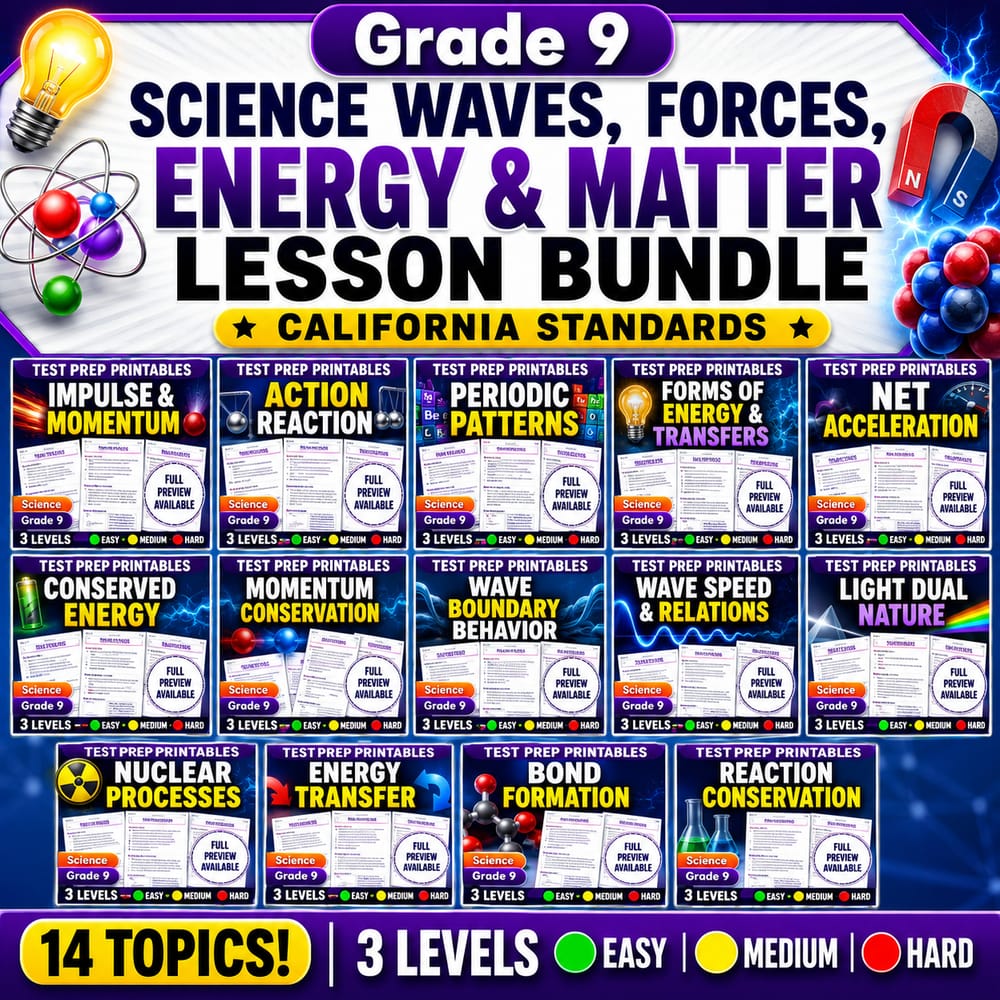


Grade 9 Science Waves, Forces, Energy & Matter Lesson Bundle | California Standards
$56.00$70.00Save $14.00
Prism Point Learning
·2 followers·14 sales
SubjectScienceGradeGrade 9
What’s included
14 worksheets · Save $14.00 (20%) · prices shown inside the bundle
 Impulse and Momentum Worksheet | Grade 9 Physics Science Practice
- Explain how impulse relates net force to a change in momentum
- Use the idea that impulse depends on both force and time duration to interpret safety design
- Describe how the direction of impulse determines the direction of momentum change
$4.00$5.00 Newton’s Third Law Action Reaction Forces Worksheet | Grade 9 Science
- Explain Newton’s third law using action-reaction force pairs between two interacting objects.
- Describe how equal-magnitude, opposite-direction forces affect the motion of each object separately.
- Use momentum ideas to predict what happens when objects push or collide.
$4.00$5.00 Periodic Patterns Worksheet | Grade 9 Chemistry Periodic Table Activities
- Explain how atomic number relates to repeating patterns in the periodic table.
- Predict trends in element properties (reactivity and typical ion charge) using group and period patterns.
- Describe how electron arrangement in outer energy levels drives periodic behavior.
$4.00$5.00 Energy Conversion Systems Worksheet | Grade 9 Science Energy Transformations
- Explain how energy conversion systems follow the law of conservation of energy while producing waste energy
- Describe efficiency as a measure of how much input energy becomes useful output energy
- Identify common energy conversions in electrical devices, motors, and generators
$4.00$5.00 Net Acceleration Worksheet | Grade 9 Science Standardized Assessment
- Explain Newton’s second law using the relationship between net force, mass, and acceleration
- Determine how unbalanced forces and their directions affect acceleration and motion
- Use vector ideas to reason about combining forces and predicting acceleration changes over time
$4.00$5.00 Conserved Energy Worksheet | Energy Conservation Grade 9 Science
- Explain energy conservation in a closed system using a quantitative energy-accounting approach.
- Identify how energy transfers and converts among kinetic, potential, internal, and radiation-related forms.
- Use energy diagrams to track changes while applying the rule that total energy stays constant in an isolated/closed system.
$4.00$5.00 Momentum Conservation Worksheet | Collisions & Physics Grade 9 Science
- Explain how momentum depends on mass and velocity and use the momentum formula in reasoning.
- Apply the law of conservation of momentum to collisions and explosions when only internal forces act.
- Compare elastic and inelastic collisions by tracking momentum and kinetic energy outcomes.
$4.00$5.00 Wave Boundary Behavior Worksheet | Grade 9 Waves & Physics Activities
- Explain how waves behave at boundaries between media using reflection and refraction
- Describe how transmission and absorption affect the energy carried by waves
- Predict changes in wavelength and wave direction when wave speed changes across media
$4.00$5.00 Wave Speed Relations Worksheet Pack | Grade 9 Science Waves Activities
- Explain how wave speed depends on frequency and wavelength using the relationship v = fλ
- Compare how wave speed can differ across media and wave types (sound vs electromagnetic)
- Use wave-property relationships to predict how changing frequency or wavelength affects propagation
$4.00$5.00 Light Dual Nature Worksheet | Wave-Particle Theory Grade 9 Science
- Explain how light can behave like a wave (interference, diffraction, polarization) and like particles (discrete energy packets).
- Describe the photoelectric effect and how it supports a particle model of light.
- Connect photon energy to frequency using the idea of an energy threshold for electron emission.
$4.00$5.00
Reviews & Feedback
Loading reviews...
Questions & Answers
Loading questions…
About this bundle
Related categories
Frequently asked questions
Who is Grade 9 Science Waves, Forces, Energy & Matter Lesson Bundle | California Standards designed for?
Grade 9 Science Waves, Forces, Energy & Matter Lesson Bundle | California Standards is designed for Grade 9 students and Science learners and can be used in classrooms, homeschool, or independent practice.
How do I download Grade 9 Science Waves, Forces, Energy & Matter Lesson Bundle | California Standards?
Add it to your cart and complete checkout. After payment, you can download immediately from your account, and you'll also receive a download link by email.
Similar Products

Grade 12 Physics & Chemistry Matter, Energy, and Waves Lesson Bundle | California Standards
$56.00$70.00

Grade 12 Energy, Forces, and Waves Science Lesson Bundle | California Standards
$56.00$70.00

Grade 9 Waves, Forces, and Energy Science Lesson Bundle | General
$38.40$48.00

Grade 9 Science Waves, Forces & Energy Transfer Worksheets Bundle
$28.80$36.00

Motion, Energy, Waves & DC Circuits Lesson Bundle – Grade 11 Science Ontario
$48.00$60.00