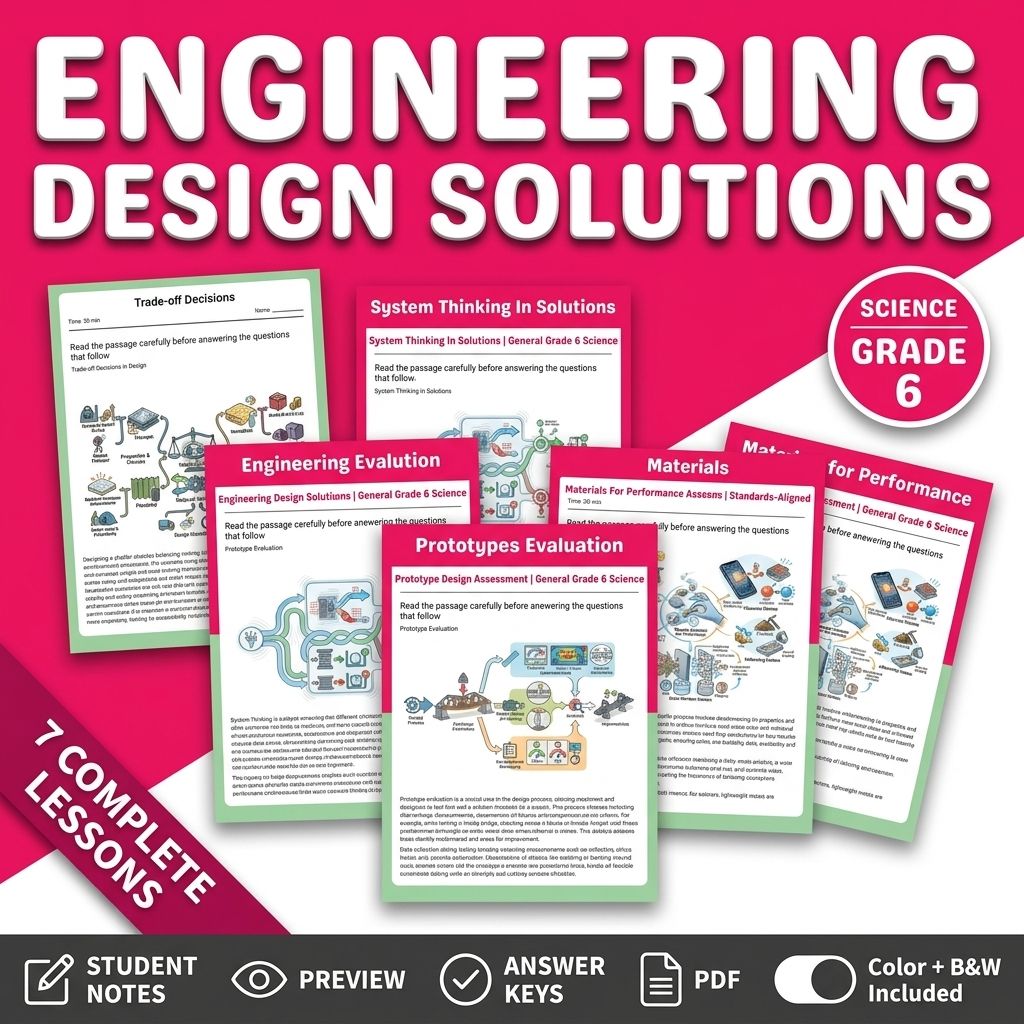
Grade 6 Engineering Design Solutions Science Lesson Bundle: General Framework — bundle cover
Grade 6 Engineering Design Solutions Science Lesson Bundle: General Framework — included worksheet 1
Grade 6 Engineering Design Solutions Science Lesson Bundle: General Framework — included worksheet 2
Grade 6 Engineering Design Solutions Science Lesson Bundle: General Framework — included worksheet 3
Grade 6 Engineering Design Solutions Science Lesson Bundle: General Framework — included worksheet 4
Grade 6 Engineering Design Solutions Science Lesson Bundle: General Framework — included worksheet 5
Grade 6 Engineering Design Solutions Science Lesson Bundle: General Framework — included worksheet 6
Grade 6 Engineering Design Solutions Science Lesson Bundle: General Framework — included worksheet 7
Grade 6 Science worksheet — Grade 6 Engineering Design Solutions Science Lesson Bundle: General Framework

Description

Overview


Grade Grade 6 Science Mini Bundle supports Grade 6 engineering design solutions using a General framework through 7 printable Assessment resources 🎓, designed to be used independently or sequenced within a full-year curriculum. These topic-focused assessment pages help students evaluate trade-offs, test prototypes, and explain improvement decisions using evidence from structured science and engineering tasks.

What’s Included


This collection includes 7 Assessment resources that correspond to the mini-unit lesson cycle, with printable PDF materials only.

  • ✅ Trade-off Decisions Assessment for Grade 6 Science | Standards-Aligned – Students identify criteria and compare competing options using provided scenarios.
  • ✅ System Thinking In Solutions Assessment | General Grade 6 Science – Students analyze how parts of a solution interact and predict system-level effects.
  • ✅ Prototype Evaluation Assessment for Grade 6 Science | Standards-Aligned – Students use results to judge how well prototypes meet performance criteria.
  • ✅ Materials For Performance Assessment | General Grade 6 Science – Students connect material choices to constraints, durability, and intended performance.
  • ✅ Iterative Improvement Assessment | Standards-Aligned Grade 6 Science – Students justify changes by referencing data, observations, and identified gaps.
  • ✅ Design Problem Assessment for Grade 6 Science | Standards-Based Worksheet – Students define problems, delimit constraints, and restate requirements clearly.
  • ✅ Criteria and Constraints Assessment | Standards-Aligned Grade 6 Science – Students sort and apply criteria/constraints to support decision-making in design work.

Use the included student pages, structured diagrams and prompts, practice/assessment activities, and answer keys to streamline grading and make expectations visible for learners. All materials are provided in PDF format only.

Skills & Standards


Built within a General framework, these assessments target engineering design thinking through crosscutting concepts such as Systems and System Models, Structure and Function, and Cause and Effect. Students engage disciplinary core ideas associated with engineering design (ETS1.A, ETS1.B, and ETS1.C) as they define problems, develop and evaluate solutions, and use optimization reasoning. The tasks emphasize modeling by having students interpret solution diagrams, prototype evidence, and system relationships before making claims. Students also practice analytical reasoning as they compare options against criteria/constraints, look for patterns in results, and explain how changes affect outcomes. Finally, each assessment is designed for evidence-based explanations—students must use observations or provided evidence to support their reasoning, not just restate preferences or steps.

Perfect For


  • Teachers seeking structured instruction
  • Sub plans
  • Homework or review
  • Intervention or centers
  • Assessment preparation

How to Use


Plan multi-day pacing by administering 1 assessment per day or pairing two shorter pages for a single class period, then using the answer keys to calibrate feedback during the same week your students work through related design discussions. Because this bundle sits within a full-year curriculum, slot it where your engineering design unit includes trade-offs, criteria/constraints, prototype evaluation, and iterative improvement; you can also run it as a focused printable classroom unit alongside your regular instruction. For practical classroom routines, consider: (1) use the design problem and criteria/constraints pages as a quick entry check, (2) complete system thinking and materials/performance prompts during guided small groups or stations, (3) assign the prototype evaluation and iterative improvement tasks as an independent checkpoint, and (4) keep selected diagrams or evidence organizers as student supports for sub-plan days.

Closing


This standards-aligned, topic-focused lesson bundle helps Grade 6 Science learners demonstrate engineering design reasoning with clear, evidence-based assessment tasks and consistent printable support.

Grade 6 Engineering Design Solutions Science Lesson Bundle: General Framework

$28.00$35.00Save $7.00
Prism Point Learning
·2 followers·13 sales
SubjectScienceGradeGrade 6

What’s included

7 worksheets · Save $7.00 (20%) · prices shown inside the bundle

  1. Prototype Evaluation Assessment for Grade 6 Science | Standards-Aligned
    Prototype Evaluation Assessment for Grade 6 Science | Standards-Aligned

    Grade 6 · Science · 7 Pages

    • Understand how data and constraints are used to evaluate prototypes.
    • Identify different types of evidence, including measurements and observations.
    • Learn how to interpret failures and compare results to criteria.
    $4.00$5.00
  2. Materials For Performance Assessment | General Grade 6 Science
    Materials For Performance Assessment | General Grade 6 Science

    Grade 6 · Science · 7 Pages

    • Understand how material properties influence their suitability for different applications.
    • Compare the factors like strength, water resistance, and conductivity in material selection.
    • Analyze how practical limitations such as cost and availability affect material choices.
    $4.00$5.00
  3. Criteria and Constraints Assessment | Standards-Aligned Grade 6 Science
    Criteria and Constraints Assessment | Standards-Aligned Grade 6 Science

    Grade 6 · Science · 7 Pages

    • Understand the difference between criteria and constraints in the design process.
    • Identify examples of criteria and constraints in real-world design scenarios.
    • Explain how constraints limit possible solutions while criteria define success.
    $4.00$5.00
  4. Iterative Improvement Assessment | Standards-Aligned Grade 6 Science
    Iterative Improvement Assessment | Standards-Aligned Grade 6 Science

    Grade 6 · Science · 7 Pages

    • Understand the concept of iterative improvement and how it involves evaluation and refinement.
    • Identify the steps involved in using data to improve prototypes or designs.
    • Explain how trade-offs are managed during iterative design processes.
    $4.00$5.00
  5. Design Problem Assessment for Grade 6 Science | Standards-Based Worksheet
    Design Problem Assessment for Grade 6 Science | Standards-Based Worksheet

    Grade 6 · Science

    • Understand the key components involved in solving a design problem.
    • Identify constraints and requirements in designing protective cases.
    • Apply problem-solving strategies to real-world engineering challenges.
    $4.00$5.00
  6. Trade-off Decisions Assessment for Grade 6 Science | Standards-Aligned
    Trade-off Decisions Assessment for Grade 6 Science | Standards-Aligned

    Grade 6 · Science

    • Understand how design choices involve trade-offs affecting properties like strength, flexibility, and insulation.
    • Identify the impact of material choices on weight, cost, and usability in shelter design.
    • Analyze how trade-offs relate to user needs and environmental constraints.
    $4.00$5.00
  7. System Thinking In Solutions Assessment | General Grade 6 Science
    System Thinking In Solutions Assessment | General Grade 6 Science

    Grade 6 · Science

    • Understand the concept of systems thinking and how components interact within a system.
    • Identify cause-and-effect relationships in system design and performance.
    • Analyze how changes to one part of a system can influence overall behavior.
    $4.00$5.00

Reviews & Feedback

Loading reviews...

Questions & Answers

Loading questions…

About this bundle

Related categories

Frequently asked questions

Who is Grade 6 Engineering Design Solutions Science Lesson Bundle: General Framework designed for?
Grade 6 Engineering Design Solutions Science Lesson Bundle: General Framework is designed for Grade 6 students and Science learners and can be used in classrooms, homeschool, or independent practice.
How do I download Grade 6 Engineering Design Solutions Science Lesson Bundle: General Framework?
Add it to your cart and complete checkout. After payment, you can download immediately from your account, and you'll also receive a download link by email.