
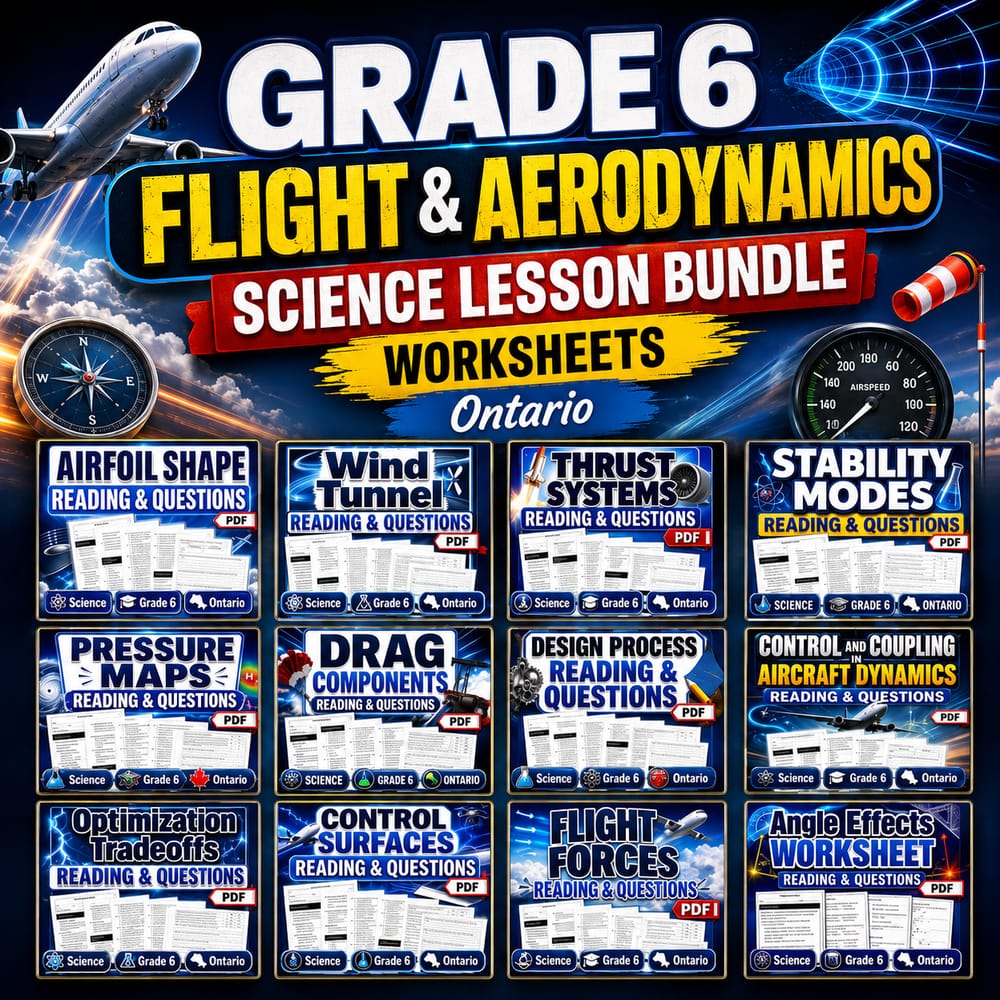


Grade 6 Flight & Aerodynamics Science Lesson Bundle Worksheets (Ontario)
$38.40$48.00Save $9.60
Evergreen Desk Education
·2 followers·17 sales
SubjectScienceGradeGrade 6
What’s included
12 worksheets · Save $9.60 (20%) · prices shown inside the bundle
 Grade 6 Science Worksheet | Understanding Airfoil Shapes (PDF)
- Explain how camber, thickness, chord length, and leading-edge curvature affect pressure distribution and lift.
- Compare simplified Bernoulli ideas with Newtonian ideas for lift in a clear, grade-appropriate way.
- Describe how angle of attack and critical angles relate to lift and stall.
$3.20$4.00 6th Grade Science | Wind Tunnel Worksheet (Ontario Standards) (PDF)
- Explain how a wind tunnel measures aerodynamic forces and moments on models using force balances and pressure taps
- Describe how similarity parameters (Reynolds and Mach numbers) affect scaled testing and boundary-layer behavior
- Calculate lift and drag coefficients from measured forces and interpret flow-visualization evidence
$3.20$4.00 6th Grade Science | Thrust Systems Worksheet (Ontario) – PDF
- Explain how propellers and jet engines produce thrust to overcome drag
- Compare propulsive efficiency at different speeds for propeller-driven vs jet-driven systems
- Describe how thrust-to-weight ratio affects acceleration and climb
$3.20$4.00 6th Grade Science | Understanding Stability Modes Worksheet (PDF)
- Explain the difference between static and dynamic stability using center of gravity and aerodynamic effects
- Describe how wing geometry and control surfaces influence longitudinal, lateral, and directional stability
- Identify stability behaviors such as damping, phugoid, and Dutch roll and their implications for safe control
$3.20$4.00 6th Grade Science – Pressure Map Worksheet (Ontario Standards) (PDF)
- Explain what a pressure map shows about airflow over an airfoil surface
- Identify how stagnation points, suction peaks, and pressure minima relate to lift
- Describe how changes in camber and angle of attack shift pressure coefficient patterns across the chord
$3.20$4.00 Grade 6 Science – Drag Components Worksheet (Ontario Standards PDF)
- Categorize aerodynamic drag into parasitic drag and induced drag
- Explain how form drag, skin-friction drag, and interference drag contribute to parasitic drag
- Describe why induced drag is tied to lift production and wing span
$3.20$4.00 6th Grade Science – Design Process Worksheet (Ontario Standards) (PDF)
- Describe the iterative design process used to improve an aircraft or glider concept.
- Identify how performance specifications and trade-offs affect lift, drag, weight, and stability.
- Interpret the meaning of measured lift and drag coefficients from tests or simulations.
$3.20$4.00 Grade 6 Science Worksheet | Control Coupling and Aircraft Dynamics (Ontario)
- Explain how roll, pitch, and yaw control inputs can affect each other through aerodynamic interactions
- Identify examples of adverse yaw and elevator–aileron coupling and describe the causes
- Describe engineering and piloting techniques (e.g., differential and Frise ailerons, trim systems, control mixers) used to reduce unwanted coupled responses
$3.20$4.00 6th Grade Science – Optimization Tradeoffs Worksheet (Ontario PDF)
- Explain how multi-criteria design balances lift, drag, weight, stability, and manufacturability.
- Describe Pareto trade-offs and how a performance envelope guides selection of viable designs.
- Use parameter tuning and structural constraints to predict how design changes affect performance and safety margins.
$3.20$4.00 6th Grade Science | Control Surfaces Worksheet (Ontario Standards) (PDF)
- Explain how primary control surfaces (ailerons, elevators, rudder) control roll, pitch, and yaw.
- Describe how secondary surfaces (flaps and trim) change lift, drag, and handling through deflection and trim settings.
- Understand control authority and why hinge moments and surface sizing affect responsiveness and energy cost.
$3.20$4.00
Reviews & Feedback
Loading reviews...
Questions & Answers
Loading questions…
About this bundle
Related categories
Frequently asked questions
Who is Grade 6 Flight & Aerodynamics Science Lesson Bundle Worksheets (Ontario) designed for?
Grade 6 Flight & Aerodynamics Science Lesson Bundle Worksheets (Ontario) is designed for Grade 6 students and Science learners and can be used in classrooms, homeschool, or independent practice.
How do I download Grade 6 Flight & Aerodynamics Science Lesson Bundle Worksheets (Ontario)?
Add it to your cart and complete checkout. After payment, you can download immediately from your account, and you'll also receive a download link by email.
Similar Products

Grade 6 Aerodynamics | Flight - Science Lesson Bundle – Ontario Framework
$48.00$60.00

Grade 6 Aerodynamics Flight Design Science lesson bundle - Ontario
$48.00$60.00

Grade 6 Science Aviation Unit Aerodynamics & Flight Testing Lesson Bundle
$48.00$60.00

Grade 6 Science Flight Lesson Bundle | Ontario Framework
$28.80$36.00

Grade 6 Science Unit Bundle | Flight, Air Pressure & Aerodynamics Worksheets
$60.00$75.00