
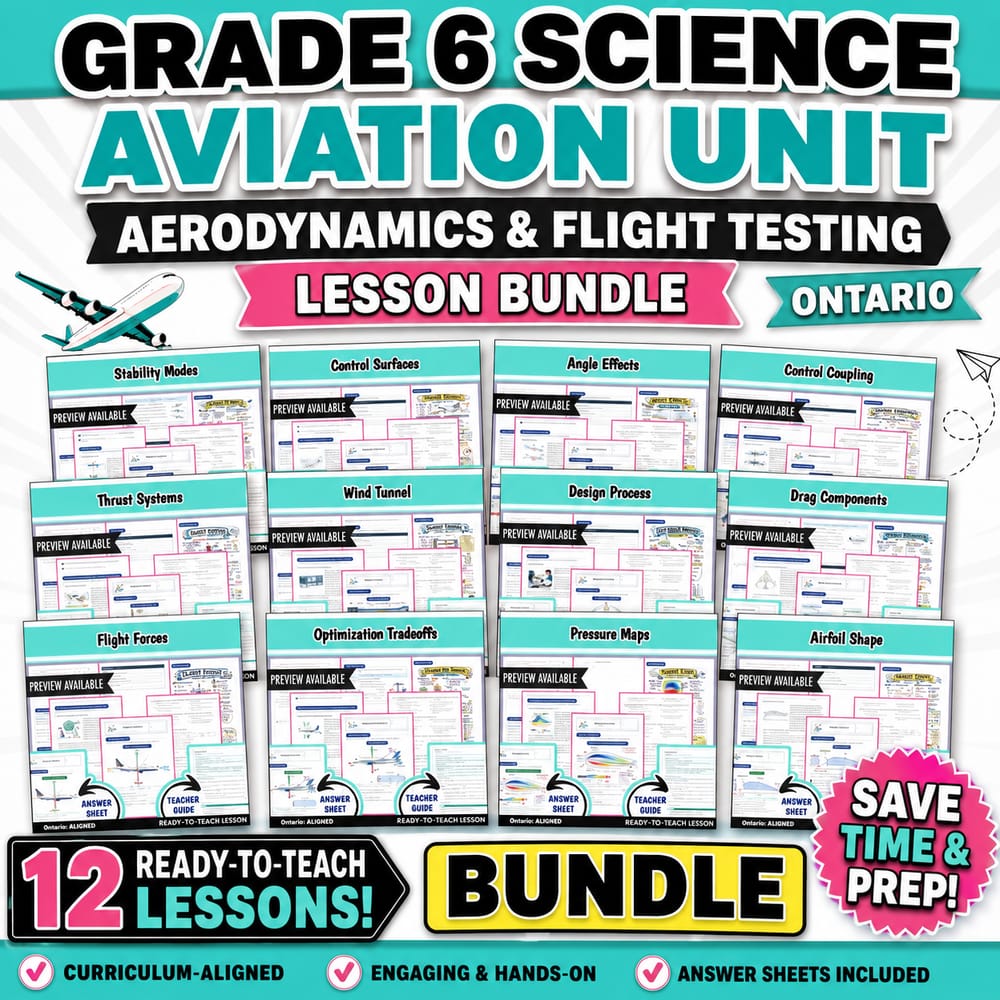


Grade 6 Science Aviation Unit Aerodynamics & Flight Testing Lesson Bundle
$48.00$60.00Save $12.00
Chalk and Compass
·5 followers·13 sales
SubjectScienceGradeGrade 6
What’s included
12 worksheets · Save $12.00 (20%) · prices shown inside the bundle
 Stability Modes Worksheet Grade 6 Science | Aircraft Stability
- Explain static and dynamic stability and how they relate to aircraft behavior after a disturbance
- Describe how center of gravity position relative to the aerodynamic center affects longitudinal stability
- Identify how dihedral angle and tail/fin design contribute to roll, pitch, and directional stability
$4.00$5.00 Control Surfaces Worksheet Grade 6 Science | Ontario Aviation Unit
- Identify primary and secondary control surfaces and describe what each one helps control (roll, pitch, and yaw).
- Explain how deflecting a control surface changes lift and produces a turning moment.
- Describe control authority and how trim and surface sizing affect aircraft responsiveness and energy cost during maneuvers.
$4.00$5.00 Angle Effects Science Worksheet Grade 6 | Lift, Airflow & Stall
- Explain how angle of attack affects airflow, lift, and stall onset
- Identify the linear lift region and what happens after the critical angle is passed
- Describe how wing incidence and control inputs change the effective angle of attack
$4.00$5.00 Control Coupling Science Worksheet Grade 6 Ontario + Doodle Notes
- Explain how roll, pitch, and yaw controls can interact through aerodynamic forces.
- Describe adverse yaw and elevator–aileron coupling in simple cause-and-effect terms.
- Identify design features (like differential and Frise ailerons) that reduce unwanted coupled moments.
$4.00$5.00 Grade 6 Thrust Systems Worksheet | Aircraft Propulsion & Forces
- Explain how propellers create axial thrust by accelerating air backward
- Compare jet propulsion and propeller propulsion using Newton’s third law and momentum
- Describe how thrust-to-weight ratio affects acceleration and climb
$4.00$5.00 Wind Tunnel Worksheet Grade 6 Science | Aerodynamics & Flight Testing
- Explain how wind tunnels measure aerodynamic forces and moments on scaled models
- Describe how similarity parameters like Reynolds number and Mach number help scientists interpret test results
- Use measured forces to understand how lift and drag coefficients are determined
$4.00$5.00 Grade 6 Design Process Worksheet | Engineering Design Cycle Ontario
- Explain the iterative design process using design criteria, prototyping, testing, and refinement.
- Describe how lift and drag measurements help refine an aircraft or glider concept.
- Identify key trade-offs among lift, drag, weight, and stability in aerodynamic design.
$4.00$5.00 Drag Components Worksheet & Doodle Notes | Grade 6 Ontario Science
- Categorize drag into parasitic drag and induced drag and explain how each relates to flight and airflow.
- Identify components of parasitic drag (form drag, skin-friction drag, and interference drag) and relate them to factors like speed and shape.
- Explain why induced drag is an unavoidable by-product of lift generation and how wing span and lift distribution affect it.
$4.00$5.00 Flight Forces Science Worksheet Grade 6 | Lift Drag Thrust Weight
- Explain how lift, drag, thrust, and weight act as interacting forces that determine motion.
- Identify weight as gravity acting downward and describe lift as the upward aerodynamic resultant.
- Use vector ideas and equilibrium to predict steady level flight, climb, and descent.
$4.00$5.00 Optimization Tradeoffs Science Worksheet Grade 6 Ontario STEM Activity
- Explain how optimizing multiple design goals can create tradeoffs between performance and safety in engineering systems
- Use Pareto trade-off thinking to compare configurations and justify choosing a viable design envelope
- Describe how constraints (like structure and materials) affect outcomes such as aspect ratio and stability buffers
$4.00$5.00
Reviews & Feedback
Loading reviews...
Questions & Answers
Loading questions…
About this bundle
Related categories
Frequently asked questions
Who is Grade 6 Science Aviation Unit Aerodynamics & Flight Testing Lesson Bundle designed for?
Grade 6 Science Aviation Unit Aerodynamics & Flight Testing Lesson Bundle is designed for Grade 6 students and Science learners and can be used in classrooms, homeschool, or independent practice.
How do I download Grade 6 Science Aviation Unit Aerodynamics & Flight Testing Lesson Bundle ?
Add it to your cart and complete checkout. After payment, you can download immediately from your account, and you'll also receive a download link by email.