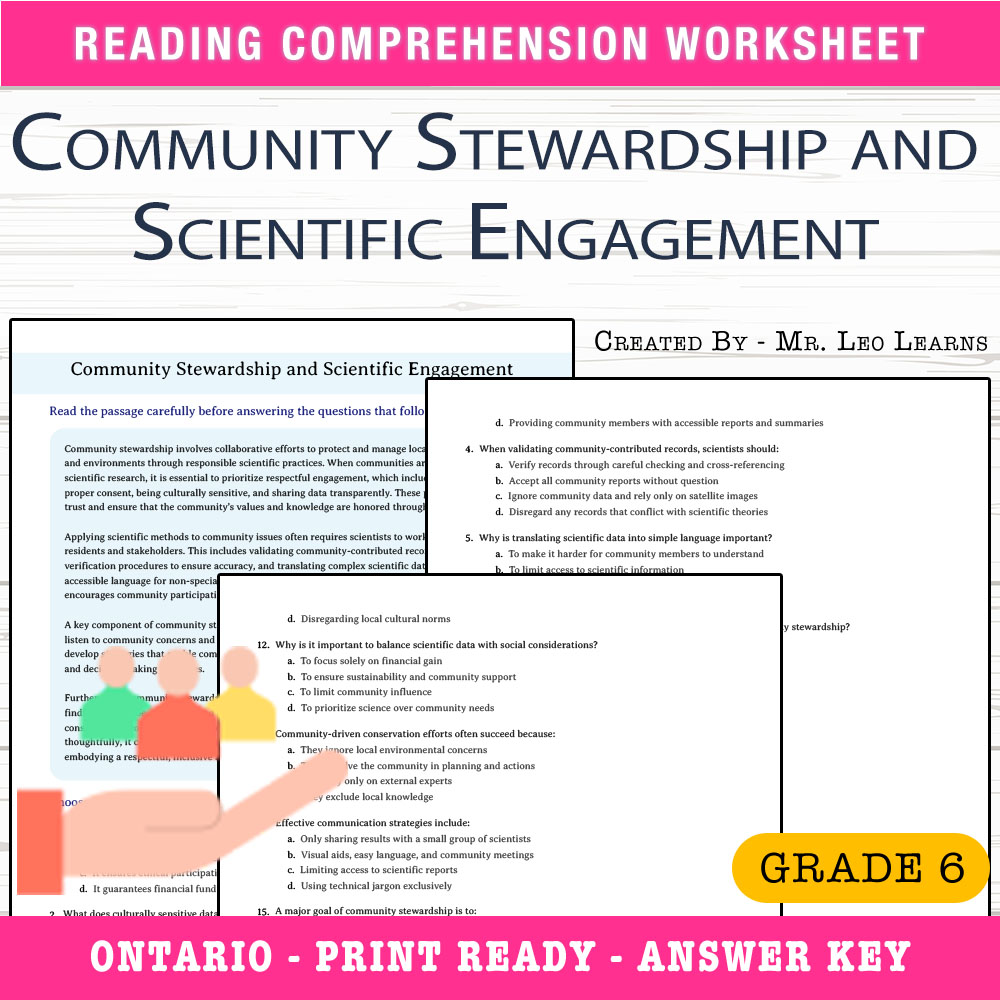
Imagine a busy classroom where students are learning about the importance of active participation in local environmental efforts. The teacher hands out a worksheet designed to deepen understanding of community stewardship and scientific engagement, topics that are vital for fostering responsible citizenship and scientific literacy. Students read a short passage about how communities work together to protect natural resources and then answer questions that reinforce key ideas. This worksheet helps clarify complex concepts like community collaboration, cultural sensitivity in research, and ethical data collection, providing a straightforward, structured approach to these important topics.
What This Resource Helps Students Do
This worksheet guides students through reading comprehension and critical thinking about community stewardship. It supports their ability to analyze what responsible scientific engagement involves and understand the ethical considerations behind community-based research. The multiple-choice questions encourage students to apply their knowledge, distinguish between different practices, and reflect on real-world scenarios. By working through these questions independently, students build confidence in explaining scientific and civic concepts, strengthening both their comprehension and their reasoning skills in social and environmental science.
Inside the PDF
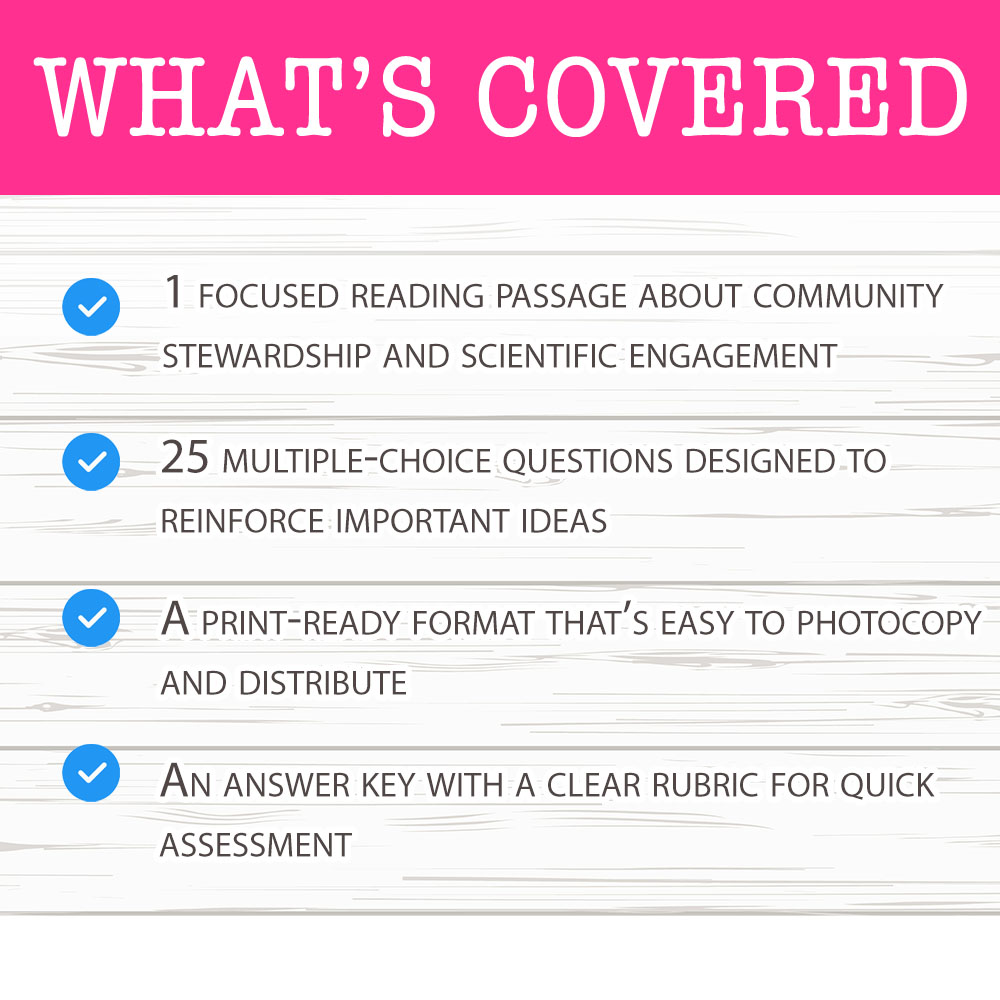
• 1 focused reading passage about community stewardship and scientific engagement
• 25 multiple-choice questions designed to reinforce important ideas
• A print-ready format that’s easy to photocopy and distribute
• An answer key with a clear rubric for quick assessment
• Layout optimized for classroom use with minimal preparation needed
How It Improves Learning
This worksheet serves as a practical tool to strengthen students’ understanding of working responsibly in the community and applying scientific ethics. The reading passage engages students with real-world applications, making abstract concepts more tangible. The questions are structured to progressively build their comprehension and reasoning, helping students move from basic understanding to more nuanced thinking. The format encourages independent work, giving students confidence as they answer each question and reinforce key ideas. As they interpret scenarios about consent and cultural sensitivity, they develop critical thinking skills essential for responsible scientific engagement and community participation. Overall, this resource helps students connect science with civic responsibility, nurturing both academic growth and social awareness.
Core Skills Students Will Develop
- ➡️ Reading comprehension of science texts
- ➡️ Understanding ethical considerations in research
- ➡️ Critical thinking about community involvement
- ➡️ Application of scientific concepts in real-world contexts
Ways Teachers Use This Worksheet
This worksheet can be used as part of classroom activities, homework assignments, or review sessions. It works well for small-group discussions and can serve as an assessment tool to gauge students’ grasp of community engagement concepts. Teachers may also use it for early finishers or as supplementary reinforcement following lessons on civic responsibility and environmental science. Its straightforward format makes it adaptable for various instructional strategies, supporting student learning at different paces and levels.
Why This PDF Saves Time
This ready-to-print PDF makes lesson planning easier by providing a comprehensive, classroom-ready resource that requires no additional setup. Teachers can distribute it immediately, reducing prep time while ensuring consistency in instruction. The included answer key simplifies grading and helps maintain clear standards for student understanding. Its print-and-go design keeps the focus on teaching, not on creating or modifying materials, making it a reliable tool for busy classrooms.
Remember, this worksheet is designed to be student-friendly and easy to implement—all set for quick distribution and engaging student discussion. It supports confident learning and fosters responsible scientific and civic awareness, empowering students to become active community members with an understanding of ethical research practices. 😊