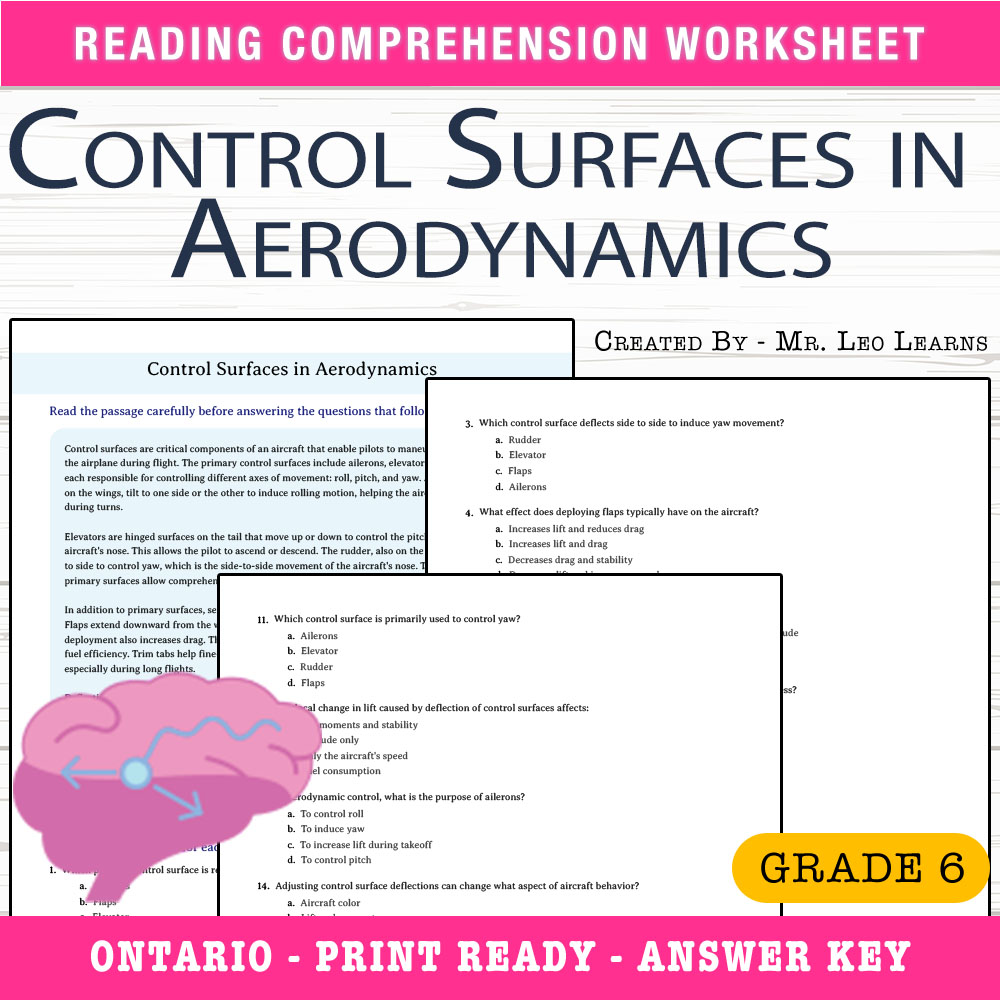
Imagine standing at the back of your classroom, watching students struggle to grasp how aircraft change direction and stay stable during flight. When discussing control surfaces like ailerons, elevators, and rudders, many sixth graders find it challenging to connect these components to real-world aerodynamics. This worksheet offers a straightforward, print-and-go solution to help students develop a clear understanding of how control surfaces influence airplane movement and stability. Designed for classroom use, it provides a practical resource to reinforce key concepts with minimal prep time for teachers.
What This Resource Helps Students Do
This worksheet guides students through the fundamental ideas behind control surfaces and their roles in aerodynamics. It encourages students to read and analyze a passage, then engage with multiple-choice questions to reinforce comprehension. The questions help students recognize the primary functions of each control surface, understand how pilots manipulate these parts to control an aircraft, and connect theory with practical aviation concepts. As students work through the activities, they build confidence in explaining how control surfaces contribute to aircraft maneuverability, supporting skill development in scientific reasoning and applied mechanics.
Inside the PDF
Use concise bullet lines separated by :
• 1 detailed reading passage explaining control surfaces and their importance in aerodynamics
• 25 multiple-choice questions focused on key control surfaces and their functions
• A clear, print-ready layout requiring no preparation or additional materials
• PDF answer key with rubric to facilitate quick grading
• Designed for easy photocopying and classroom distribution
How It Improves Learning
This worksheet makes complex aerodynamics concepts accessible for Grade 6 students by providing clear explanations and engaging activities. The reading passage sets a solid foundation by introducing terminology and illustrating how control surfaces help pilots maneuver airplanes effectively. The multiple-choice questions allow students to apply what they’ve learned immediately, reinforcing their understanding and encouraging critical thinking. With this structured approach, students gain confidence in explaining the purpose of each control surface and how they alter aircraft flight. The answer key ensures teachers can quickly assess comprehension and provide targeted feedback, helping students progress from uncertainty to mastery. Overall, this resource blends reading comprehension, scientific vocabulary, and reasoning skills, making the learning process both effective and engaging.
Core Skills Students Will Develop
- ➡️ Understanding aerodynamics principles
- ➡️ Applying scientific vocabulary related to flight
- ➡️ Analyzing functional relationships in engineering
- ➡️ Developing critical thinking through scenario-based questions
Ways Teachers Use This Worksheet
This worksheet serves multiple purposes in the classroom. It is ideal for independent practice, allowing students to review control surfaces after a lesson, or as part of a targeted assessment. Teachers can incorporate it into small-group activities to facilitate discussion or assign it as homework to reinforce concepts learned during class. It also functions well as a quick review for students who finish early, or as a formative check to gauge understanding before moving on to more complex topics. Its print-and-go format makes it easy for teachers to implement without extra preparation, ensuring consistent and effective instruction.
Why This PDF Saves Time
This resource is designed to be instantly ready for classroom use. With a clean, printable layout, teachers can distribute the worksheet immediately without any additional setup. The comprehensive answer key with rubric helps streamline grading and provides clear benchmarks for student understanding. Its straightforward format minimizes prep time while maximizing instructional effectiveness, giving teachers a reliable tool for reinforcing concepts on control surfaces and aerodynamics.
As you prepare your lessons on flight and aircraft systems, this worksheet offers a practical, classroom-ready resource that supports student learning and confidence. It is designed to fit seamlessly into your curriculum and help students succeed in understanding the science of aerodynamics. 📚