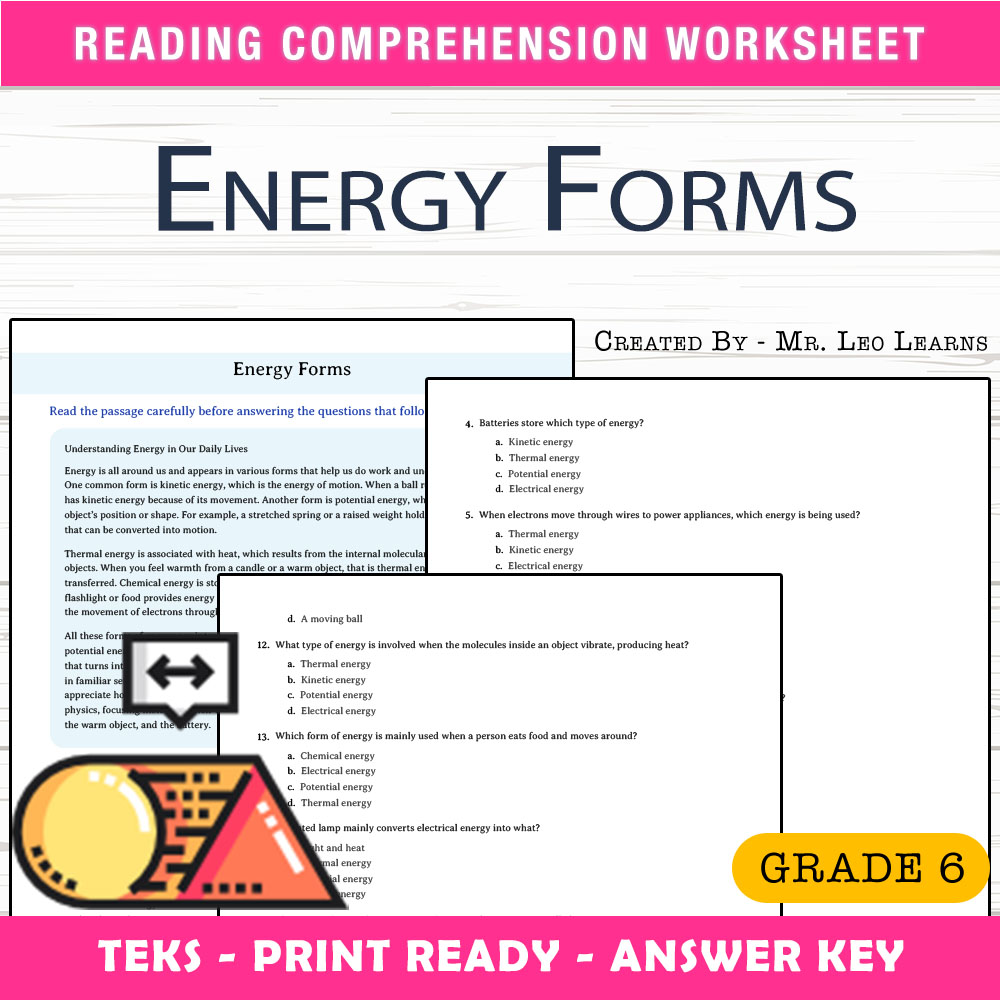
Imagine a busy classroom where students are eager to explore how energy powers the world around them. As they work through a lesson on different forms of energy, some students may find the concepts abstract or challenging to grasp. This worksheet provides a straightforward, reliable resource for teachers to clarify those ideas and guide students toward greater understanding. The structured questions, including a compelling reading passage and multiple-choice practice, help students connect real-world examples to scientific principles, making the topic both accessible and engaging.
What This Resource Helps Students Do
This worksheet supports students in developing a solid understanding of the various forms of energy, how energy transfers and transforms, and their role in everyday life. The reading passage offers background information that sets the context, while the multiple-choice questions reinforce key concepts and vocabulary. Students learn to identify different energy types such as kinetic, potential, electrical, and thermal, with opportunities to analyze scenarios and apply their knowledge independently. It fosters critical thinking and helps students build confidence in explaining their reasoning, preparing them for more complex science concepts.
Inside the PDF
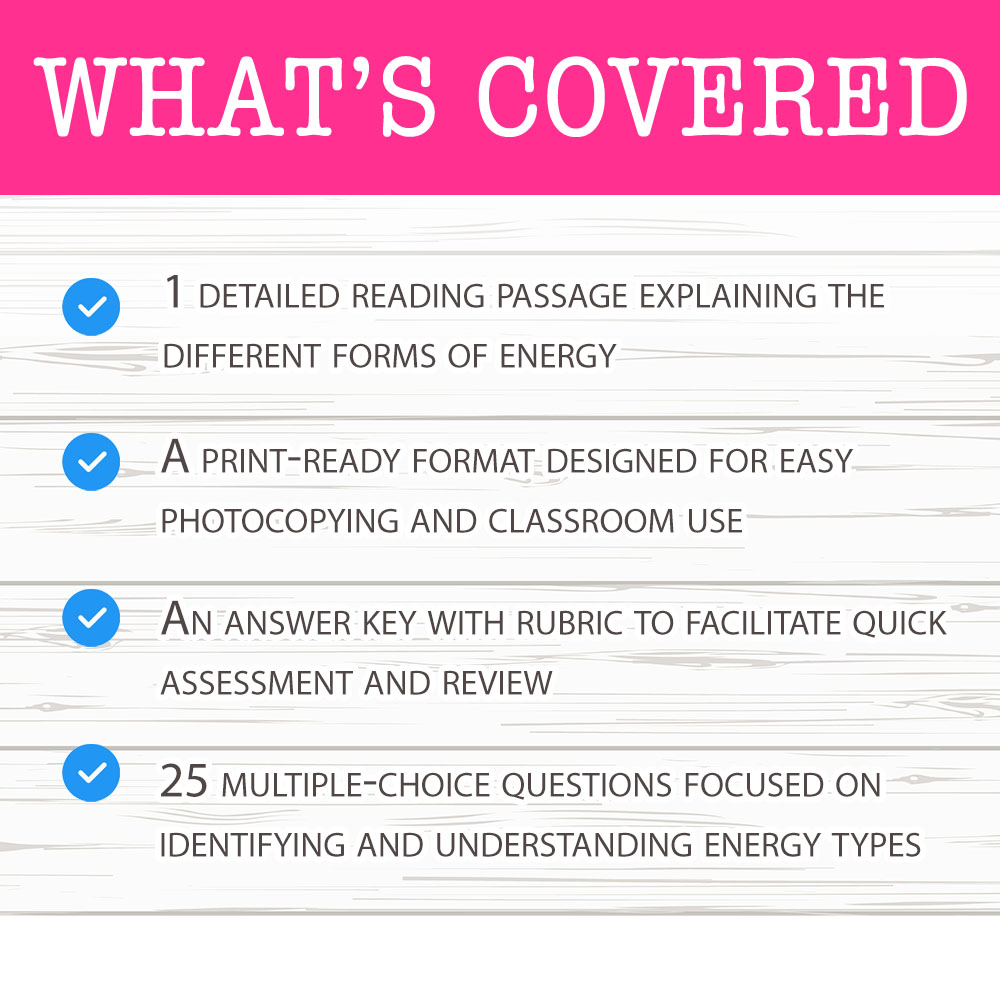
• 1 detailed reading passage explaining the different forms of energy
• 25 multiple-choice questions focused on identifying and understanding energy types
• A print-ready format designed for easy photocopying and classroom use
• Clear layout that requires no preparation before class
• An answer key with rubric to facilitate quick assessment and review
How It Improves Learning
This resource encourages active reading and critical thinking, which are essential for mastering scientific concepts. The reading passage contextualizes the different energy forms within familiar situations, helping students visualize and relate to the material. The multiple-choice questions challenge students to distinguish among energy types and understand their properties, promoting analytical skills. By working through these questions, students reinforce their learning, build confidence in their understanding, and develop a deeper appreciation for how energy influences daily life. Teachers can use this worksheet as a formative assessment tool or class activity to reinforce instruction effectively, ensuring students are prepared for higher-level science topics.
Core Skills Students Will Develop
- → Understanding different forms of energy
- → Applying scientific vocabulary accurately
- → Analyzing scenarios to identify energy types
- → Connecting real-world examples with scientific concepts
Ways Teachers Use This Worksheet
This worksheet is a versatile tool that can be incorporated into various classroom activities. Use it as part of a lesson on energy, assign it as homework for reinforcement, or utilize it during small-group work to provide targeted support. It is also effective for assessment review sessions or early finisher assignments, helping students deepen their understanding while keeping them engaged. Its print-and-go format makes it easy for teachers to implement without extra preparation, allowing more time to focus on student interactions and discussions.
Why This PDF Saves Time
This resource is designed to be print-ready, eliminating the need for extensive preparation. With clearly organized questions and an included answer key, teachers can quickly produce copies for the class and assess student understanding efficiently. The consistent format ensures reliable teaching and assessment, making it a practical addition to any science lesson plan. Its straightforward design supports seamless classroom integration, saving valuable time while maintaining quality instruction.
Ultimately, this worksheet is a supportive, classroom-ready tool that helps students grasp the essential concept of energy forms with confidence. It offers a structured approach to learning that builds foundational knowledge while simplifying the teacher’s workload. Ready to print and distribute, it makes science instruction more effective and enjoyable. 😊