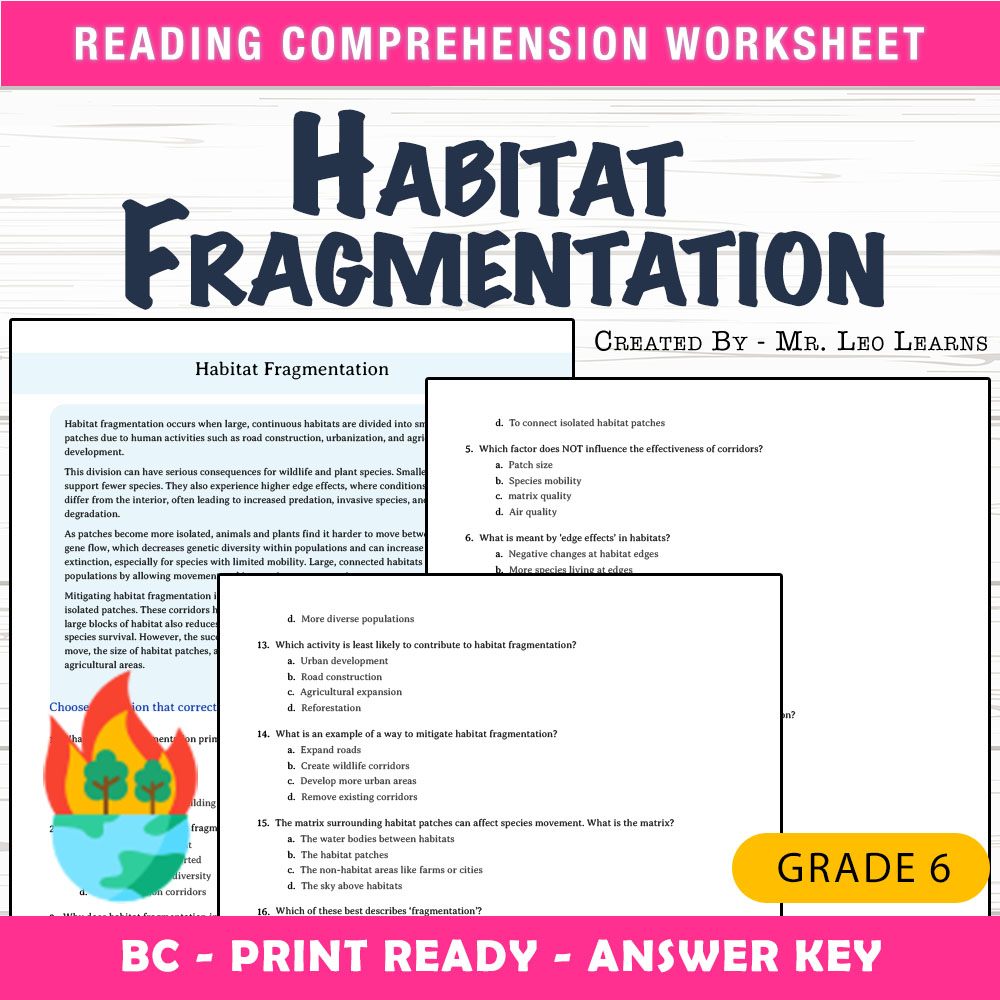
Imagine standing at the front of your classroom as students work through questions about habitat fragmentation, trying to grasp why large ecosystems are affected when divided. Some students may struggle to connect the concept of habitat divisions with their impacts on animals and plants. This PDF worksheet provides a clear, structured way for students to assess their understanding through multiple choice questions based on a reading passage. It is designed to guide students step-by-step, helping them develop confidence in analyzing ecological changes and the causes behind habitat fragmentation.
What This Resource Helps Students Do
This worksheet offers an engaging way for students to deepen their understanding of habitat fragmentation and its effects on biodiversity. By reading a brief passage and answering related multiple choice questions, students learn to identify causes such as deforestation and urban development. The worksheet encourages independent thinking and applies key scientific concepts to real-world scenarios, fostering critical thinking skills. As students navigate through the questions, they reinforce their ability to analyze environmental issues and make connections between human activity and ecosystem health.
Inside the PDF
• 1 reading passage explaining habitat fragmentation and its effects
• 25 structured questions designed for step-by-step comprehension
• A print-ready format that requires no preparation
• PDF answer key with a rubric for easy assessment
• Layout optimized for photocopying and classroom use
How It Improves Learning
This worksheet promotes active learning by breaking down complex ecological concepts into manageable parts. The reading passage introduces key ideas in a straightforward manner, making it accessible for Grade 6 students. The multiple choice questions challenge students to think critically about causes and consequences of habitat fragmentation, encouraging reasoning and evidence-based answers. The structured questions help students articulate their understanding clearly, building confidence in scientific literacy. Teachers can use this as a formative assessment or a reinforcement activity after instruction, ensuring students grasp foundational ecological principles while developing their test-taking skills.
Core Skills Students Will Develop
- ➡️ Reading comprehension of scientific passages
- ➡️ Critical thinking about environmental issues
- ➡️ Analysis of cause-and-effect relationships
- ➡️ Applying scientific vocabulary accurately
Ways Teachers Use This Worksheet
Many educators incorporate this resource into their lesson plans by using it as classroom work, homework assignment, or quick assessment tool. It can serve as practice after introducing the topic of ecosystems and human impacts. Teachers also find it useful for small-group discussions, review sessions, or as an early finisher activity when students complete other tasks. Its print-and-go format makes it easy to implement with minimal prep, providing a dependable resource to reinforce ecological concepts efficiently.
Why This PDF Saves Time
This worksheet is designed with busy teachers in mind: it is ready to print and distribute, eliminating the need for time-consuming preparations. The included answer key allows for quick grading, saving valuable classroom time. Because the questions are well-structured and clearly laid out, teachers can be confident in the consistency and reliability of the assessment. This reduces stress and ensures that assessment of student understanding is straightforward and efficient, giving teachers more time to focus on student needs and follow-up instruction.
Remember, this resource is completely classroom-ready, built to support your teaching and your students' learning journey. Simply print and use it to help students develop a stronger understanding of habitat fragmentation with confidence. 😊