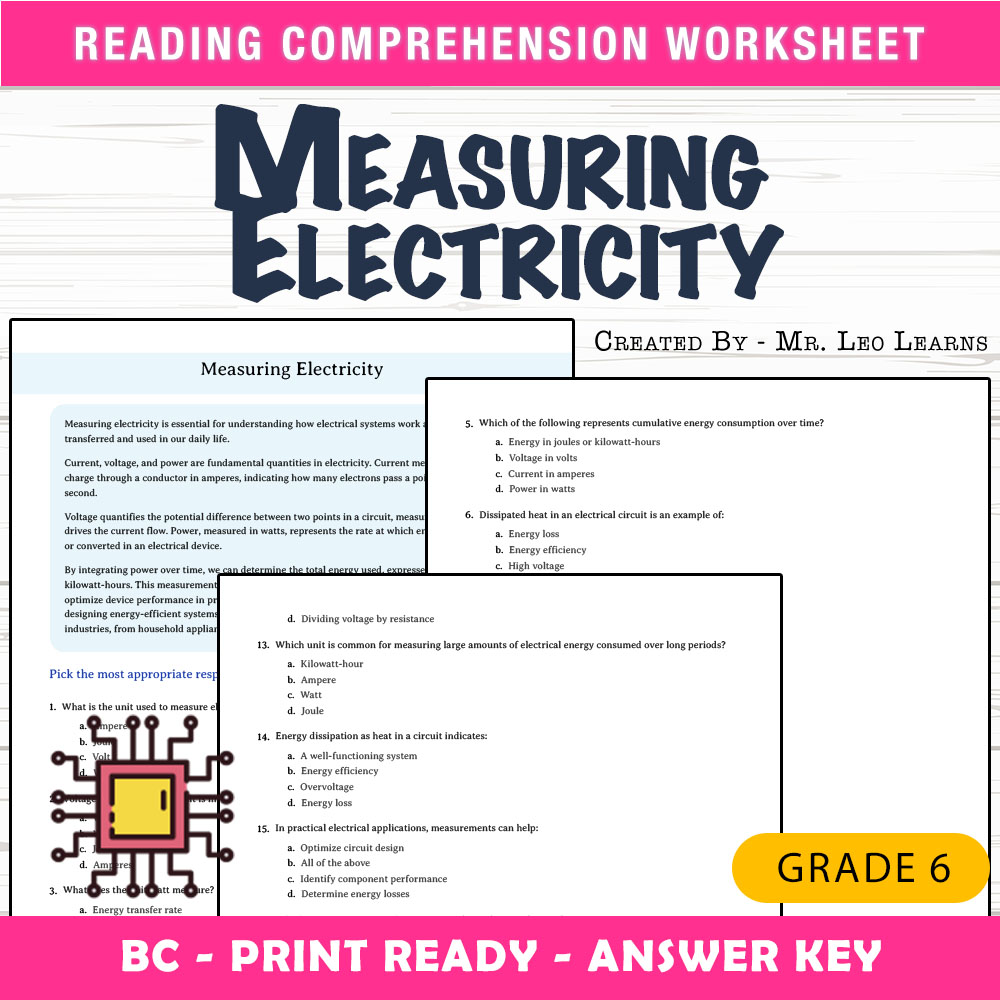
Imagine standing at the front of your classroom as students work through a lesson on measuring electricity. Some students look uncertain when asked about the units used to measure electrical current or voltage, revealing a common area of confusion. This worksheet provides a straightforward, printable resource that guides students through understanding these concepts with clarity and structure. It serves as an effective tool to reinforce their grasp of electrical measurement and helps them build confidence in their ability to interpret key scientific quantities related to electricity.
What This Resource Helps Students Do
This worksheet supports students in mastering fundamental concepts related to measuring electrical quantities such as current and voltage. The activities are designed to promote independent thinking, allowing students to practice identifying units, interpreting measurement data, and applying their understanding through multiple-choice questions. It encourages critical reasoning by prompting students to analyze information, differentiate between concepts, and confidently select correct answers. As students progress through the questions, they develop a clearer understanding of the practical significance of measuring electricity accurately in real-world contexts.
Inside the PDF
• 25 structured questions that guide students through understanding and applying concepts of measuring electricity
• A print-ready format that requires no additional preparation
• An answer key with a rubric for quick assessment
• Designed layout for easy photocopying and classroom distribution
How It Improves Learning
This worksheet provides a step-by-step approach that helps students move from basic recall to higher-level understanding of electric measurement. The initial questions prompt students to recognize key units, such as amperes for current and volts for voltage, reinforcing their vocabulary and conceptual knowledge. The multiple-choice questions are designed to challenge students to analyze scenarios and distinguish between different measurement units and their uses, fostering reasoning skills. The clear layout and focused content help students gain confidence in applying their knowledge practically, reducing misconceptions and increasing accuracy in assessments. Teachers can use this resource to reinforce instruction, provide meaningful practice, or assess understanding with minimal prep time, ensuring that student learning progresses steadily and confidently.
Core Skills Students Will Develop
- ➡️ Understanding and identifying electrical measurement units
- ➡️ Applying measurement concepts to real-world electrical systems
- ➡️ Analyzing scientific information and data
- ➡️ Building confidence in answering multiple-choice questions accurately
Ways Teachers Use This Worksheet
This worksheet can serve multiple classroom needs—used as part of a lesson to reinforce new content, assigned as a quick in-class practice activity, incorporated into homework to extend understanding, or employed as an assessment tool to gauge student progress. It’s ideal for small-group review sessions or early finishers who need additional practice. Teachers may also use it during review sessions before a quiz or unit test to solidify key measurement concepts in a supportive, structured format.
Why This PDF Saves Time
This resource is ready to print and distribute immediately, saving valuable planning and preparation time. Its layout is designed to be photocopied directly, ensuring consistency and saving effort in creating assessments from scratch. The included answer key allows for quick, accurate grading, giving teachers more time to focus on individual student needs or additional instruction. With a clear, straightforward format, this worksheet provides a reliable, classroom-ready tool that supports efficient teaching and learning.
Remember, this printable worksheet is designed to be teacher-friendly and student-centered, promoting understanding of measuring electricity with confidence. It’s a practical addition to your science resources, capable of enhancing student comprehension while saving you time in the classroom. 😊