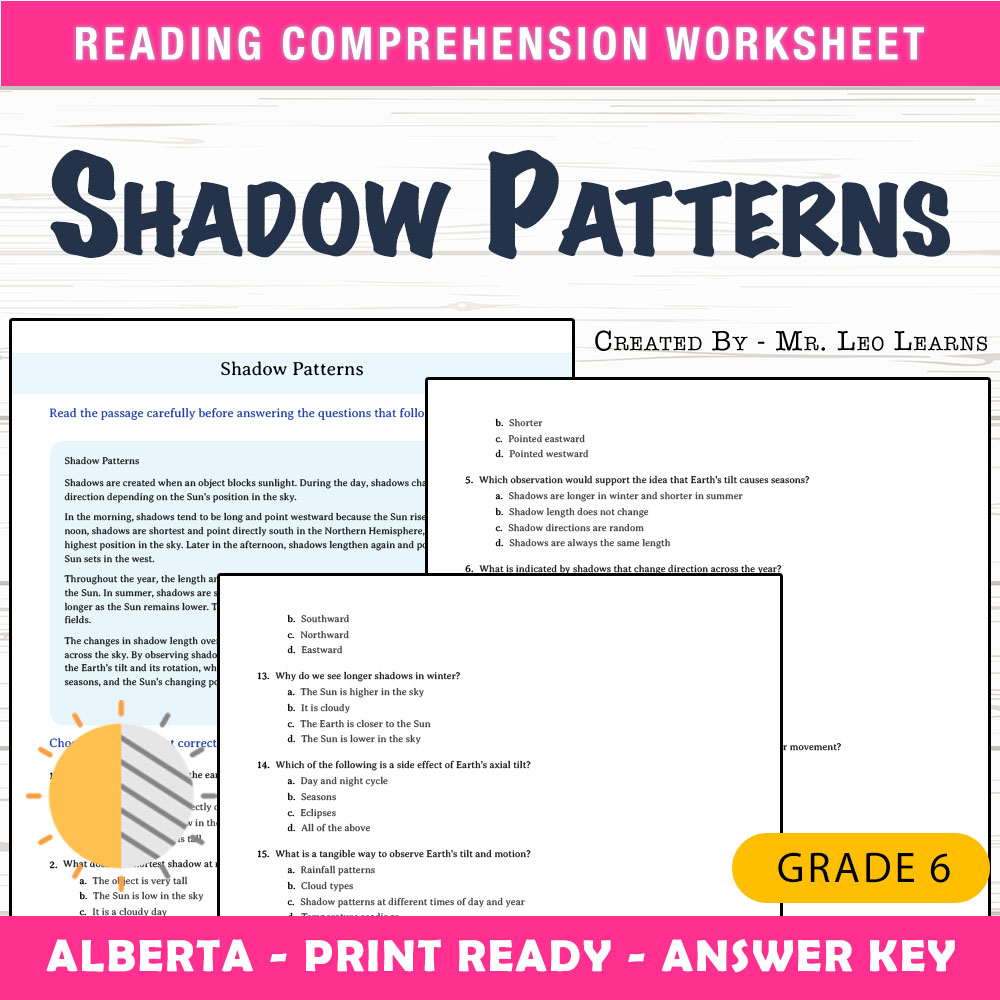
Imagine standing in a sunny outdoor space, trying to understand why your shadow stretches long in the early morning and late afternoon but shrinks at midday. As a teacher, you know that explaining how shadows form and change can be challenging for students. This worksheet provides a clear, straightforward resource that guides students through understanding shadow patterns, helping them grasp how the position of the Sun affects shadow length and direction. With its focus on key concepts like the relationship between Sun angle and shadow size, this worksheet simplifies the learning process, encouraging independent thinking and reinforcing scientific reasoning.
What This Resource Helps Students Do
This worksheet is designed to support students in developing a solid understanding of how shadows are created and how they change during the day. Through a combination of a reading passage and multiple-choice questions, students are guided to analyze and interpret how sunlight interacts with objects to form shadows. It encourages active reading and critical thinking, helping students connect real-world observations to scientific principles. By practicing these questions, students build confidence in identifying patterns and explaining phenomena related to shadows, preparing them for deeper scientific inquiry.
Inside the PDF
• 1 reading passage explaining how shadows are formed and why they change in length and direction
• 25 multiple-choice questions that assess understanding of shadow patterns and Sun positioning
• Layout designed for easy photocopying and classroom use
• Print-ready format requiring no preparation or additional materials
• Clear, simple design suitable for diverse classroom environments
How It Improves Learning
This worksheet enhances student understanding by providing targeted practice that connects observation to scientific concepts. The included reading passage offers foundational knowledge, setting the stage for the multiple-choice questions that reinforce this understanding. Students are prompted to think critically about why shadows are longest at certain times of day and shortest at noon, helping them grasp the relationship between Sun angle and shadow length. The variety of questions encourages reasoning, as students analyze scenarios and select correct explanations. Overall, this resource helps students move from initial confusion to clarity by building their confidence and understanding step by step.
Core Skills Students Will Develop
- ➡️ Analyzing how light sources affect shadow formation
- ➡️ Understanding the relationship between Sun position and shadow length
- ➡️ Interpreting diagrams and reading passages related to sunlight and shadows
- ➡️ Applying scientific reasoning to real-world phenomena
Ways Teachers Use This Worksheet
This worksheet can be used in a variety of ways to support student learning. It is ideal for classwork activities that reinforce morning or afternoon lessons on shadows, as well as homework to deepen understanding beyond the classroom. Teachers may also use it during small-group discussions or review sessions to assess student comprehension. Additionally, it serves as an effective tool for students who finish early or need extra practice in understanding sunlight and shadow concepts, providing a structured way to review key ideas independently or collaboratively.
Why This PDF Saves Time
This resource is designed in a print-ready PDF format, so teachers can open the file and use it immediately without additional preparation. Its straightforward layout minimizes photocopying time and ensures consistency across different classes. The included answer key with rubric simplifies assessment and provides quick grading, helping teachers maintain efficiency while providing meaningful, rigorous practice for students.
Overall, this worksheet offers a classroom-ready tool that supports clear understanding of shadow patterns, encourages independent learning, and saves valuable preparation time. It is a dependable resource that fits seamlessly into your science curriculum, ready to help your students explore and explain shadow phenomena with confidence. 😊