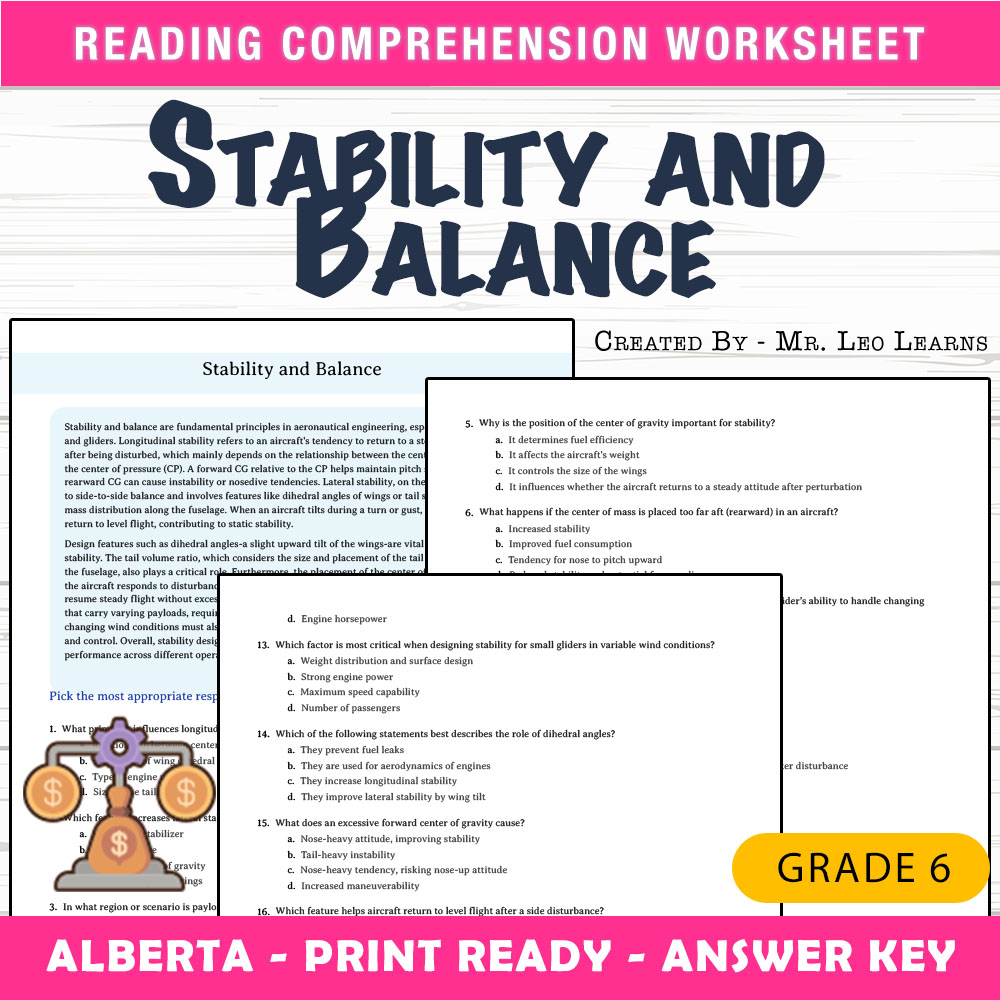
Imagine standing at the front of the classroom as your students prepare to explore the essential concepts of stability and balance in aeronautical engineering. Some students may struggle to connect theory with real-world applications, feeling unsure about what affects an aircraft's ability to stay balanced during flight. This worksheet offers a straightforward, print-ready solution that helps clarify these fundamental principles by providing a focused series of questions aligned with the Alberta science standards.
What This Resource Helps Students Do
This worksheet is designed to reinforce students’ understanding of stability and balance, specifically within the context of aeronautical engineering. It guides them through reading comprehension with an introductory passage and tests their ability to apply key concepts through multiple-choice questions. The resource enables students to practice identifying factors that influence an aircraft’s stability—both longitudinal and lateral—and to recognize features that enhance balance. As students work through the questions, they develop critical thinking skills and confidence in applying scientific principles to complex technical topics.
Inside the PDF
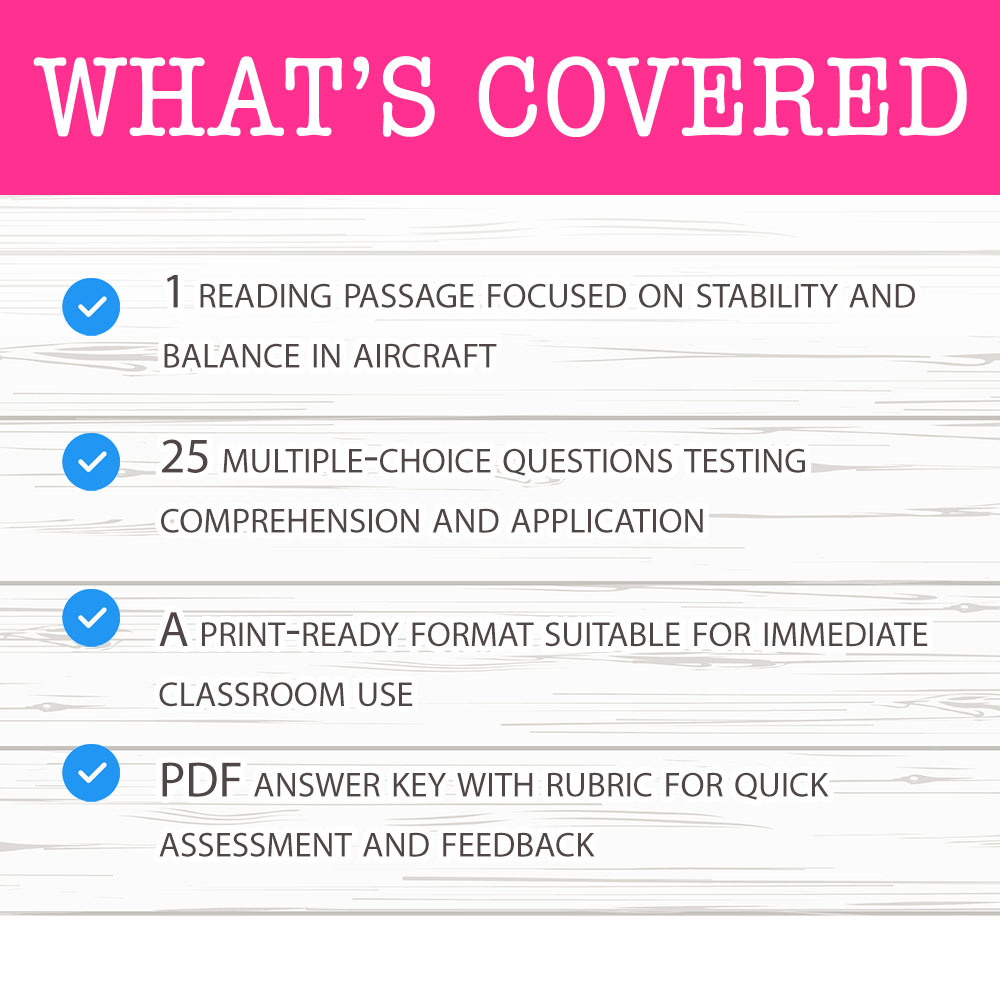
• 1 reading passage focused on stability and balance in aircraft
• 25 multiple-choice questions testing comprehension and application
• A print-ready format suitable for immediate classroom use
• PDF answer key with rubric for quick assessment and feedback
• Designed for easy photocopying and classroom distribution
How It Improves Learning
This worksheet promotes clarity by providing students with a clear explanation of the core ideas surrounding stability and balance in flight. The reading passage contextualizes the concepts, making it easier for students to engage and understand. The multiple-choice questions help assess comprehension and reinforce learning, encouraging students to reason through potential answers rather than guessing. As students analyze and select the correct options, they build confidence in their ability to connect theoretical knowledge with practical flight principles. The immediate feedback from the answer key supports independent learning and teacher assessment, helping students identify areas for further study and practice. The overall structure supports students in moving from initial confusion to a solid understanding of how different features influence an aircraft’s stability, a key component of science and engineering education.
Core Skills Students Will Develop
- ➡️ Understanding scientific principles related to stability and balance
- ➡️ Applying knowledge to analyze different aircraft features
- ➡️ Reading comprehension and critical thinking skills
- ➡️ Assessment and self-evaluation through multiple-choice questions
Ways Teachers Use This Worksheet
Many teachers incorporate this worksheet into classwork to introduce or review the topic of stability and balance in aeronautics. It also serves well as a homework assignment or as a quick assessment tool to gauge student understanding after a lesson. Small-group or individual practice sessions become more focused and productive by using this worksheet for targeted reinforcement. Additionally, teachers can use it for early finishers or as part of station work, providing consistent and classroom-friendly materials that support active, independent learning.
Why This PDF Saves Time
This resource offers a simple, ready-to-use solution that minimizes preparation time. The PDF format is print-ready and requires no additional setup, allowing teachers to distribute the worksheet immediately. The included answer key with rubric simplifies grading, ensuring consistency and efficiency in assessment. Its clear layout is easy to photocopy and fits seamlessly into busy classroom routines, saving time while supporting meaningful learning experiences.
Overall, this worksheet provides a practical and effective way to deepen students’ understanding of stability and balance in aeronautics. It is designed to be student-friendly, easy to implement, and aligned with your curriculum goals, making it a valuable addition to your teaching toolkit. With this resource, you can foster confidence in your students as they explore important science concepts—ready to print and classroom-ready. 😊