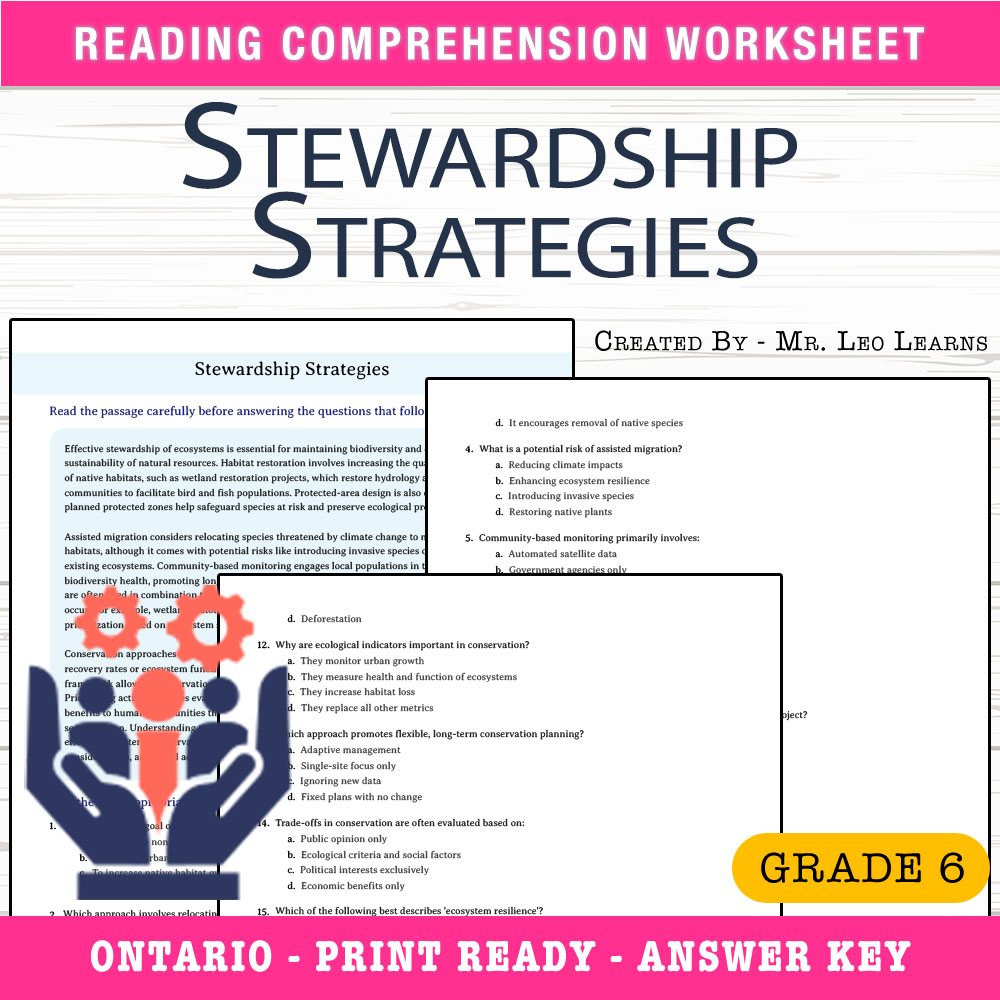
Imagine stepping into your classroom, ready to engage students in meaningful science dialogue, only to find that many are unsure how to connect their understanding of ecosystems with tangible stewardship actions. This scenario is common when discussing topics like ecosystems management and conservation strategies. The Stewardship Strategies worksheet offers a straightforward, print-ready resource designed to reinforce essential concepts while providing clear practice opportunities. Its well-organized format helps students develop a stronger grasp of sustainable environmental practices, supporting your efforts in fostering ecological responsibility.
What This Resource Helps Students Do
This worksheet guides students through understanding key ideas related to stewardship of ecosystems, such as biodiversity conservation, habitat restoration, and climate-sensitive relocation approaches. With a carefully structured reading passage complemented by multiple-choice questions, students build their comprehension skills while learning how human actions impact ecosystems. The worksheet encourages independent practice, helping learners analyze real-world scenarios and apply theoretical knowledge to practical stewardship strategies. It motivates critical thinking and deepens understanding by connecting science concepts to current environmental issues.
Inside the PDF
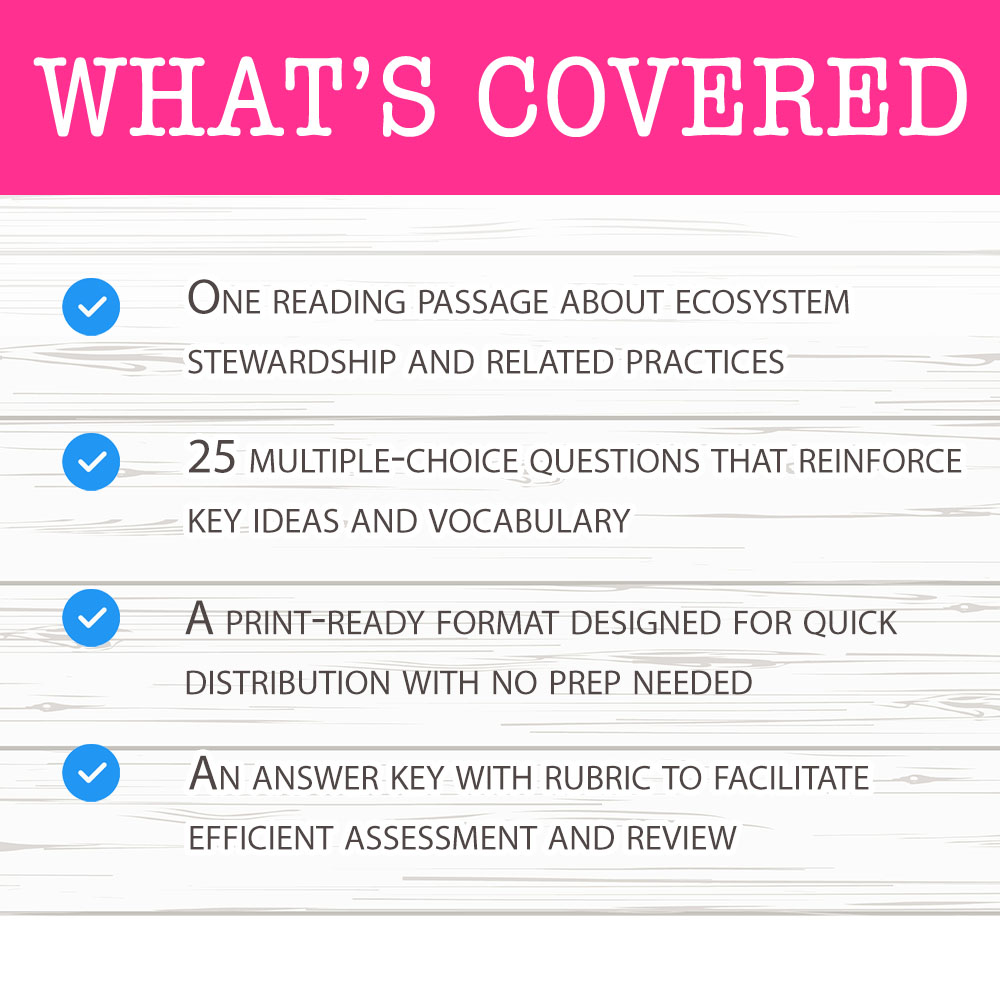
• One reading passage about ecosystem stewardship and related practices
• 25 multiple-choice questions that reinforce key ideas and vocabulary
• A print-ready format designed for quick distribution with no prep needed
• Clear layout that simplifies photocopying for classroom use
• An answer key with rubric to facilitate efficient assessment and review
How It Improves Learning
This worksheet enhances student learning by providing a focused, engaging way to explore environmental stewardship principles. The reading passage offers context and background, laying a foundation for understanding conservation efforts. The multiple-choice questions challenge students to interpret and analyze details, encouraging them to think critically about real-world applications. Using this worksheet, students move from initial exposure to concepts toward confident comprehension and evaluation. It also serves as a useful formative assessment to identify areas where further instruction may be needed, all while reinforcing vocabulary and key skill sets in environmental science.
Core Skills Students Will Develop
- ➡️ Reading comprehension of scientific texts
- ➡️ Critical thinking about environmental issues
- ➡️ Application of science concepts to real-world scenarios
- ➡️ Analyzing cause-and-effect relationships within ecosystems
Ways Teachers Use This Worksheet
This worksheet can be integrated into your lesson plans as a classwork activity to reinforce recent instruction on ecosystems and conservation. It also works well as a homework assignment to encourage independent learning outside of class. Teachers may use it as part of a review session before a quiz or test, or as a small-group activity for students needing additional support. Its clear structure makes it a reliable resource for early finishers and is also suitable for extension activities that promote discussion about current environmental challenges.
Why This PDF Saves Time
This resource comes in a print-ready PDF format, allowing teachers to distribute it immediately without prep work. Its organized layout reduces copying time and ensures consistency in delivery. The included answer key with rubric provides a straightforward way to check understanding quickly, supporting efficient assessment and progress tracking. Overall, it offers a dependable, classroom-ready tool that saves valuable planning time while maintaining high-quality content.
With this worksheet, you can confidently facilitate meaningful discussions about environmental stewardship, knowing your students have a well-structured, comprehensive resource designed specifically to support their understanding of ecosystems and conservation efforts. It’s a practical addition that helps students grasp complex ideas through accessible, structured activities. 😊