
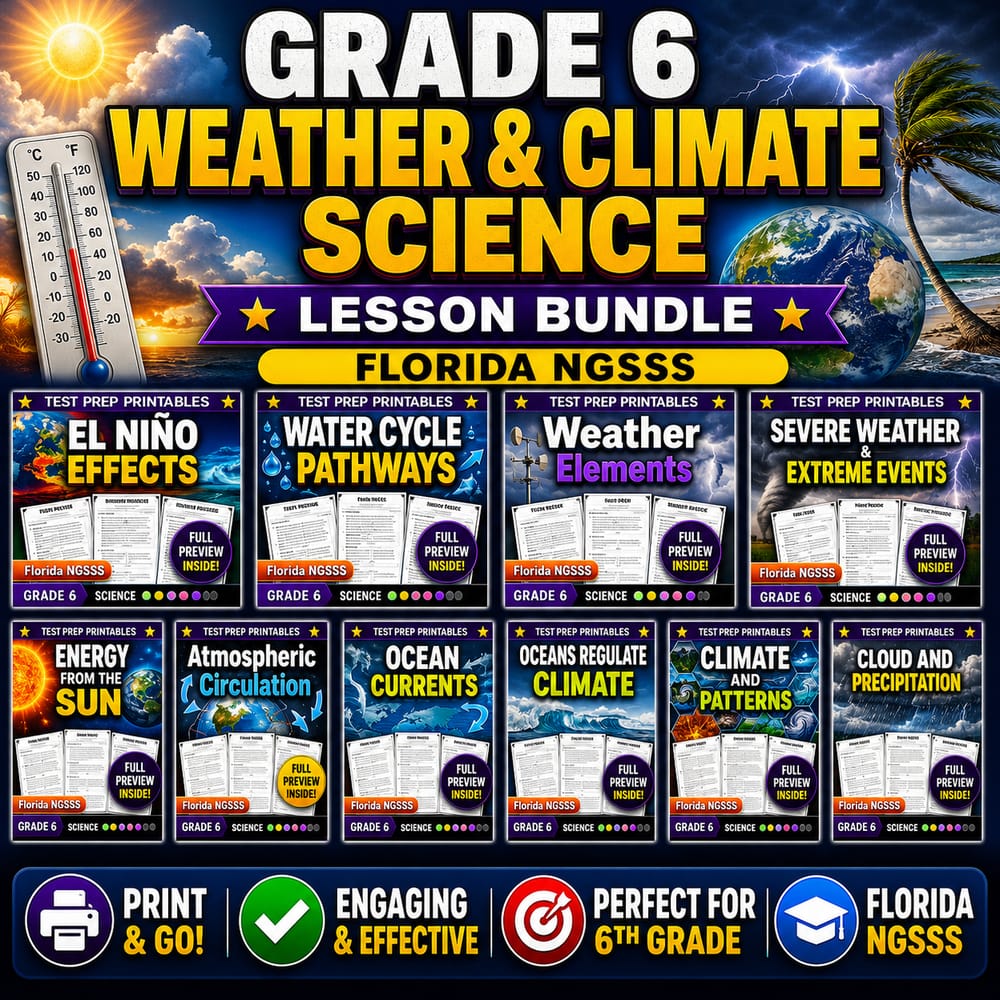
Grade 6 Weather & Climate Science Lesson Bundle | Florida NGSSS
$40.00$50.00Save $10.00
Prism Point Learning
·2 followers·13 sales
SubjectScienceGradeGrade 6Pages307 Pages
What’s included
10 worksheets · 307 pages · Save $10.00 (20%) · prices shown inside the bundle
 El Niño Effects Worksheet Pack | Grade 6 Science Weather & Climate
- Explain how El Niño conditions in the tropical Pacific can change evaporation, cloud formation, and wind patterns
- Describe how shifts in ocean-atmosphere conditions can lead to changes in rainfall and temperatures in other regions
- Compare typical patterns with El Niño and La Niña impacts using evidence from precipitation and wind trends
$4.00$5.00 Water Cycle Pathways Worksheet | Grade 6 Science Water Cycle Activity
- Describe the main pathways of the water cycle, including evaporation, condensation, precipitation, runoff, and infiltration.
- Explain how energy changes water’s state and how those changes move water between the atmosphere and Earth’s surface.
- Connect water cycle pathways to effects such as humidity, cloud formation, stream flow, and drought or flooding.
$4.00$5.00 Weather Elements Worksheet | Grade 6 Weather & Climate Science Activity
- Identify major weather elements and describe what each one tells us about current conditions.
- Explain how observing multiple weather elements can help make sense of why forecasts change.
- Interpret basic statements about weather using correct science vocabulary.
$4.00$5.00 Earth System Interactions Worksheet | Grade 6 Earth Science Activity
- Explain how the atmosphere, hydrosphere, geosphere, and biosphere interact through matter and energy flow.
- Describe how heating, cooling, evaporation, and condensation can change water from one form to another and affect weather.
- Give examples of how erosion and deposition change landforms and connect to other Earth spheres.
$4.00$5.00 Energy From the Sun Worksheet | Grade 6 Weather & Climate Science
- Explain how the angle of incoming solar energy affects Earth’s temperature patterns.
- Describe how unequal heating drives air movement and influences ocean circulation.
- Connect energy transfers in the atmosphere and oceans to daily weather and seasonal climate changes.
$4.00$5.00 Atmospheric Circulation Worksheet | Grade 6 Science Weather & Climate
- Explain how uneven solar heating causes air to rise and sink, creating global wind patterns.
- Describe how warm air density changes and how that affects vertical motion in the atmosphere.
- Connect atmospheric circulation to the movement of moisture and the formation of storms.
$4.00$5.00 Ocean Currents Worksheet | Grade 6 Weather & Climate Science Activity
- Explain how wind patterns and Earth’s rotation help create ocean current systems.
- Describe how moving warm and cool water affects coastal climates and weather.
- Identify key differences between surface currents and deeper ocean movement.
$4.00$5.00 Oceans Regulate Climate Worksheet | Grade 6 Weather & Climate Science
- Explain how oceans absorb, store, and release energy to reduce temperature extremes.
- Describe how ocean heat affects evaporation, water vapor, humidity, and atmospheric stability.
- Connect ocean circulation and changes in ocean heat content to weather patterns near coastlines.
$4.00$5.00 Climate and Patterns Worksheet | Grade 6 Science Weather & Climate
- Explain how climate differs from short-term weather patterns
- Identify key factors that influence climate, such as latitude and ocean effects
- Use evidence from climate patterns to describe why different ecosystems form in different regions
$4.00$5.00 Cloud and Precipitation Worksheet | Grade 6 Weather Science Activity
- Explain how clouds form from cooling water vapor and condensation on tiny particles
- Describe how precipitation forms when droplets or ice crystals become heavy enough to fall
- Compare precipitation types (rain, snow, sleet, hail) based on temperature and atmospheric conditions
$4.00$5.00
Reviews & Feedback
Loading reviews...
Questions & Answers
Loading questions…
About this bundle
Related categories
Frequently asked questions
Who is Grade 6 Weather & Climate Science Lesson Bundle | Florida NGSSS designed for?
Grade 6 Weather & Climate Science Lesson Bundle | Florida NGSSS is designed for Grade 6 students and Science learners and can be used in classrooms, homeschool, or independent practice.
How do I download Grade 6 Weather & Climate Science Lesson Bundle | Florida NGSSS?
Add it to your cart and complete checkout. After payment, you can download immediately from your account, and you'll also receive a download link by email.
Similar Products

Grade 9 Earth, Weather & Climate Systems Lesson Bundle | Florida ngsss
$36.00$45.00

Grade 9 Earth Systems Weather & Climate Science Lesson Bundle: Florida NGSSS
$36.00$45.00

Grade 8 Weather and Climate Science Lesson Bundle: General Framework
$19.20$24.00

Grade 7 Weather & Climate Science Lesson Bundle | Florida NGSSS
$40.00$50.00

Weather, Water Cycle & Climate Systems Lesson Bundle | Grade 6 Science | NGSS
$24.00$30.00